
Good design is only half of a modern website. The other, less visible but no less important half is technical quality: how fast the site is under load, whether it's ready to grow, and how quickly and safely updates ship. In 2026 this is exactly what separates something "thrown together" from a product that can withstand scale.
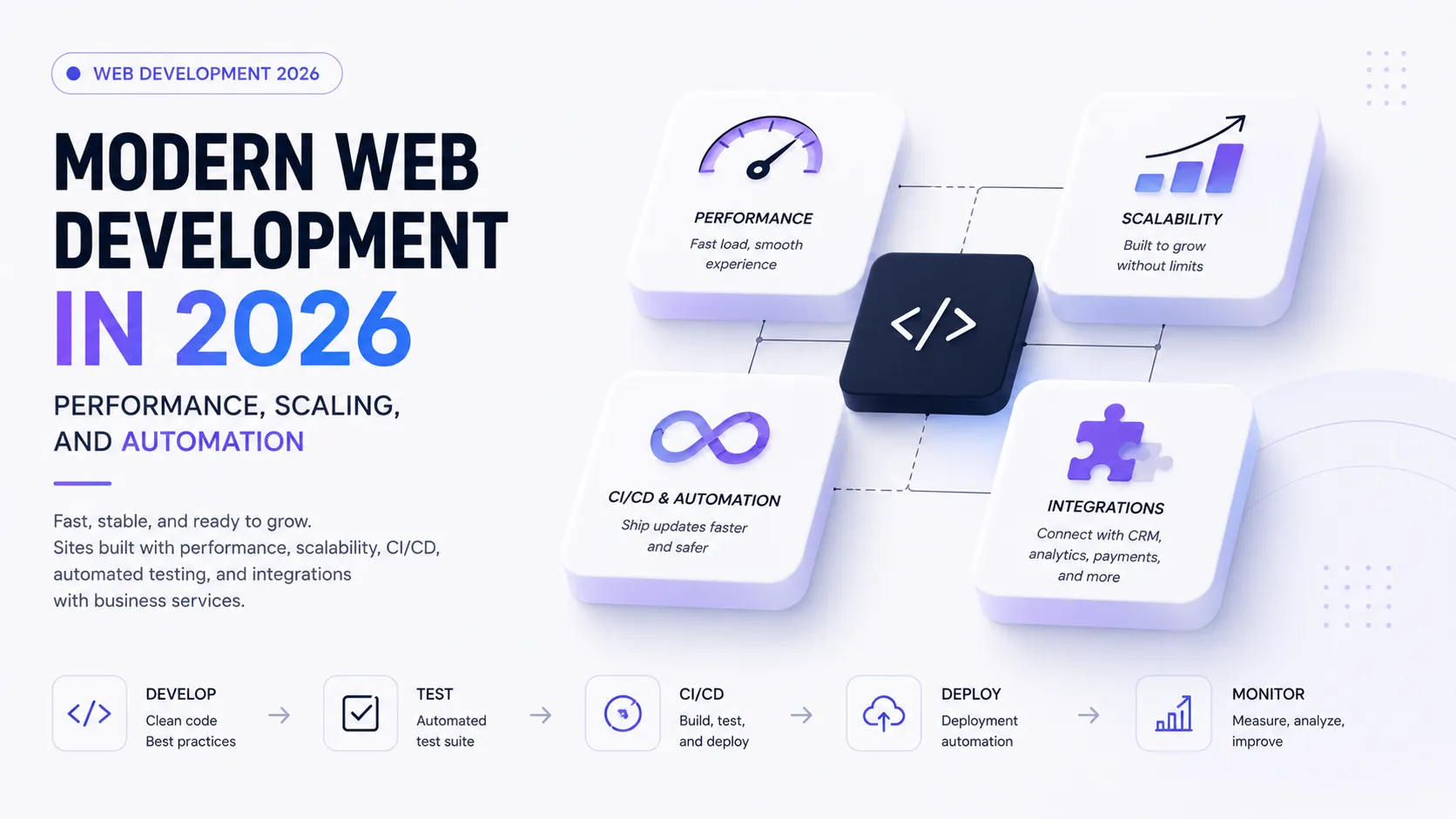
On top of that, a site less and less often exists on its own. It becomes part of larger business processes: CRM, analytics, lead handling, integrations with third-party services. In this article we'll unpack the four technical pillars of modern web development — performance, scaling, automation, and integrations — and what they mean for your role. It complements the topic of the developer's working AI stack with its applied, infrastructural side.
Performance: Speed as the Foundation
Speed has stopped being a "nice bonus" — it's a baseline requirement both for users and for SEO. The modern approach rests on a few things:
- Caching at every level — from the browser to the CDN and server cache.
- CDN and edge — static assets and even some logic are moved closer to the user to cut latency.
- Resource optimization — image compression, lazy-loading, JS minimization.
- Stability under load — the site should work equally well for 100 and for 100,000 users.
A good benchmark is the metrics and practices at Google's web.dev: they set measurable speed criteria worth aligning to.
Scaling: Readiness to Grow
Scalability is the ability to withstand growing load without rewriting everything from scratch. There are two base directions:
- Vertical — give the server more resources (simpler, but has a ceiling).
- Horizontal — add more servers and distribute the load (harder, but almost without a ceiling).
At the architecture level this is done through:
- Microservices — splitting the app into independent services that scale separately. The classic breakdown of the pattern is in Martin Fowler's article.
- Serverless — code runs on demand with no server management (AWS Lambda, Vercel, Netlify), paying for actual usage.
- Distributed databases — data is spread across nodes so the database doesn't become the bottleneck.
Not every site needs this from day one — but the architecture should be laid out so there's room to grow.
Automation: CI/CD and Testing
In 2026, manual deploys and "I'll check it by hand before release" are an antipattern. The baseline of the process:
- CI/CD — every change is automatically built, checked, and rolled out. The canonical description of the idea is in Martin Fowler on continuous integration.
- Automated testing — unit, integration, and e2e tests run on every commit, catching regressions before production.
- Automated deployment — a release becomes a routine, safe operation rather than a stressful once-a-month event.
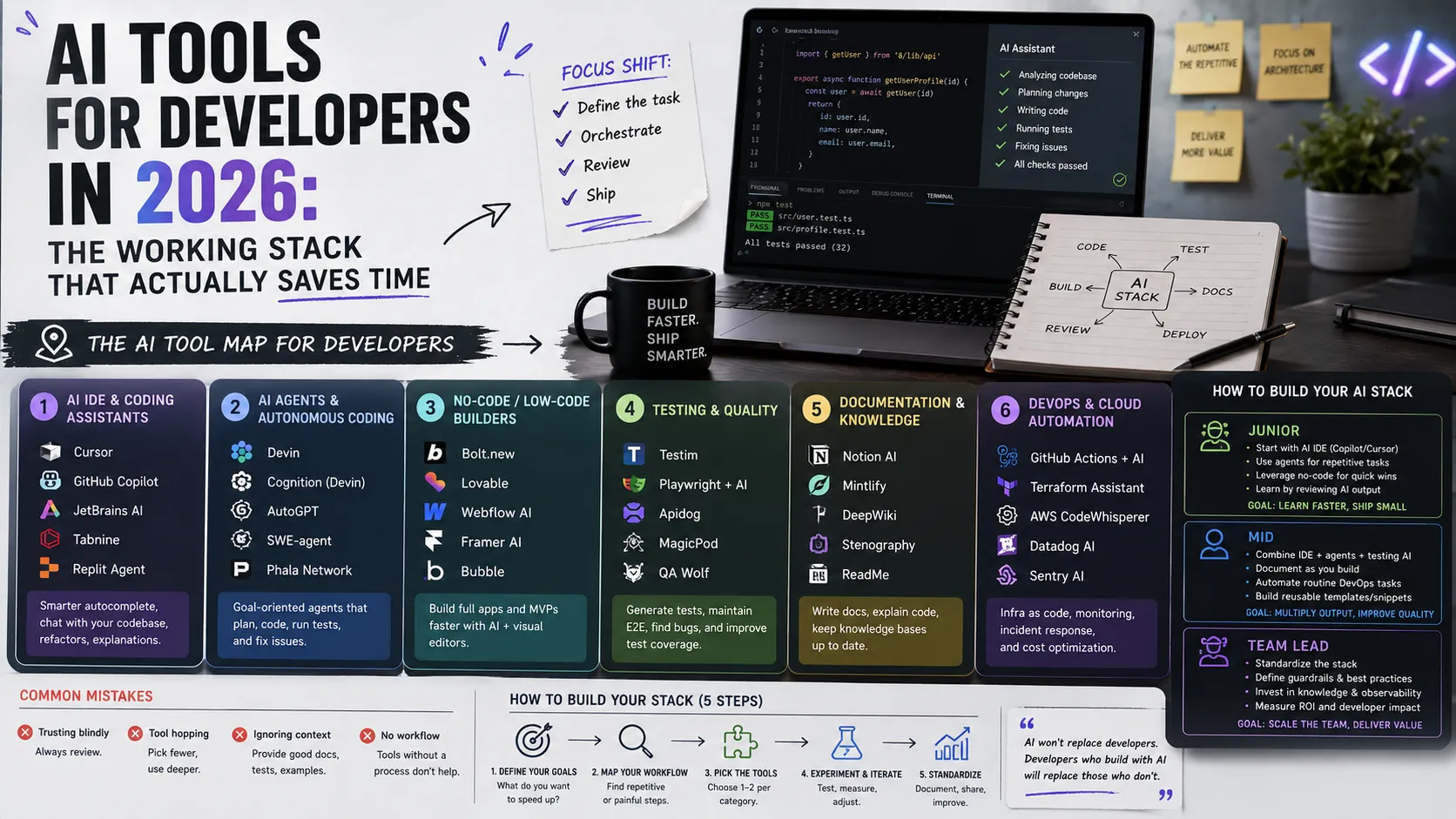
This is exactly where AI tools deliver the fastest win: generating tests and setting up pipelines delegate beautifully to agents — more on that in the article on AI agents in a developer's work.
Integrations: The Site as Part of Business Processes
A modern site rarely lives alone. The business expects it to be wired into the rest of the toolset:
- CRM — form submissions land straight in the sales system.
- Analytics — user behavior is visible and can be acted on.
- Lead handling and services — payments, mailings, support, inventory.
That's why understanding integration protocols is increasingly valuable. One of the key standards of 2026 is MCP (the "USB-C for AI"), which gives agents and services a universal way to connect to business systems.
What This Means for Your Role
Modern web development is no longer "build it and forget it." It combines programming, performance, automation, and business understanding. So a specialist's value is increasingly defined by whether they can think about the system as a whole: not just "how to build the feature" but "how it behaves under load, how it's tested, and what it integrates with." This applies to backend and full-stack developers alike.
FAQ
Does every site need microservices?
No. For most projects a monolith is simpler, cheaper, and faster at the start. Microservices are justified when the team and the load grow to the point where a monolith becomes awkward to manage.
Where do I start improving performance?
With measurement. First capture the metrics (load time, time to interactive), find the slowest spots, and fix them by priority. Optimizing "blindly" is a waste of time.
Is CI/CD mandatory for a small project?
Even a basic pipeline (auto-build + tests + auto-deploy) saves time and prevents errors on a small project too. This is a case where a small upfront investment pays off quickly.
What to Show in Your Portfolio
Technical quality can and should be shown too. In your cases, describe not only "what I built" but how you handled performance, how you set up CI/CD, which services you integrated with and why. That's what separates an engineer from a "page assembler." How to build such a case is in the guide How to Make a Portfolio. And for the modern look of interfaces, read the article on frontend trends 2026.
Add the relevant skills and tools to your profile, tag your project technologies, and see how other specialists present their work.
Ready to act?
- Create your own portfolio: https://searchtalent.dev/en/projects/new
- Skill and technology directory: https://searchtalent.dev/en/talents/skill
- Browse other specialists' projects: https://searchtalent.dev/en/projects
- More articles: https://searchtalent.dev/en/articles