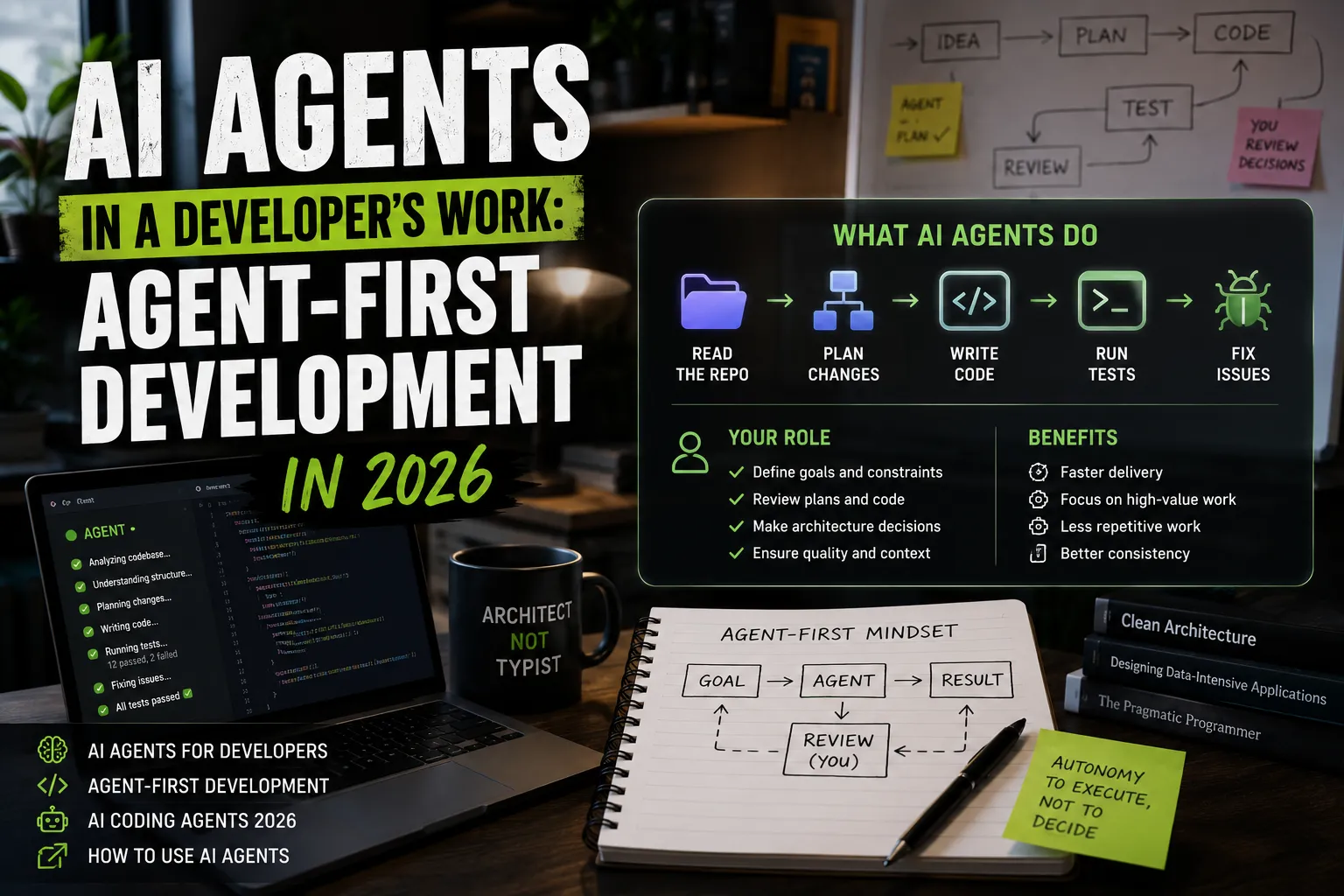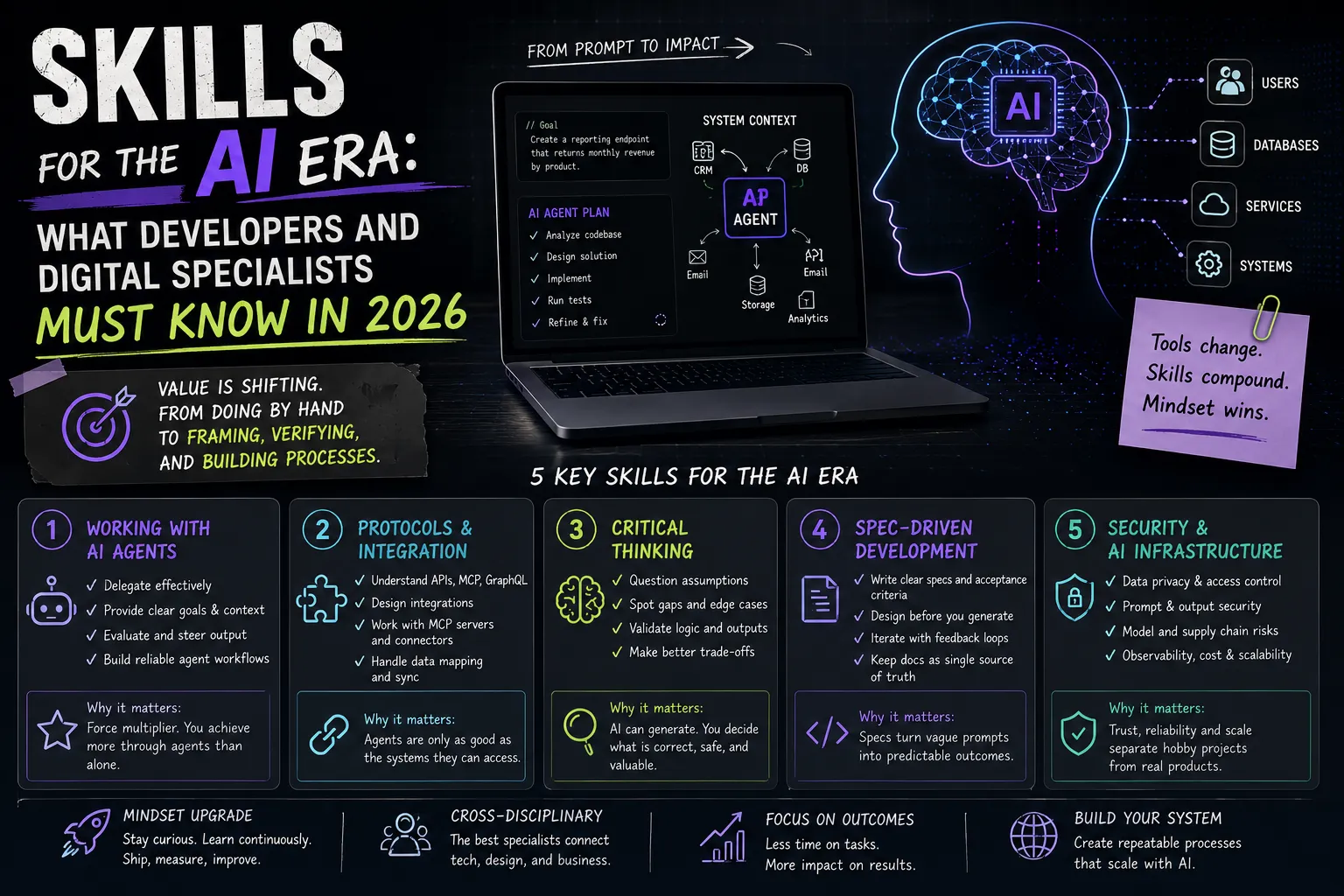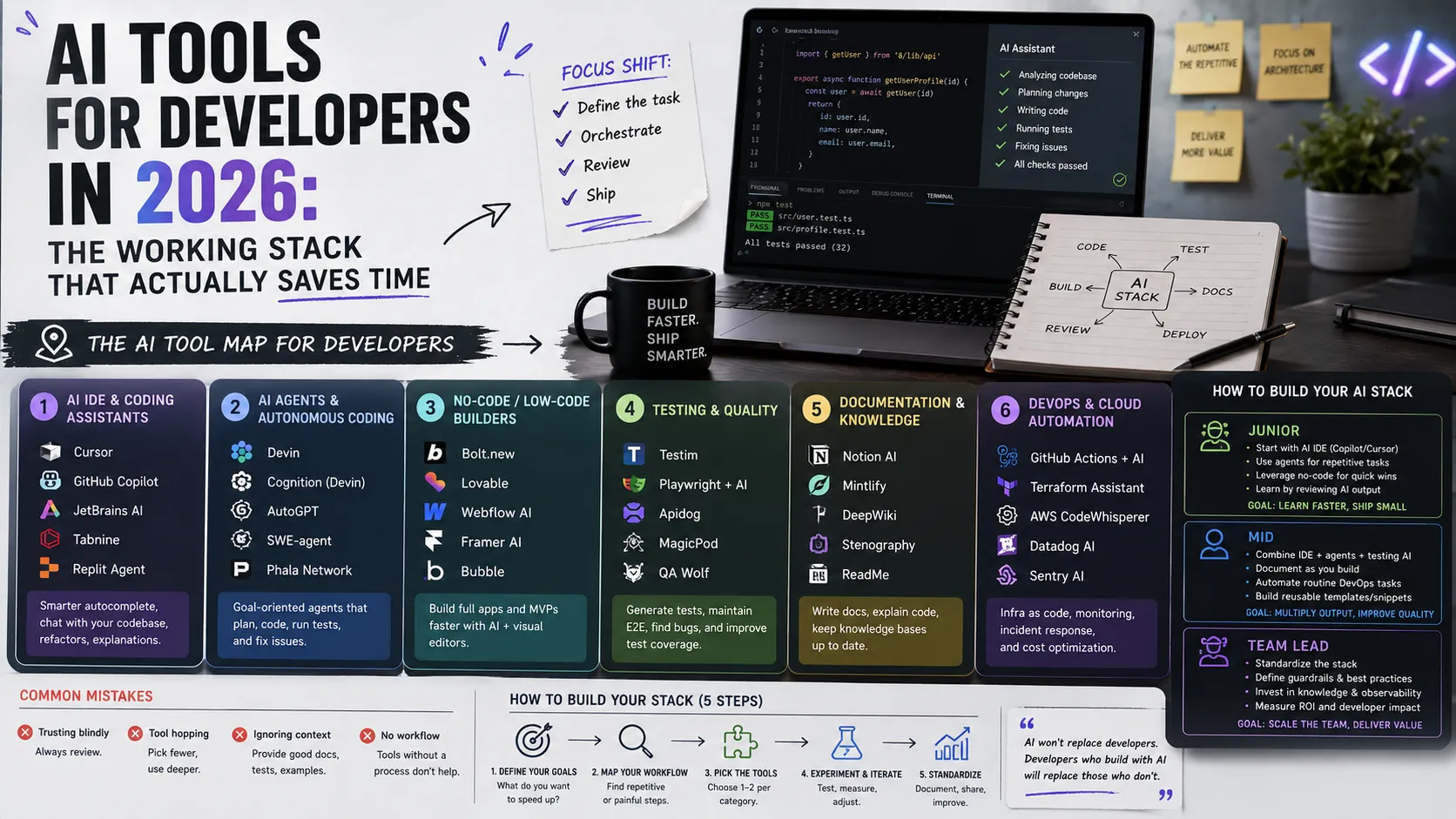

Once an AI agent learned to write code and run tests on its own, the next question appeared: how do you let it reach real systems — a CRM, a database, email, a warehouse, a website? For a long time every such integration was written by hand for a specific model and a specific product. In 2026 one open standard solved this problem — the Model Context Protocol (MCP).
In this article we will unpack, in plain words, what MCP is, why it's called "USB-C for AI," which numbers prove it's already a standard rather than hype, how businesses use it, and where it is not a silver bullet. If you have not yet read about the shift toward agent-first development, start there — MCP is the "glue" that connects agents to the outside world.
What MCP Is, in Plain Words
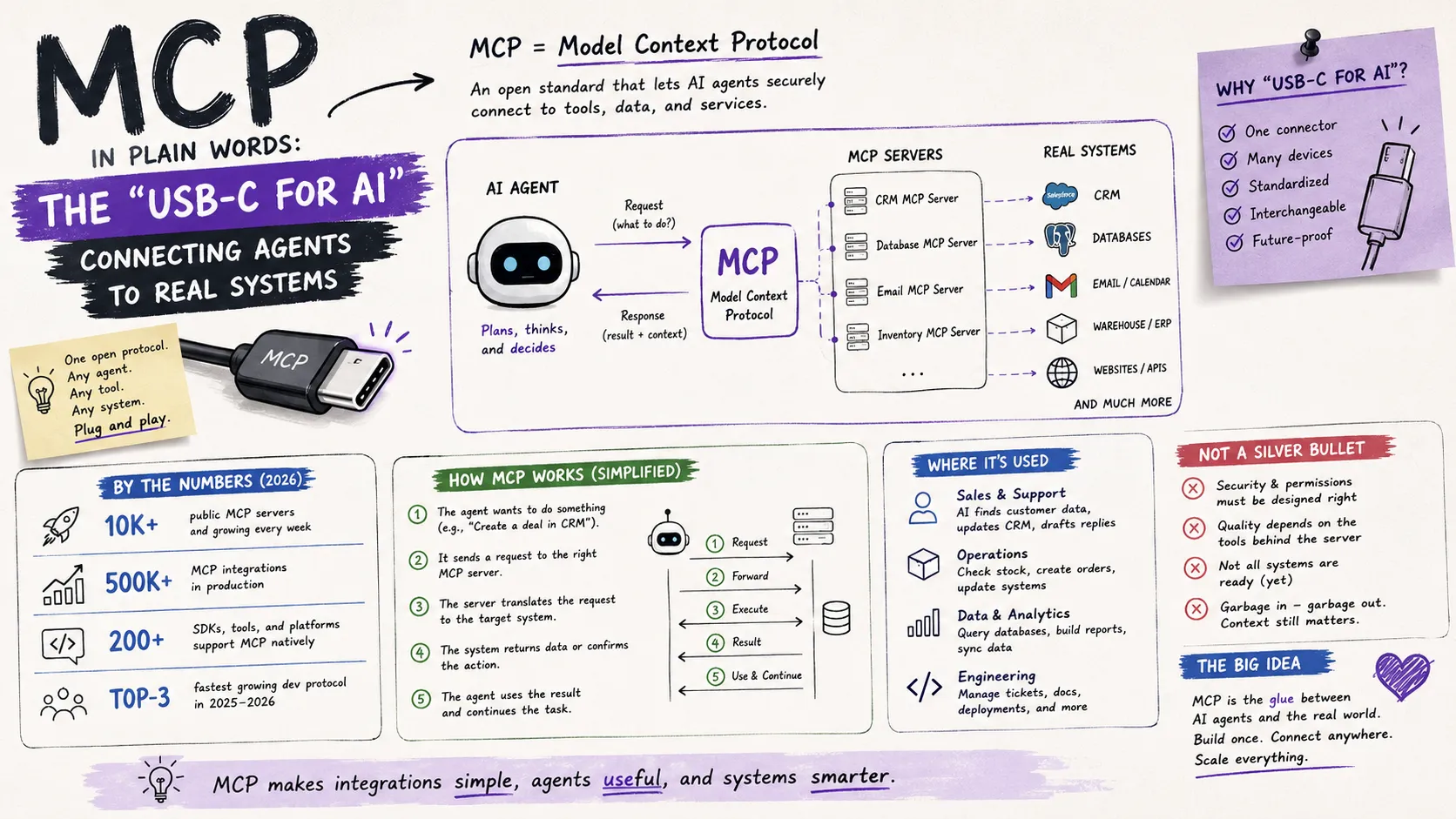
MCP is an open standard, introduced by Anthropic in late 2024, that gives models and agents a universal way to connect to external tools, data, and services. Instead of "baking" every integration into your application's code, you stand up an MCP server — a separate component that describes which tools and data it exposes — and any MCP-compatible client can use it.
Hence the most common analogy: MCP is USB-C for AI. One connector that any tool plugs into. Previously every "model ↔ service" pair had its own cable; now there is a single standard port.
Technically, MCP describes how a client (the agent) and a server exchange three things: tools (actions the agent can call), resources (data it can read), and prompts (ready-made interaction templates). The details are in the official protocol documentation.
Why It Matters: The M×N Integration Problem
Imagine M models and N services. Without a standard you need M×N separate integrations — each written, tested, and maintained. That does not scale: add a new model and you rewrite everything.
MCP turns that into M+N. One MCP server for your database works with dozens of clients at once, and one client sees all your servers. The protocol is already supported by the key players — Claude, ChatGPT, Cursor, VS Code, Gemini, Microsoft Copilot, and many others. In other words, an MCP server you write today will run in any of these environments tomorrow with no rework. This directly complements your working AI stack: the tools differ, the protocol is one.
The Numbers That Show It's a Standard, Not Hype
The "just another trendy protocol" skepticism does not survive contact with the data. As of early 2026, according to WorkOS's state-of-MCP overview:
- over 10,000 public MCP servers;
- around 97 million monthly SDK downloads (Python and TypeScript) — roughly a 970× increase in a year and a half;
- first-class support across all major AI clients.
Even more telling is the institutional recognition. In late 2025 Anthropic donated MCP to the newly formed Agentic AI Foundation under the Linux Foundation — a vendor-neutral foundation that, per the official Linux Foundation press release, OpenAI, Block, AWS, Google, Microsoft, and others joined. When competitors co-govern a standard, it's infrastructure, not someone's product.
How Businesses Use MCP
The best proof of maturity is production usage, not a demo. A telling example is Uber: per a breakdown on the Agentic AI Foundation blog, the company runs about 1,500 monthly active agents executing over 60,000 tasks per week on top of its own MCP infrastructure — an MCP Gateway and Registry that turn 10,000+ internal services into tools for agents.
The use cases reach far beyond code:
- Analytics and CRM — the agent pulls data from a database, builds a report, updates a customer record.
- Email, warehouse, website — routine operations on top of existing systems with no hand-written integrations.
- Real time — video conferencing, video surveillance, streaming: specialized MCP servers are written for such tasks.
For more complex cases there are established architectural patterns: a gateway (a single entry point with routing and audit), authorization via OAuth 2.1, and redaction of sensitive data (PII) at the gateway level. This is no longer a toy but serious engineering — close in spirit to the work of a backend developer.
Where MCP Is Not a Silver Bullet
It's important to keep MCP in its place: it is one component of an agent system, not a one-size-fits-all solution.
- Sometimes a plain API or CLI is enough. If an agent just needs to hit one endpoint once, a full MCP server with a registry and authorization is overkill. "State of MCP" reviews say it plainly: the bottleneck is no longer the model but the connectivity between components — and it does not always need to be solved with an MCP server.
- MCP does not make an agent smart. It only provides access to tools. The quality of decisions still depends on the model, the prompts, and — always — human review.
- Security is not "included." An open port into your systems is also an attack surface. Permissions, audit, sandboxing, and protection against prompt injection remain your responsibility.
The rule is simple: an MCP server is justified where the integration will be reused by many clients or where authorization and audit are needed. For a one-off action, a simpler tool will do.
What This Means for Your Work
Being able to design and stand up an MCP server is quickly becoming a valuable skill — at the intersection of backend development, security, and working with agents. It's exactly the kind of competence worth showing in a portfolio: not "I know about MCP" but "here's a server I built, here are the tools it exposes, here's how I handled authorization."
If you are unsure how to structure cases, start with the guide How to Make a Portfolio. Add the relevant skills and tools to your profile, tag your project technologies, and see how other specialists present their work.
Ready to act?
- Create your own portfolio: https://searchtalent.dev/en/projects/new
- Skill and technology directory: https://searchtalent.dev/en/talents/skill
- Browse other specialists' projects: https://searchtalent.dev/en/projects
- More articles: https://searchtalent.dev/en/articles