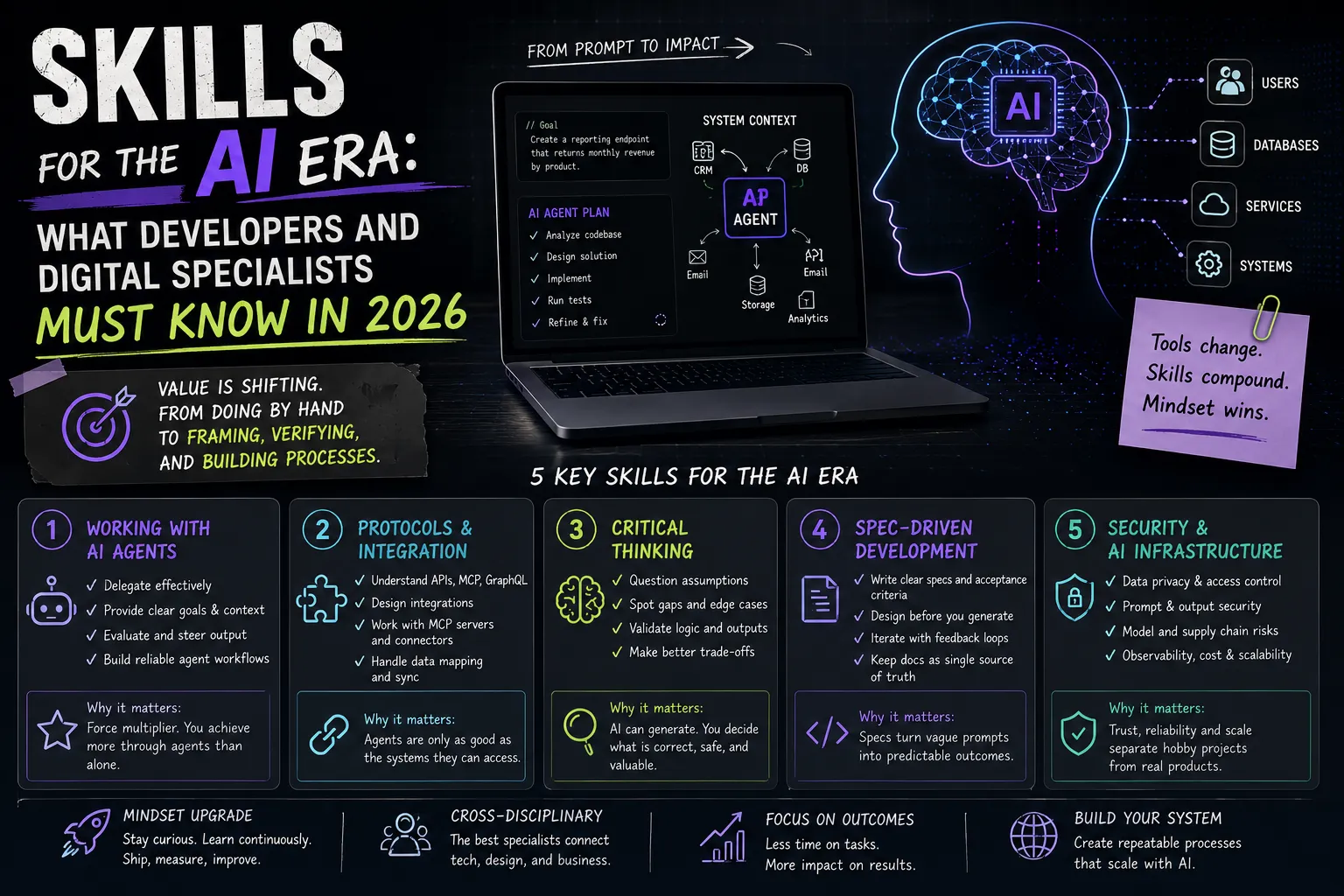

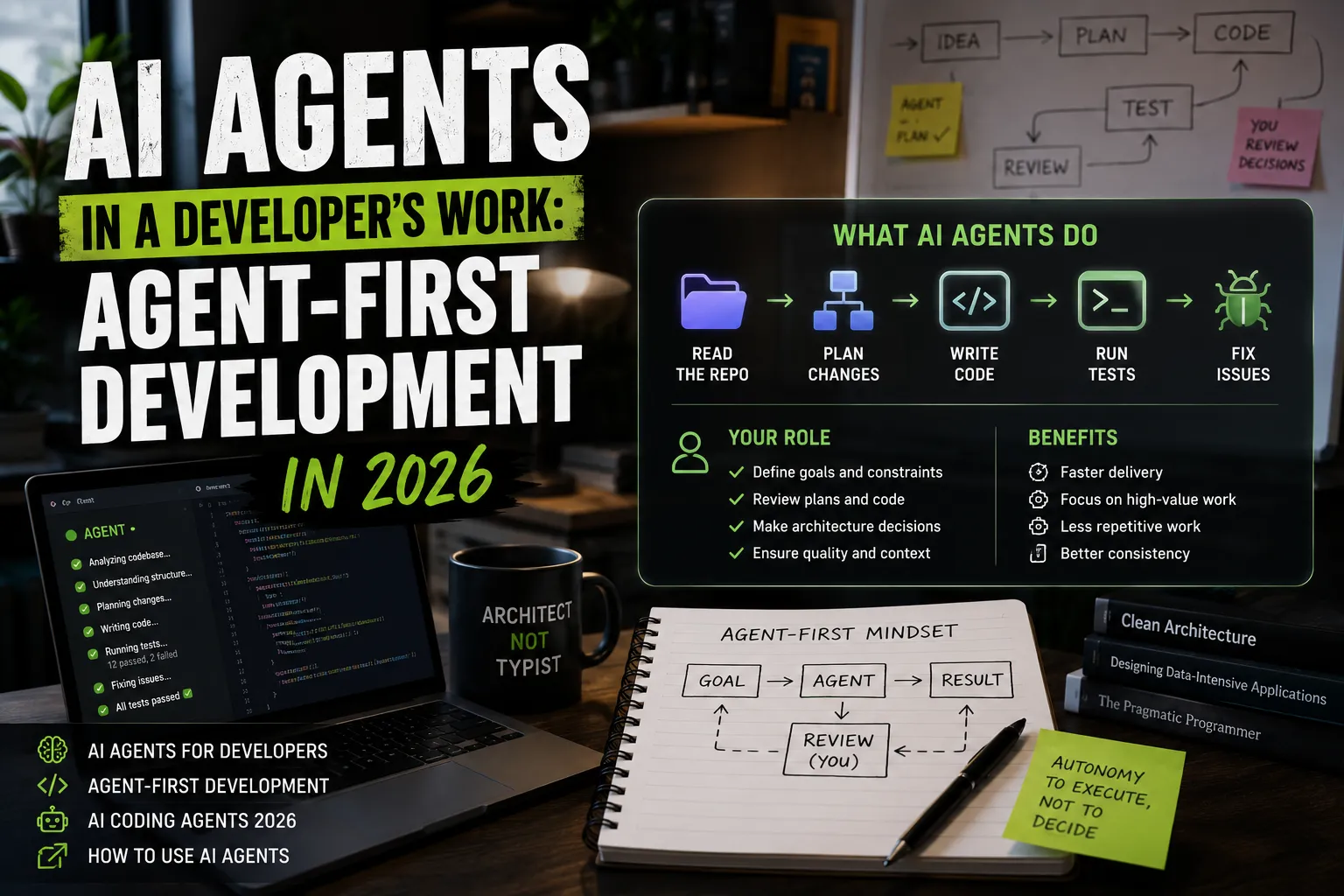
Two years ago, "AI in development" meant code autocomplete and a chat where you asked how to write a regular expression. In 2026 the conversation is different: agents read the repository, plan changes, write code, run tests, and fix a share of the errors on their own — while the developer increasingly acts as an architect and reviewer rather than the person typing every line by hand.
This shift is called agent-first development. In this article we will unpack how an AI agent differs from an ordinary chatbot, what actually changed in 2025–2026, which scenarios already work, where the limits of trust and the risks are, how to get started, and where all this is heading. It is useful both for those still choosing a path into programming and for practitioners who want to fold agents into their daily workflow.
What an AI Agent Is, and How It Differs from a Chatbot
A classic language model responds with text: you ask a question, it generates an answer. An AI agent is a layer on top of the model that can act. It breaks a goal into subtasks, uses tools (IDE, terminal, browser, API), performs many steps in a row, and moves the task toward a result while checking against intermediate feedback.
The key characteristics that set an agent apart from "just a chat":
- Autonomy. The agent gets a goal ("add an endpoint for CSV export"), not a step-by-step instruction, and decides for itself how to reach it.
- Tools. It reads and edits files, runs terminal commands, browses the web, calls APIs — it does not just "talk," it executes.
- Multi-step work. One task is dozens of actions: read the code, find dependencies, make changes, run tests, read the error, fix.
- Error recovery. A good agent sees a test fail and adjusts its approach instead of stopping at the first obstacle.
In plain words: a chatbot is an advisor, an agent is a doer with access to your work environment. It is exactly that access to tools and the ability to carry a cycle to completion that makes it a qualitatively different class of tool.
The 2025–2026 Trend: From Models to Agents
The main vector of the last two years is the move from "just models" to autonomous agents. Reviews of AI trends for 2026 almost unanimously call out the agent boom as a separate point: as noted in Speka's trend overview, AI is moving from "a tool for individual tasks" to core infrastructure, and agents are becoming personal digital assistants that plan, act, and adapt.
For development this means a concrete change: an agent can close a full task cycle — from analyzing requirements and building architecture to writing, testing code, and preparing a deploy. According to figures cited by AIN.ua in its piece on agents as the new business standard, by the end of 2026 about 40% of corporate applications will contain AI agents — versus less than 5% in 2025. In other words, agentic AI is not a six-month hype cycle but a mainline direction for years ahead.
How a Developer's Role Changes
The most common wrong reaction is "agents will take our jobs." In reality it is not the existence of the work that changes, but its nature. A developer is less and less "the person who writes 100% of the code by hand," and more and more:
- An architect. You frame the task, constraints, and quality criteria so an agent can execute them. Clarity of specification becomes a key skill.
- A reviewer. The code an agent generates must be read, understood, and owned. The ability to review code quickly and critically matters more than ever.
- A tool operator. You configure the environment, permissions, and logging, and decide which tasks to delegate and which to keep.
This raises the bar on fundamentals rather than lowering it. To review an agent you must understand what good architecture is yourself — so the base roles are not going anywhere. If you are still deciding on a direction, it helps to understand what a frontend developer, a backend developer, or a full-stack developer actually does: an agent amplifies each of these roles but does not remove the need to understand the domain.
Real Scenarios That Already Work
This is not futurology — agents already do all of the below with proper oversight.
- A refactor plan across the repository. The agent reads the codebase, builds a dependency map, and proposes a refactoring plan: what to extract, what to merge, where to remove duplication. You approve a plan instead of guessing where to start.
- A new service from a spec. From a task description in your issue tracker, the agent creates a new function or microservice: structure, endpoints, basic tests. You get a draft to polish instead of a blank page.
- Running tests and self-fixing. The agent runs the tests, reads the errors, and fixes a share itself — typical bugs, type mismatches, forgotten imports. It leaves the hard failures to you with an explanation of what is wrong.
- Documentation and ADRs. The agent drafts a README, comments for complex modules, or architecture decision records (ADRs) that capture why a decision was made. This is exactly the chore people tend to put off.
- Automating the routine. CI/CD setup, migration scripts, one-off data scripts, dependency updates — the agent does all of this faster than you can switch into the right context.
The common thread: an agent is most useful where the task is clearly described and verifiable (there are tests, there is a "done" criterion). The vaguer the task, the more human control it needs.
Limits and Risks
Agent-first does not mean "launch and forget." Some things are not yet safe to hand to agents unsupervised.
Which tasks to keep under control:
- decisions with a high cost of error (payments, security, personal data);
- changes without tests, where there is no objective "correct" criterion;
- product-wide architectural decisions — a human sets these; the agent only helps explore options.
Security — separately and seriously:
- Secrets and access. Never give an agent broader rights than the task needs. Production keys, live-DB access, delete permissions — under strict control.
- Prompt injection. If an agent reads external content (an issue, an email, a web page), someone can plant instructions there like "delete the files" or "send the secrets." The agent must work in a sandbox and never blindly execute commands from untrusted sources.
- Code review is mandatory. Generated code can look correct yet hide subtle bugs or vulnerabilities. A mindset close to a QA engineer's helps here: not "does it run?" but "how could this break?".
Typical agent failures:
- Getting stuck in loops — the agent tries the same failing approach over and over. A step limit and human intervention are the cure.
- Wrong assumptions — the agent "fills in" what is not in the task. The fix is a more precise spec and examples.
- Confidently wrong answers — the code looks convincing but does the wrong thing. That is why the final word always belongs to the reviewer.
How to Get Started with Agents
You do not have to rebuild your whole process at once. Start with one or two tasks and expand.
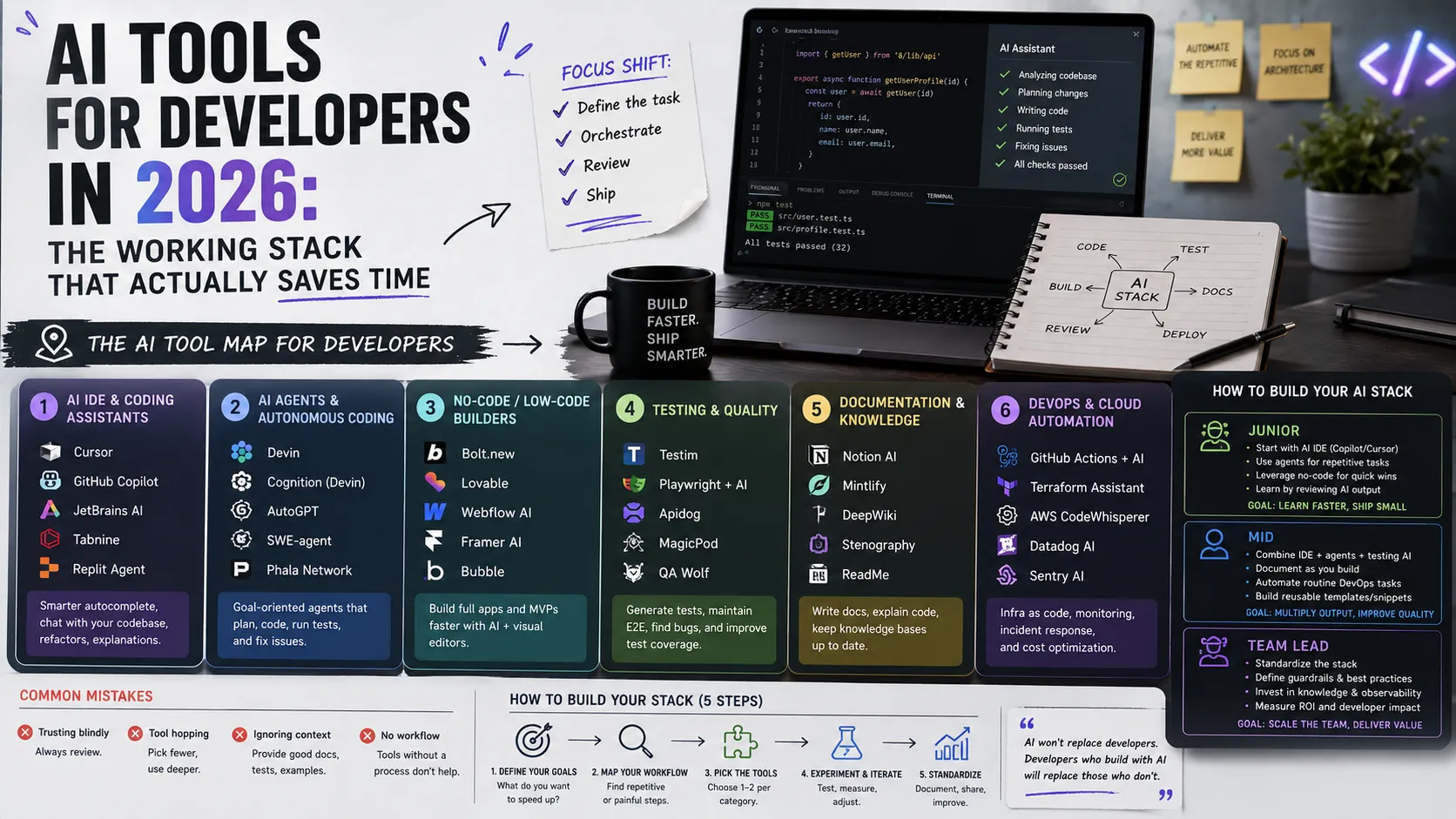
A tool overview (the landscape shifts fast). They roughly split into a few groups:
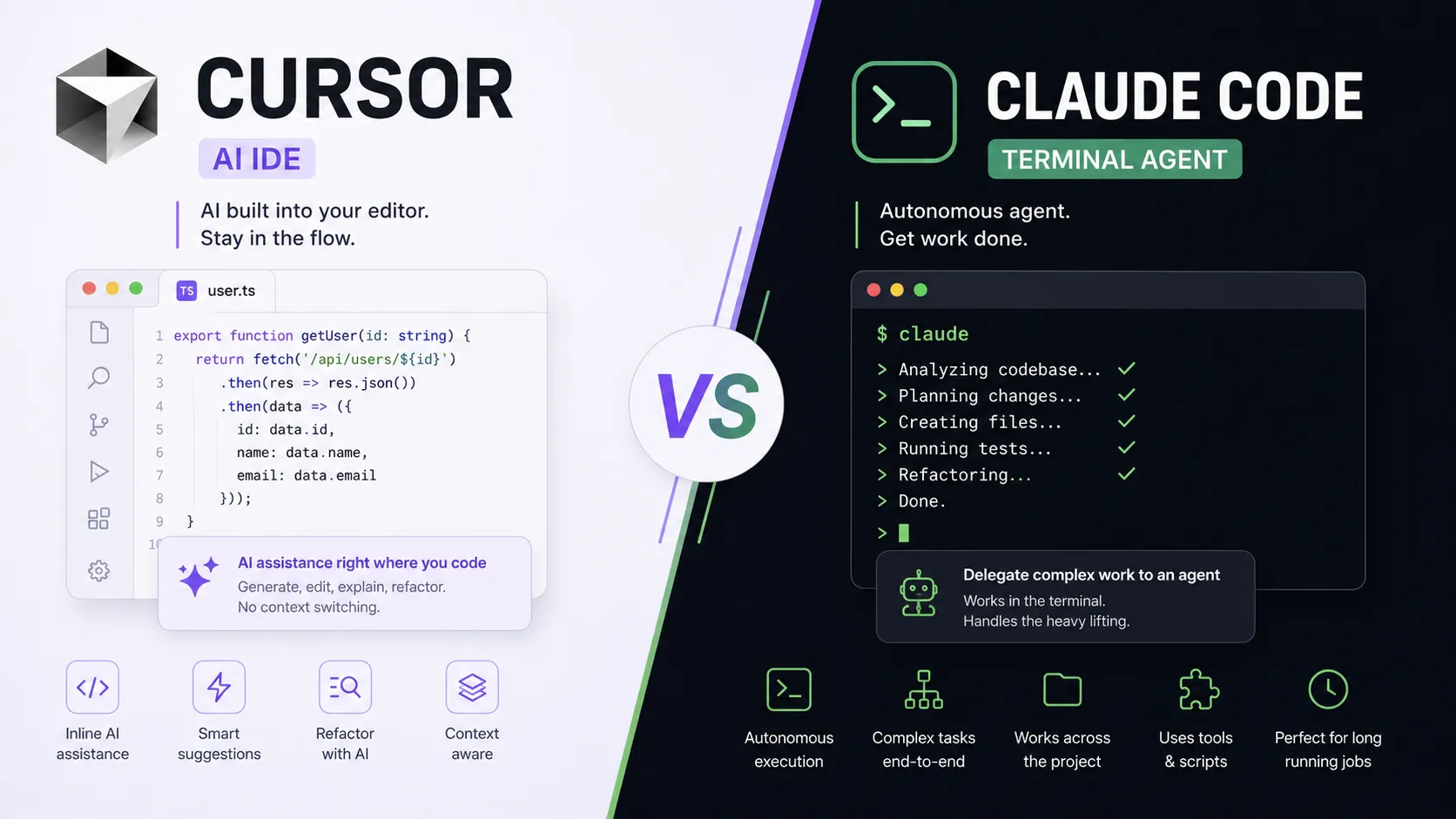
- Coding agents: Claude Code (works in the terminal, reads the whole codebase, writes code, runs tests, and fixes errors), OpenAI's Codex (code and script generation), Devin (a full-stack agent for projects "from scratch"), plus agent modes inside IDEs.
- Platforms for building your own agents: open-source options like OpenClaw, covered in detail in Naoma's AI-agent guide, let you assemble an agent for your own tasks.
- Business-process agents: n8n AI Agents, Copilot Agents, Notion Custom Agents — for automating routine outside code.
If you want a systematic introduction with setup examples and real scenarios, Zemith's practical guide "How to Use AI Agents" explains the basic connection logic well.
The basic setup is almost always the same:
- Connect to the repository — give the agent access to code on a separate branch, not on
main. - Configure permissions — least privilege: exactly as much access as the task requires.
- Logging — record what the agent did so you can roll back and debug.
- Sandbox — an isolated environment where the agent cannot reach production or secrets.
- Review before merge — no agent PR ships to production without a human look.
The Outlook: Team-Based Multi-Agent Systems
The next step is not one universal agent but a team of specialized ones. Instead of a single "do-everything" tool, several agents play different roles: one an architect, another a tester, a third a DevOps engineer — and they interact with each other, covering an end-to-end process. This shift — from single solutions to multi-agent systems — is exactly what analysts point to, and it maps neatly onto how a real engineering team is organized.
In parallel, autonomy grows, integration moves deeper into the IDE, and personalization rises: agents that adapt to a specific developer or team — knowing your style, conventions, and decision history. This does not make the engineer redundant — on the contrary, it raises the value of those who can frame tasks clearly, review the result, and take responsibility.
What This Means for Your Portfolio
The market will value not "I can write code" but "I can direct agents and own the result." And that is worth showing. In your project cases, describe not only what you did but how: where you delegated to an agent, how you reviewed it, which decisions you kept for yourself. If you are unsure how to structure cases, start with the guide How to Make a Portfolio — the "problem → solution → result" principle fits agent-first stories perfectly.
Add relevant skills and tools to your profile, tag your project technologies accordingly, and see how other specialists do it. Working with agents is the new baseline literacy for a developer — and a portfolio is the best place to demonstrate it.
Ready to act?
- Create your own portfolio: https://searchtalent.dev/en/projects/new
- Skill and technology directory: https://searchtalent.dev/en/talents/skill
- Browse other specialists' projects: https://searchtalent.dev/en/projects
- More articles: https://searchtalent.dev/en/articles