
Frontend builds the visible part; backend builds the server side. So who builds both? A full-stack developer. In this article we will unpack what a full-stack developer is in plain words, what they can (and can't) really do, which skills they need, who the role suits, and how to become one from scratch.
What a Full-Stack Developer Is, in Plain Words
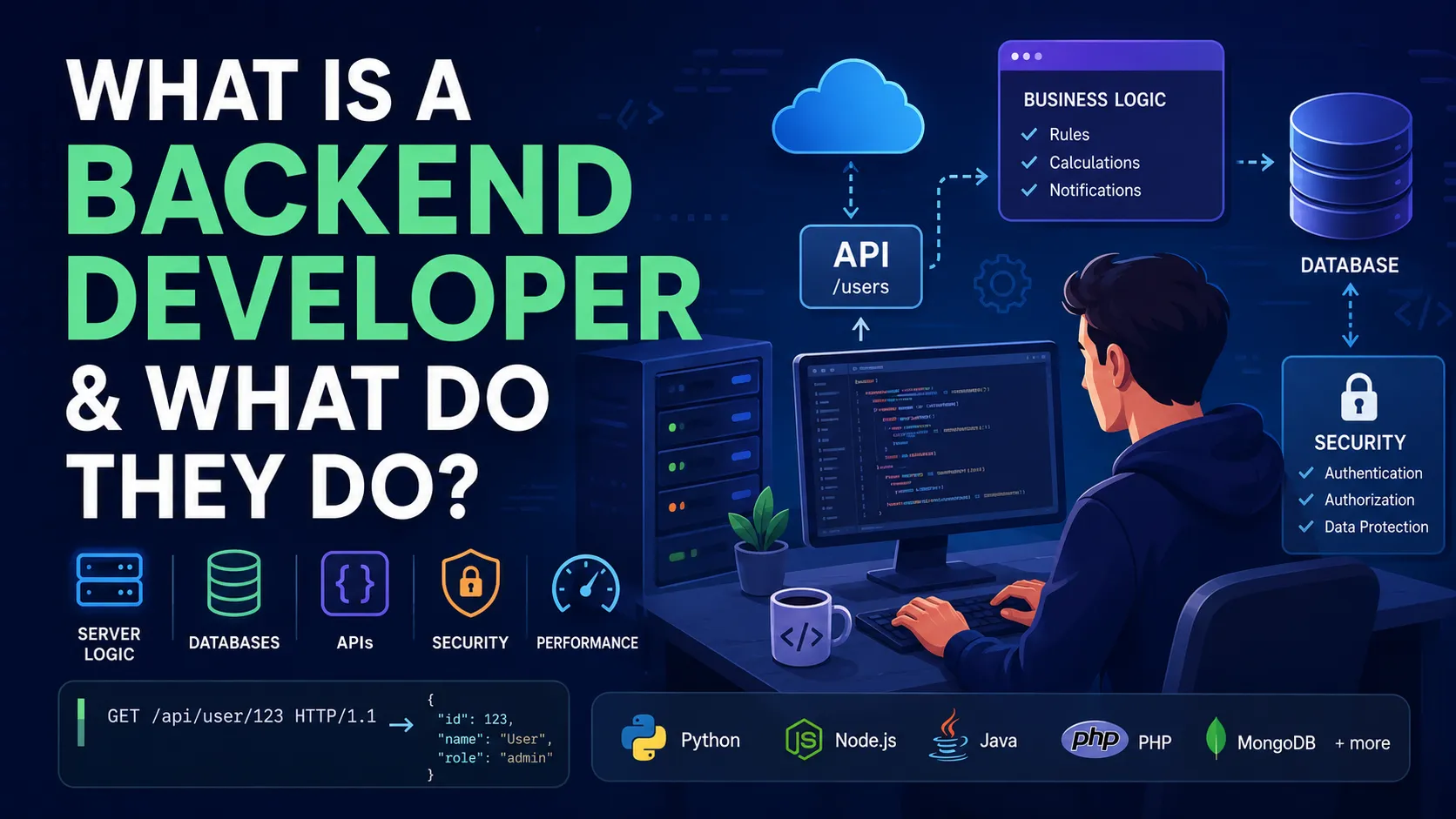
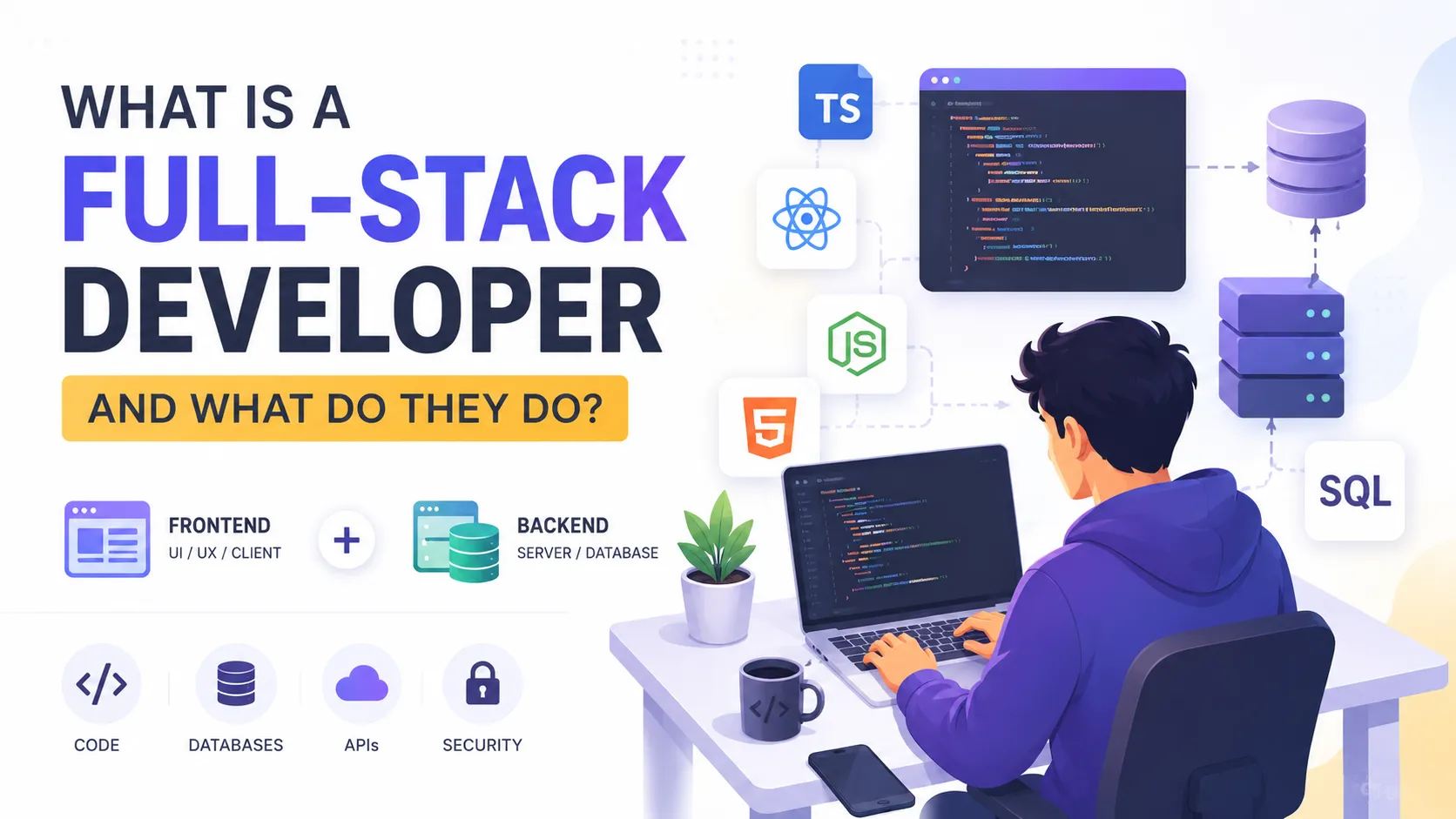
A full-stack developer is someone who can work on both sides of a product: the frontend (what the user sees) and the backend (server, data, logic).
In plain terms: a full-stack developer can carry a feature "end to end" — from a button in the interface to a record in the database. They don't have to know absolutely everything at a specialist's depth, but they navigate the whole chain and can build a small product entirely on their own.
The name comes from "full stack" — the complete stack of technologies, from the client to the server and the database.
Frontend, Backend, and Full-Stack: How They Relate
- Frontend — the visible part, running in the user's browser (
HTML,CSS,JavaScript,React). - Backend — the server side: databases, business logic, security,
APIs. - Full-stack — someone who does both at a sufficient level.
A restaurant analogy: frontend is the dining room and the waiter, backend is the kitchen and storeroom, and full-stack is the all-rounder who can both greet the guest and cook the dish when the team is small.
Does a Full-Stack Developer "Know Everything"? Myth vs Reality
The biggest misunderstanding around this role is that a full-stack developer masters everything equally deeply. That's not the case.
Debunking the "full-stack = expert in everything" myth
In practice, almost every full-stack developer has a stronger side — frontend or backend — and a "sufficient" level in the other. That's normal and even expected.
The role of a full-stack developer is not "to be the best at every technology," but to see the product as a whole and carry a task independently from the interface to the database. Where deep expertise is required (complex graphics, high load, security), narrow specialists step in.
So don't set yourself the goal of "learning everything equally deeply" — that's a road to burnout. The goal is to confidently close the full cycle of a small feature.
What a Full-Stack Developer Does: Typical Responsibilities
- Carries a feature end to end — from building the interface to server logic and a database record.
- Builds and connects
APIs — so the frontend and backend "talk" to each other. - Works with the database — storing, searching, and updating data.
- Launches small products solo — especially valuable in startups and small teams.
- Communicates with both "worlds" — understands both the designer and DevOps, becoming a bridge in the team.
Skills a Full-Stack Developer Needs
- A frontend foundation —
HTML,CSS,JavaScript, and one framework (most oftenReact). - A backend foundation — a server-side language (
Node.js,Python, etc.) and the ability to buildAPIs. - Databases and
SQL— you can't close the full cycle without working with data. HTTPand client-server interaction — how the parts of a system communicate.- Git — version control that no team works without.
- Systems thinking — the ability to hold the whole picture in mind, not just your own piece.
Who the Full-Stack Role Suits: Pros and Cons
Pros:
- You see the product as a whole and don't depend on anyone to ship a feature.
- Flexibility: valued in startups, and it's easier to try different directions.
Cons:
- The risk of "knowing a bit of everything" — you must deliberately keep depth in at least one direction.
- More context in your head — higher cognitive fatigue.
The role suits people who love seeing the complete result and don't want to be confined to a single side of development.
How to Become a Full-Stack Developer from Scratch
A rough roadmap for a beginner:
- Pick one side to start — it's usually easier to begin with frontend (
HTML+CSS+JavaScript). - Take it to a confident level and adopt one framework (
React). - Add the backend — a server-side language,
APIs, and databases withSQL. - Build an end-to-end side project — a small app with an interface, a server, and a database. That's what proves you're full-stack.
- Build a portfolio of 2–3 such projects and start applying for junior roles.
Don't try to learn frontend and backend at the same time from zero — that's the fastest way to get stuck. First one side, then the other.
FAQ
Is full-stack harder than frontend or backend? Not harder, but broader. Full-stack covers both sides at a sufficient level, while a narrow specialist goes deep in one. That's why the advice is to start with one direction and become full-stack gradually.
Where do I start on the way to full-stack? Most often with the frontend (HTML, CSS, JavaScript) — you see results quickly, which is motivating. Once you hold one side confidently, add the backend and databases.
Do companies hire full-stack developers at junior level? Yes, especially startups and small teams that value versatility. The key is to show an end-to-end project built on your own, from the interface to the database.
Ready to act?
- Browse talents by direction: https://searchtalent.dev/en/talents/role
- Skill and technology directory: https://searchtalent.dev/en/talents/skill
- Browse projects: https://searchtalent.dev/en/projects
- Create your own portfolio: https://searchtalent.dev/en/projects/new