
Many people think a software tester is "someone who clicks buttons and hunts for bugs." In reality, a QA engineer is responsible for product quality as a whole — from the first mockup to release. In this article we will unpack what a tester is, what software testing involves, which skills you need, and how to become a QA tester from scratch.
What a Software Tester Is, in Plain Words
A QA engineer (Quality Assurance) checks whether a product works as intended and whether it is convenient to use. Their goal is to find problems before the user does and help the team fix them before release.
An important nuance: QA does not "get in the developers' way" — it protects the product's reputation. One critical bug in production costs the business far more than an hour of a tester's work.
What a QA Engineer Does: Typical Responsibilities
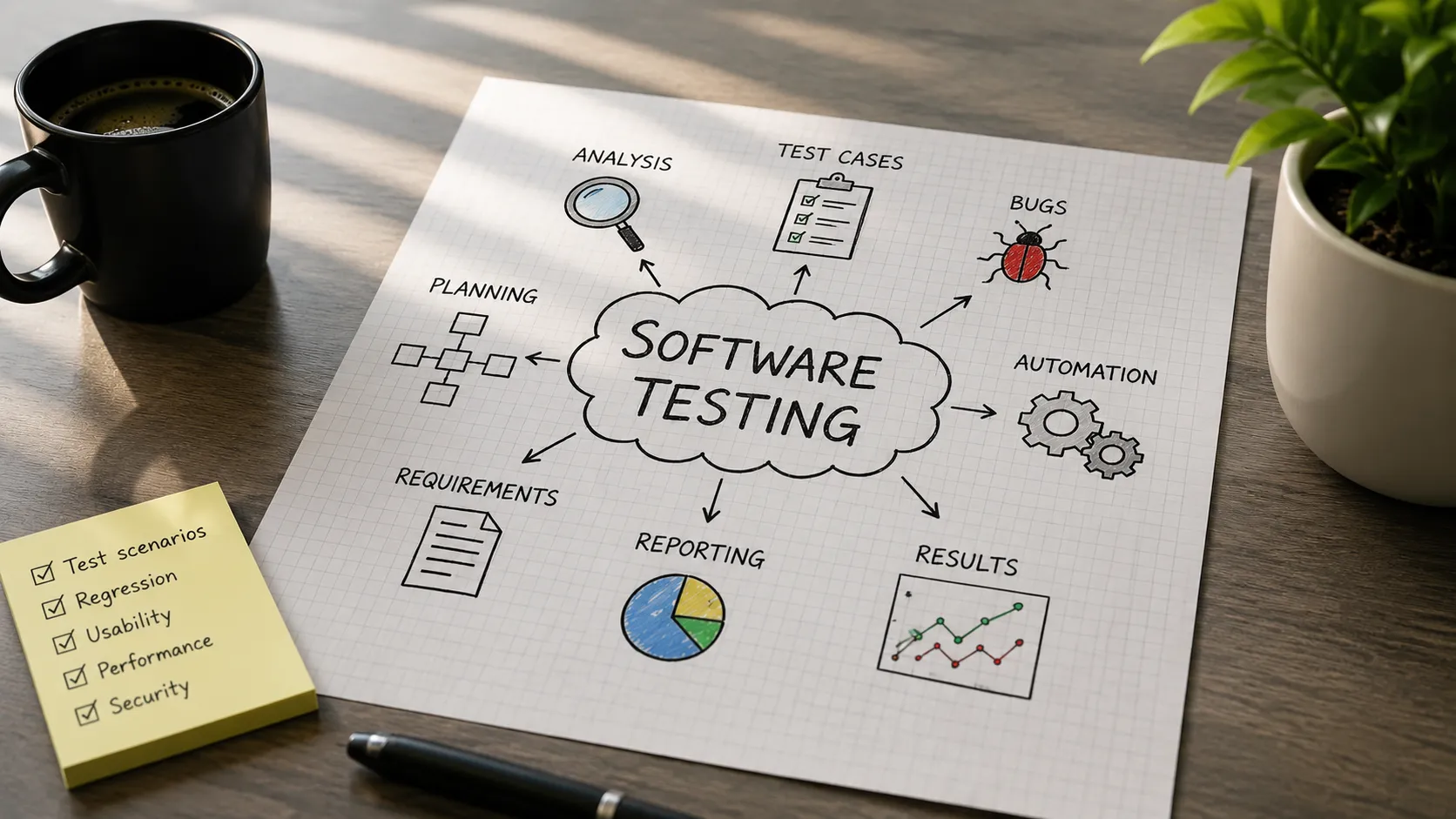
- Requirements analysis — before any code, the tester checks whether the task is clear and consistent.
- Writing test cases — verification scenarios: what to click, what to enter, what result to expect.
- Manual testing — running scenarios "by hand" and spotting discrepancies.
- Filing bugs — a clear description: what is broken, how to reproduce it, what was expected.
- Regression testing — confirming a new feature did not break old ones.
- Automated tests (for AQA) — automating repetitive checks in code.
Types of Testing Worth Knowing
- Functional — does the product do what it should.
- Regression — did anything old break after changes.
- UI/UX — is the interface convenient and correct.
- Performance testing — how the system behaves under load.
- Security testing — whether user data is protected.
- Manual — the entry point for most. Focus on scenarios, attention, and product understanding. Coding is not required at the start.
- Automation (AQA) — the next level: automated tests in Python, JavaScript, or Java. It requires programming but is valued more highly.
Many people start with manual and later move into automation — a natural growth path.
Skills a Tester Needs
- Attention to detail — QA's main superpower.
- Structured thinking — the ability to break a feature into scenarios (this is test design technique).
- A basic grasp of how the web and APIs work — to test deliberately.
- English — most documentation and communication is in English.
- For AQA — a programming language and automation tools.
How to Become a QA Tester from Scratch
- Learn the basics: what software testing is, the bug life cycle, the types of testing.
- Master test design techniques — turning a complex feature into a complete set of checks.
- Practice filing bugs and writing test cases on real websites.
- Build a small portfolio: sample test cases, bug reports, checklists.
- Apply for junior QA roles and learn automation in parallel.
FAQ
Do I need to code to become a tester? To start in manual QA, no. Programming is needed to move into automation (AQA), and that is a logical next step rather than an entry requirement.
Are "tester" and "QA" the same thing? In practice the terms are used as synonyms. Formally, QA is broader — it is about quality processes overall — while "tester" refers to checking a specific product.
Where should a beginner start? With understanding what a bug, a test case, and the types of testing are. Then practice on real products and build your own checklists to show an employer.
Ready to act?
- Browse talents by direction: https://searchtalent.dev/en/talents/role
- Find specialists: https://searchtalent.dev/en/talents
- Create your own portfolio: https://searchtalent.dev/en/projects/new