
Freelancers share one task almost nobody enjoys: writing about their own work. Portfolio case studies, project descriptions, proposals, posts, answers to the same client questions over and over. The work is done and it is good — but to get bought, it also has to be described. And that is where most people stall: the portfolio sits with empty cards, and the proposal is on its second evening.
This is where AI delivers the biggest gain. Not because it "writes for you," but because it removes the most expensive barrier — the blank page. AI is bad at inventing facts about your project, and excellent at turning your scattered notes into a structured text in minutes.
Below: where it works, how to phrase the requests, and where AI will reliably ruin the result.
The Core Principle: Facts Are Yours, Structure Is the Machine's
One sentence defines the whole approach: AI knows nothing about your project. It was not on the client call, it has not seen the brief, it does not know why you chose that particular solution. Anything it can invent in place of those facts, it will invent — and that is exactly where fake numbers like "increased conversion by 47%" come from, measured by nobody.
So the working scheme looks like this:
- You supply raw facts — messy, as bullet points, unstructured.
- AI supplies structure and phrasing — turning notes into text.
- You verify and rewrite everything touching facts, numbers and your voice.
That scheme also sets the main requirement for a prompt: the more specifics you provide up front, the less the model has to invent. An empty request — "write a case study about a coffee shop website" — yields empty text that is spotted from a mile away.
The rule: AI must never be the source of facts about your work. It is the editor that organizes the facts you already have.
Use Case 1: A Portfolio Case Study
The most valuable one. Case studies are the hardest thing specialists write, and the usual reason portfolios stay empty.
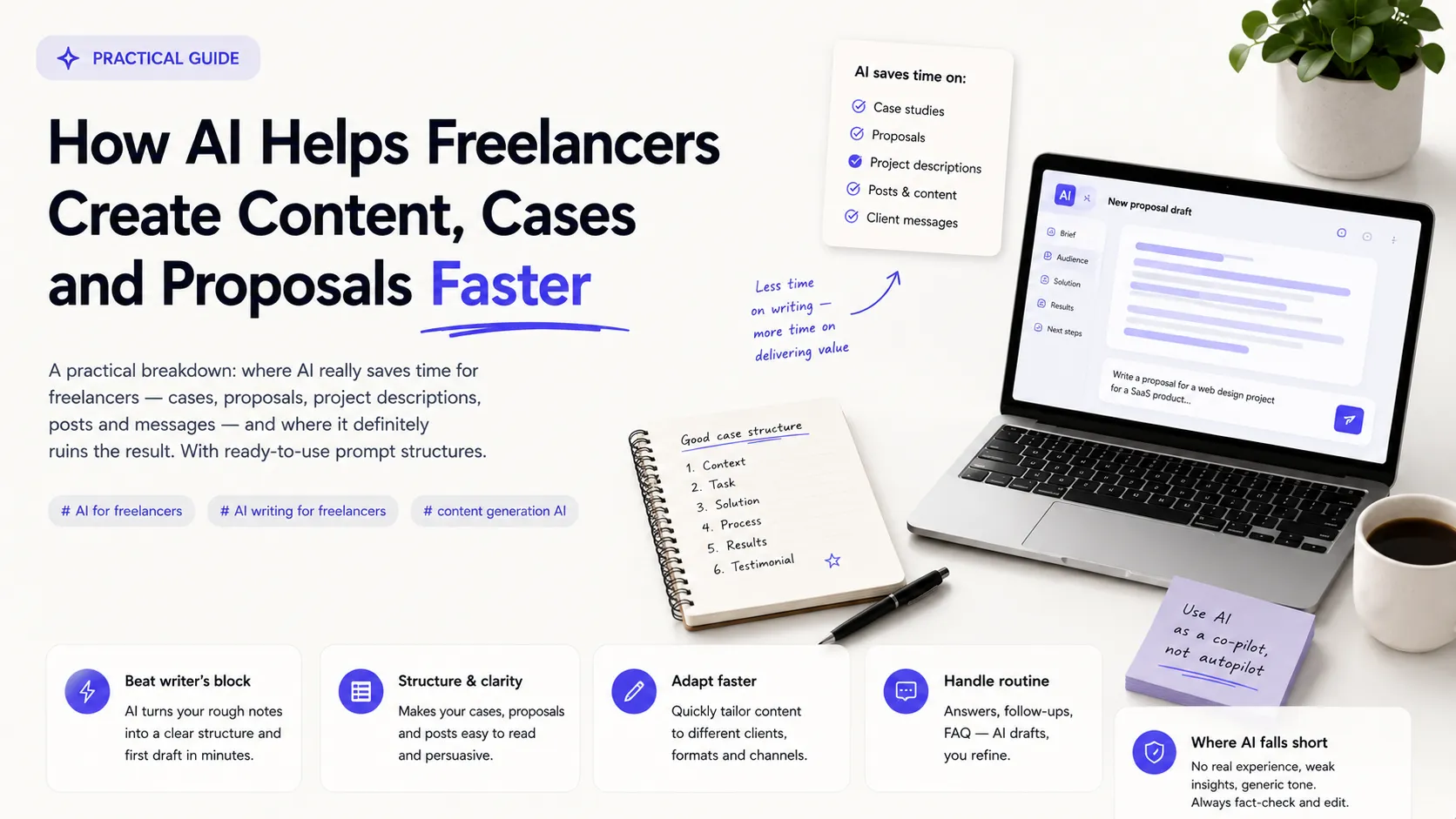
The working approach is to dictate or jot down answers to six questions and ask the model to assemble the text from them:
- What the project was and who it was for.
- What problem or task there was.
- What the constraints were — deadline, budget, requirements, existing assets.
- What exactly you did, what decisions you made and why.
- What the outcome was (no invented numbers — if there are no metrics, describe the qualitative result).
- What you learned or would do differently.
Then a prompt roughly like this:
"Here are my notes on a project [paste]. Assemble a portfolio case study from them with this structure: task → context and constraints → what I did → outcome → takeaway. Write in first person, no marketing adjectives, no generic filler. Do not add any numbers or facts that are not in my notes. Maximum 400 words."
Three clarifications that matter most for quality:
- "Do not add facts that are not there" — the single most important sentence in the prompt.
- "No marketing adjectives" — otherwise every paragraph gets an "innovative solution" and a "unique approach."
- A length limit — without it the text inflates to twice what you need.
What stays with you regardless: fact-checking, tuning to your voice, and the first sentence. The opening of a case study is best written by hand — it decides whether anyone reads on. What makes a strong case study in the first place is covered in How to make a portfolio.
Use Case 2: A Client Proposal
The second most useful task. A proposal is a text with a predictable structure that is slow to write by hand and easy to assemble from your inputs.
What to give the model: the client's request in their own words, your understanding of the task, the scope, stages, timeline, price and terms. What to ask for: a structure.
- the client's problem restated in their own words;
- what exactly you propose to do;
- stages and timelines;
- what is included and what is not in scope;
- price and payment terms;
- the next step.
The most valuable part here is "not in scope." AI is good at articulating boundaries you routinely forget to write down — and those boundaries are exactly what saves you from endless revisions later.
What to verify manually: every number, deadline and condition. Models tend to round figures and "improve" commercial terms in ways that work against you.
Won't the client notice the proposal was written by AI?
They will, if you send the draft as is: the averaged style, smooth empty paragraphs and a three-sentence intro about "today's digital landscape" are recognized instantly. They will not, if you strip the filler, add specifics about their project and rewrite the opening in your own words. A practical rule: a proposal must contain at least one detail that would be impossible to write without having looked at the client's product. That detail is what separates a real proposal from a mail merge.
Use Case 3: Project Descriptions and Your Profile
The short texts nobody wants to write but without which a portfolio does not work: the title of a piece, a two- or three-sentence description, image captions, the profile headline and bio.
Here AI is most useful not as a generator but as a generator of options:
"Here is a description of my work [paste]. Give me 5 title options: specific, no adjectives, each under 60 characters. One of them must contain the word [keyword]."
Then you pick one and edit it. That is faster than inventing from scratch and safer than taking a single generated line: with five options in front of you, the weak ones are obvious.
The same approach works for a profile headline built on the "who → for whom → what outcome" formula — that formula and the rest of the profile elements are broken down in How to set up a profile.
Use Case 4: Content and Posts
An article or a problem breakdown is the most durable way to demonstrate expertise, and the hardest to start. AI helps at three stages here and hurts at a fourth.
Helps:
- Outlining. "Here is the topic and my notes — propose a six-section structure" saves the most time.
- Transcribing and organizing. You talk your thoughts out loud, the model turns them into an ordered draft.
- Editing. "Cut this paragraph in half without losing meaning," "find where I repeat myself," "flag claims made without support."
Hurts: when you ask it to write an article from scratch on a topic. The output is an averaged text containing none of your experience — precisely what the internet already has in surplus. That content builds neither trust nor search visibility: it holds nothing you cannot get elsewhere. How to write so that both people and AI search engines value it is covered in SEO for AI search.
Use Case 5: Client Messages and Negotiation
The most delicate use case — handle with care.
Where AI helps:
- Rephrasing a sharp message into a neutral one when you are writing while annoyed. Possibly the single most useful application there is.
- Drafting an answer to a routine question — about timelines, process, revision policy.
- Preparing a template for declining work or responding to a discount request, so you do not improvise every time.
- Translating correspondence into another language when you are unsure of the phrasing.
Where it does not belong:
- Fully automated client replies. Clients quickly sense they are not talking to a person, and that costs more trust than the time it saves.
- Difficult or conflict situations. Models default to being overly polite and accommodating — they readily "agree" to terms that hurt you.
- Money agreements. Write payment wording yourself: mistakes here are measured in currency.
Use Case 6: The Routine Around the Work
Small tasks that eat hours every week:
- An FAQ for your profile or site — assembled from questions your past conversations show up most often.
- Service descriptions with boundaries and an outcome instead of a category.
- Translating your portfolio into a second language — with mandatory proofreading: terminology and names get mangled regularly.
- A delivery checklist — what to verify before sending work to a client.
- Summarizing a long call into a task list, if you have a transcript.
Each of these looks trivial on its own. Together they add up to a few hours a week — exactly the time you supposedly "don't have" for your portfolio.
Where AI Reliably Ruins the Result
The mistakes that make text work against you.
- Invented numbers. "Raised conversion by 40%" with nothing measured is not decoration, it is a falsehood exposed by one client question: "how did you measure that?"
- Averaged style. The model writes like the internet's average. The average is exactly what fails to stick and fails to distinguish you from a dozen similar profiles.
- Empty intros. "In today's fast-moving digital world…" — three sentences about nothing at the start of every text. The simplest tell of generated writing.
- Uniformity. If all your case studies came from the same prompt, they read like one text copied five times.
- Client data in a third-party service. An NDA brief, personal data, an unreleased product — check your contract and the service's data terms before pasting.
- Someone else's phrasing as yours. Models can reproduce wording close to what already exists online. For public materials that is a risk worth checking.
- Losing your own voice. The most long-term damage: publish generated text for six months and readers stop recognizing you specifically. And recognition is the whole point of writing about your work.
How to Keep Your Own Voice
Techniques that work better than asking the model to "write naturally."
- Give it a sample. "Here are two of my texts. Write a third in the same manner: shorter sentences, no adjectives, examples instead of generalities." A sample outperforms any description of style by an order of magnitude.
- Keep a banned-words list. "Innovative," "unique," "seamless," "leverage," "next level" — put them in the prompt as an explicit prohibition.
- Write the first and last sentence yourself. The opening and the ending carry most of the sense of authorship.
- Insert your own details. One concrete moment from the project — "the client sent mockups as a PDF and half the fonts did not match" — brings a text alive more than any editing pass.
- Read it aloud. If you do not recognize your own way of speaking anywhere in it, the text is not yours yet.
Ethics and Honesty With Clients
Using AI in your work is normal practice and there is no need to hide it. But a few boundaries are worth keeping:
- Clients buy the outcome and your accountability for it. If you hand over an unverified generated draft, you sold someone else's work — and you still own the errors in it.
- Do not pass automated output off as deep work. It surfaces quickly and costs reputation.
- Fact-check whatever you deliver. Especially names, numbers, and legal or technical wording.
- Respect NDAs. The most common unnoticed mistake: pasting a confidential brief into a third-party service without thinking about where the data goes.
Broader context on how expectations of specialists shift in an era of cheap AI tools is in the article on skills for the AI era.
A Workflow: Fitting This Into Your Week
A scheme where AI covers the routine and you cover the meaning.
- Right after a project — dictate answers to the six case-study questions while everything is fresh. Five minutes.
- The same day — ask the model to assemble a draft case study from them.
- The next day, with a clear head — verify facts, rewrite the opening paragraph, cut the excess.
- Publish the work in your portfolio with a description and tags.
- From the same material, make a short post and, if the topic deserves it, an article outline.
- Once a month — refresh your profile: new headline, recent work moved to the front, new skills.
Step 1 is the critical one. The real reason case studies never get written is not that writing is hard, but that two weeks later the details are gone and there is nothing left to write from.
Key Takeaways
- AI knows nothing about your project: you supply the facts, it supplies the structure.
- The strongest use case is a portfolio case study built from your notes as "task → context → solution → outcome."
- In a proposal, the most valuable thing AI produces is the boundary: what is not in scope.
- For titles and descriptions, ask for options rather than a single text.
- Write articles from your own experience: outline and editing to the machine, substance from you.
- Invented numbers, empty intros and averaged style destroy trust faster than they save time.
- Check where client data goes before pasting a brief into a third-party service.
- Always write the first and last sentence yourself.
FAQ
Can I write portfolio case studies with AI?
Yes, as long as all the facts are yours. The working scheme: you answer six questions in note form (project, task, constraints, what you did, outcome, takeaway), the model assembles a structured text, and you verify the facts and rewrite the opening. What you must not do is ask AI to invent a case study or add result figures you never measured.
How do I keep the text from looking generated?
Three actions deliver most of the effect: give the model a sample of your own writing instead of describing your style, explicitly ban marketing adjectives and empty intros, and add at least one concrete project detail that could not be invented. Write the first and last sentence yourself — they carry the sense of authorship.
Is it safe to paste a client brief into an AI service?
It depends on the contract and the service. If there is an NDA, personal data or an unreleased product, check the data processing terms first or strip anything identifying the client. The safest option for sensitive projects is anonymized wording: "a booking service" instead of the company name.
Should I tell clients I use AI?
There is no obligation to declare it — it is a tool like an editor or a template. But do not present generated output as deep authored work: clients pay for your expertise and accountability, and you own everything you deliver regardless of what wrote it.
Where to Start Today
Take one finished project that never made it into your portfolio and dictate answers to the six questions — five minutes. Then ask the model to assemble a case study, verify the facts, and publish it.
One cycle of that teaches more than any amount of reading about prompts: you see immediately where AI saves time and where you end up rewriting. Add the work here — create a project — and if the material turned into a bigger topic, write an article.
Ready to act?
- Add your case study to a portfolio: https://searchtalent.dev/en/projects/new
- Write an article about your experience: https://searchtalent.dev/en/articles/new
- Talent catalog: https://searchtalent.dev/en/talents
- More articles: https://searchtalent.dev/en/articles