
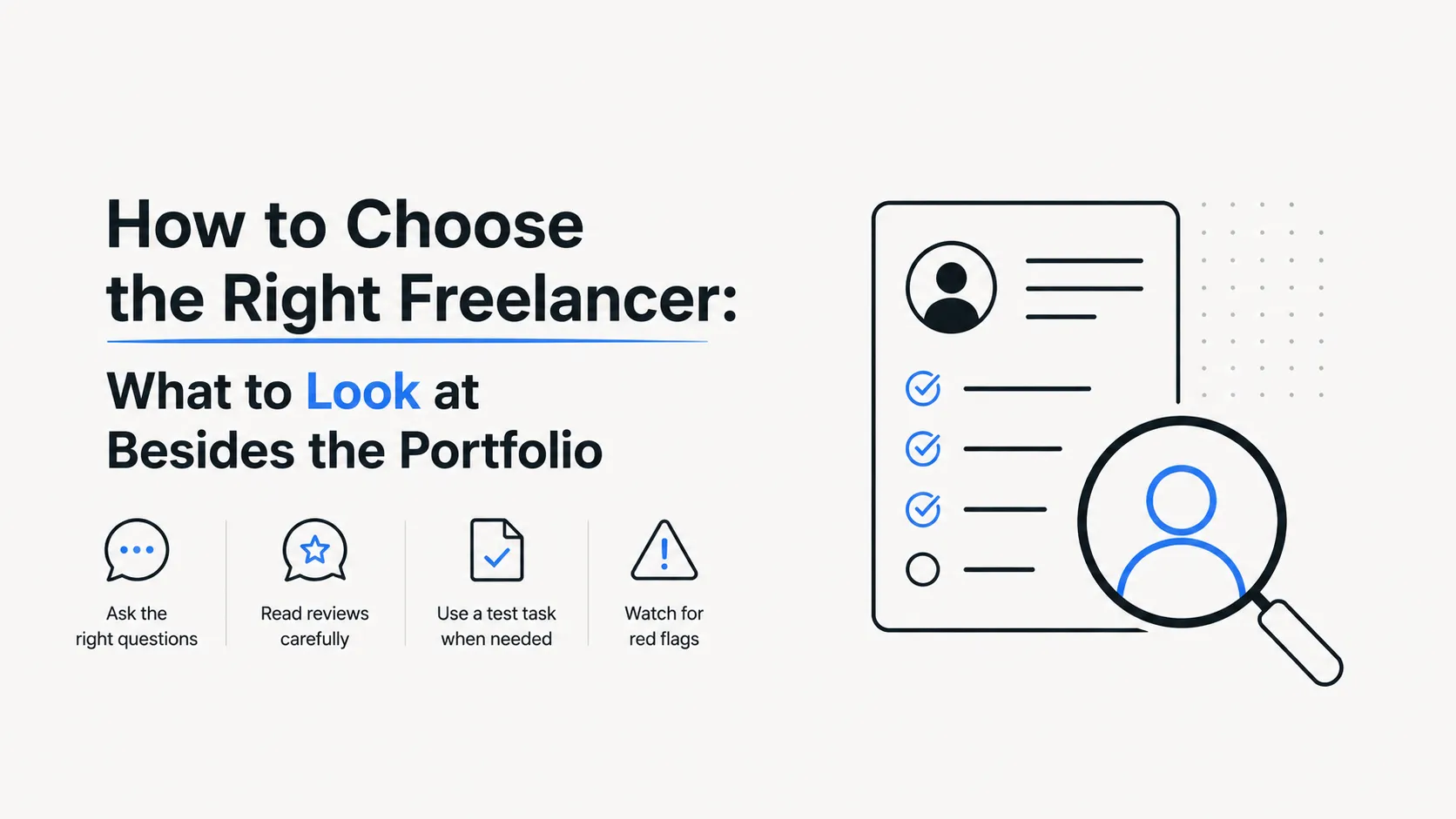
Most clients choose by portfolio — reasonable, but insufficient. A portfolio shows that someone can do the work. It says nothing about whether they will finish it, answer messages, warn you about a slipping deadline in advance, or disappear for two weeks in the middle of the project.
And that is where most failed projects fail. Not from a lack of skill but from a lack of predictability: mismatched expectations, silence, "I'll have it by Friday" with no statement of what exactly will be ready.
So evaluate two groups of signals at once: can they do it (portfolio, relevant experience) and will working with them be sane (communication, questions, agreements). The second group matters just as much and, fortunately, is visible before you sign anything.
Step 0: Describe the Task First
The most common mistake is starting with "how much for a website?" You will get numbers that cannot be compared, because everyone priced something different.
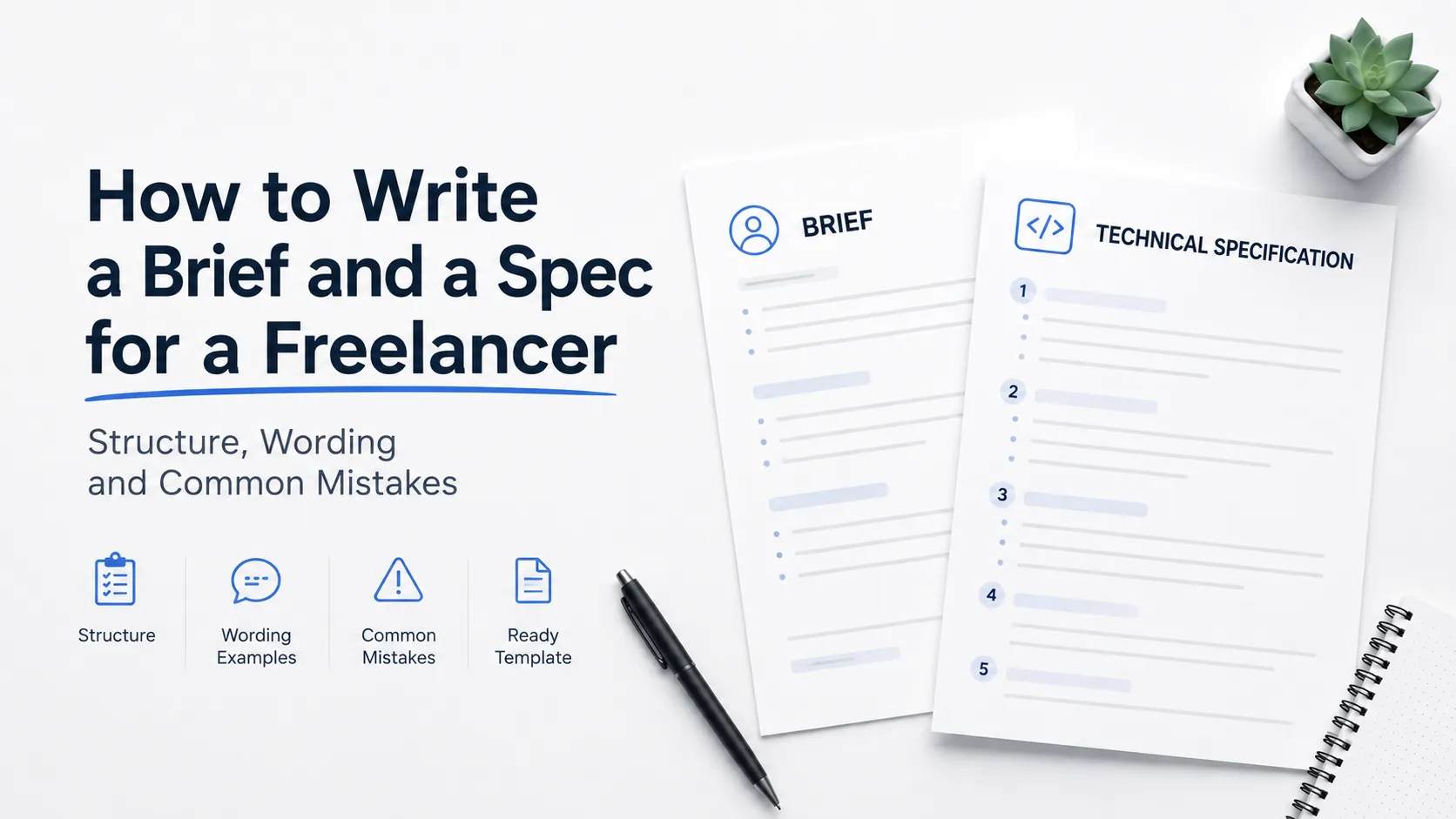
Describe the task before asking about price: goal, audience, scope, existing assets, deadline, approximate budget. That is 20–30 minutes that dramatically narrows the spread of quotes. A ready template is in How to write a brief, and the factors behind cost are in How much does a website cost.
Side effect: the reaction to a brief reveals more about a specialist than any portfolio. Whoever read it and came back with questions has already shown their level.
What to Look for in a Portfolio
Relevance beats beauty. A site of a similar type is worth more than a beautiful site of a different class. A designer with a strong mobile-app portfolio will not necessarily build you a good online store.
- Similarity of task, not of industry. It does not matter whether they built a site for a dental clinic — it matters whether they built a site with the same mechanics (catalog, booking, calculator).
- Descriptions, not just images. Work without explanation shows the result but not the thinking. One case explained as "task → solution → outcome" beats three pretty screenshots.
- Their role in the project. Most digital work involves several people. If the contribution is not stated, ask directly.
- Freshness. A portfolio last updated two years ago is a reason to ask what they have done since.
- Consistency of level. One strong piece among ten weak ones more often means a team project than a leap in skill.
Red flags: work with no descriptions at all, portfolios made entirely of mockups (pretty images, nothing launched), identical cases appearing in several people's portfolios, and reluctance to state their role.
The Main Signal: What Questions They Ask
This is the best predictor available, and it is free. Compare two replies to the same brief:
- "Sure, I can do it. Budget X, two weeks."
- "A few clarifications: who populates the catalog after launch? How many page types are actually needed — I count four? Is there a brand guide? Which matters more to you, the deadline or the scope?"
The second person has done nothing yet but has already shown they understand the task, see the risks, and are thinking about your outcome rather than their invoice. Someone who agrees instantly with no questions either did not read the brief or will later discover the scope is different — and then come the surcharges or the disappearance.
Whoever does not ask questions before the contract will ask them mid-project, when changing anything is expensive.
What to Ask Them
The list that saves the most trouble. Ask before signing.
- What is included and what is NOT in the quoted price.
- How many revision rounds are covered, and what counts as a revision versus a new task.
- What the stages are and what you see at each one.
- What is needed from you and by when (copy, photos, access, feedback).
- What you receive at the end: source files, credentials, rights, documentation.
- How and where you communicate, and the realistic response time.
- What other projects they have running and how much time yours actually gets.
- What happens if a deadline slips — on either side.
- Whether post-launch support exists and on what terms.
- Whether you can talk to someone they did a similar job for.
The most informative is question one. Phrasing it as "what is not included" forces the boundaries into the open — and that is usually where you discover the design, the copy or the content population lived in your head rather than in the quote.
How to Read Reviews
Reviews are useful, but not the way people assume. "Great work, highly recommend" carries no information. Look for other things:
- Specificity. A review naming the task and the outcome is worth ten enthusiastic ones.
- Repeat engagements. The strongest signal of all: a client who came back a second time is confirming the working relationship, not the skill.
- How they handle criticism. A public reply to a negative review shows more than twenty positive ones. A calm "yes, we slipped, here is what we did" is a good sign; hostility is not.
- Activity, not just the rating. A live profile with work and posts is more reliable than a high score with no history.
No reviews is not an automatic minus, especially for newcomers. Then other signals carry the weight: the quality of their questions, how their cases are written, how precise their proposal is.
Test Tasks: When They Make Sense
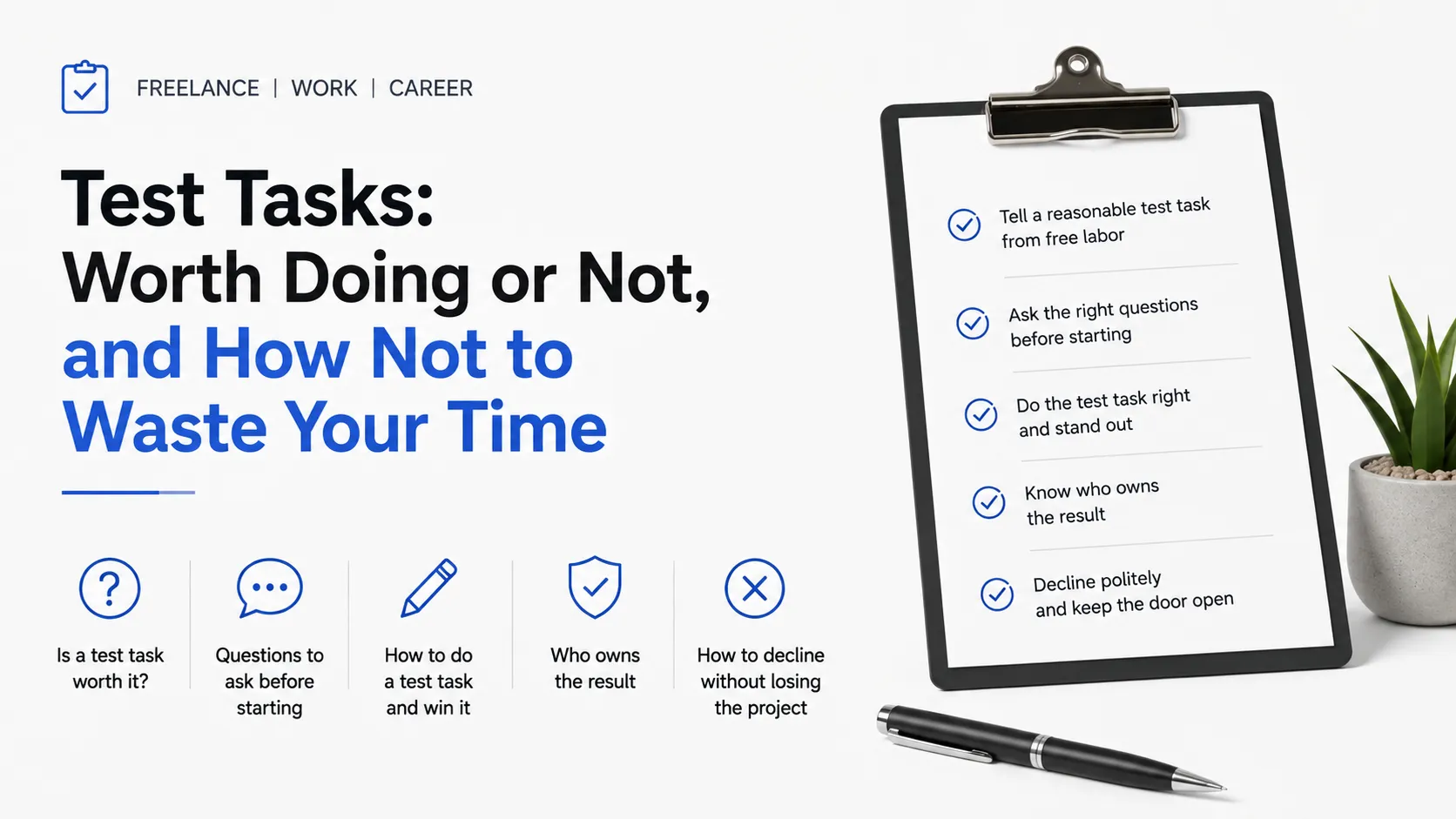
Sometimes reasonable, but under rules — otherwise you either scare off strong candidates or get free work with a bad aftertaste.
- Small scope. One screen, one paragraph, one short fragment — something done in an hour or two.
- Paid, if it takes more than a couple of hours. Strong specialists are usually busy and do not do unpaid tests.
- Not live work. If the "test" is a real fragment of your project, that is a job, not a test.
- Identical terms for everyone and a clear evaluation criterion.
Often the better alternative is a paid first stage: order a small part of the project for money. You will see quality, communication and deadline discipline at once — exactly what a portfolio cannot show.
Freelancer, small team or studio?
A freelancer is cheaper and faster to communicate with, and you work directly with whoever does the job. The risk is the human factor: illness, parallel projects, holidays. Works well for clearly bounded tasks.
A small team covers adjacent disciplines (design + development + content) and has backup, but costs more and moves slower through approvals.
A studio gives you process, a manager and formal guarantees; you pay for predictability. The risk is that you may not know who actually does the work, and levels inside can vary.
Practical rule: the more adjacent disciplines a project spans and the more expensive a mistake would be, the more a team makes sense. For one clearly defined task, a freelancer is usually optimal.
Price: Why the Cheapest Quote Is the Riskiest
A low price almost always means one of three things: something you assumed was included was removed from scope; risks were not priced in and the work will become a loss; or the work will be built so it cannot be developed further.
A practical filter: if one quote is substantially lower, ask for a detailed list of work. In most cases the difference is explained right there, not by seniority. More on price structure in How much does a website cost.
The reverse is also true: the most expensive quote is not automatically the best. Ask what the premium buys — experience with your type of task, project management, or guaranteed support.
Red Flags
- Agrees to everything without questions. Either did not read the brief or will bring surcharges later.
- Guarantees results in numbers. "I'll get you to the top," "+40% sales" — nobody can guarantee that.
- Will not say what is not included. Means the boundaries will appear mid-project, not in your favor.
- Pressures you to decide. "This price is valid today only" in a services context is manipulation.
- Replies slowly before the contract. It only gets worse afterwards.
- Refuses to put agreements in writing. The most serious flag on the list.
- Is vague about their role in portfolio pieces.
- Has no link to anything live — only mockups and presentations.
- Asks for full prepayment on a large project with no stages.
What to Lock Down Before Starting
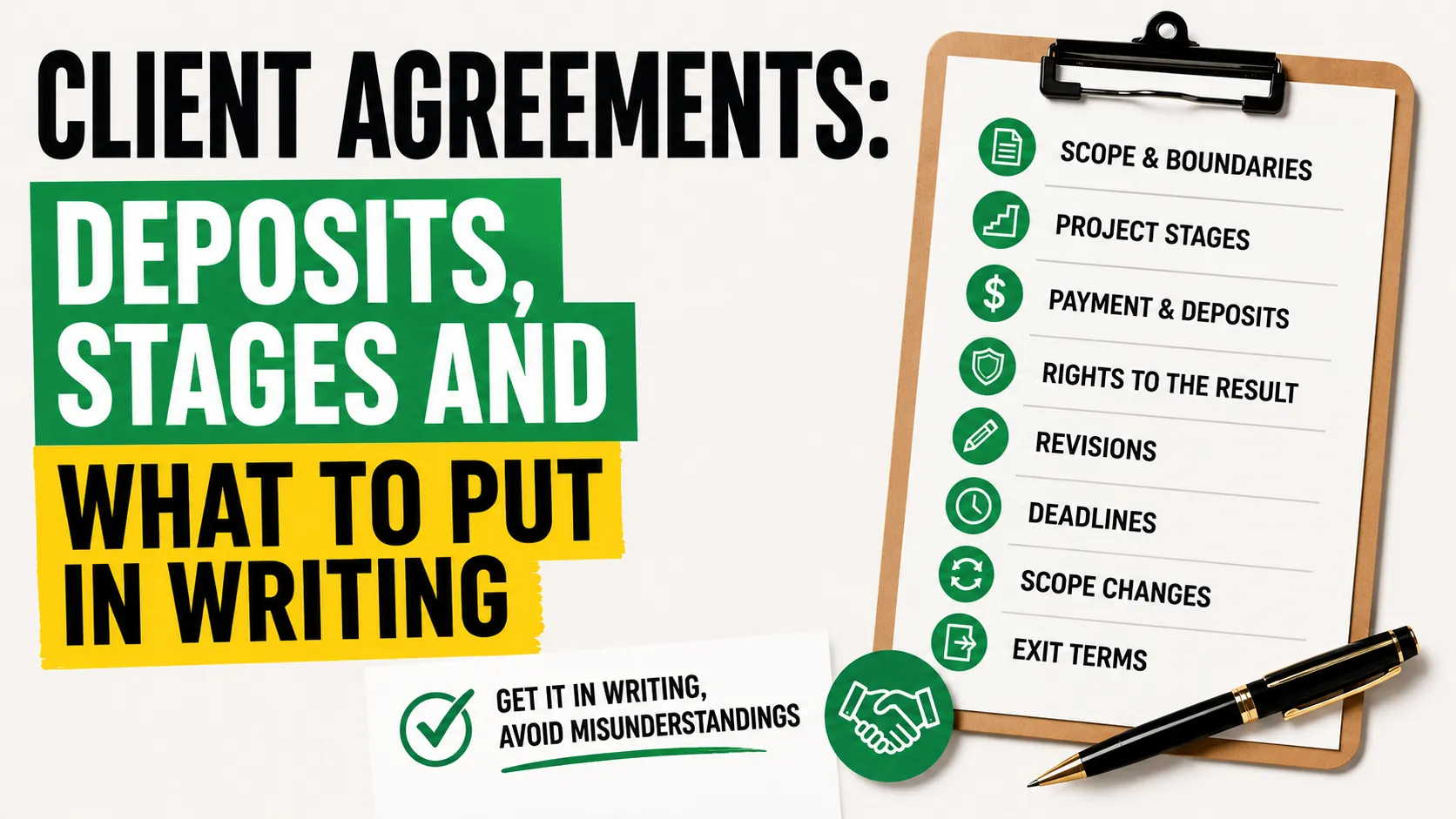
The minimum that must be in writing — in a contract or at least in messages confirmed by both sides:
- scope, and what is not included;
- stages, deadlines and what is delivered at each;
- amount, payment schedule, size of the deposit;
- number of revisions and what counts as a new task;
- what you receive: source files, credentials, usage rights;
- how completion is established — acceptance criteria;
- what happens if a deadline slips on either side.
A deposit is normal practice: the specialist reserves time and turns down other work. A healthy setup for medium projects is stage payments, where both sides risk one stage at a time.
Key Takeaways
- A portfolio shows whether someone can do the work; communication shows whether they will finish it.
- Brief first, price questions second — otherwise quotes cannot be compared.
- In a portfolio, task relevance, written cases and stated role matter more than pretty images.
- The best signal is the questions a specialist asks before the contract.
- "What is NOT included" is the most informative question you can ask.
- In reviews, look for specifics and repeat engagements rather than the score.
- Test tasks should be small and paid; a paid first stage is usually better.
- The cheapest quote is generally the shortest in scope, not the best value.
FAQ
What should I look at when choosing a freelancer besides the portfolio?
At communication before the contract: what questions they ask, how fast they reply, whether they state the boundaries of scope, whether they will put agreements in writing. A portfolio shows skill level, but projects most often fail from unpredictability rather than incompetence. The second signal is experience relevant to your specific task rather than general visual quality.
Can I ask for a test task?
Yes, if it is small (an hour or two), identical for all candidates, and not a real fragment of your project. Anything larger should be paid: strong specialists are usually booked and do not do unpaid tests. It is often more effective to order a small paid first stage — you see quality, communication and deadline discipline immediately.
How many quotes should I collect?
Three or four is enough, provided everyone is answering the same brief. More is usually wasted time rather than a better decision. What matters is comparability: without a single description of the task you will be comparing different scopes, and the lowest number will almost always turn out to be the shortest list of work.
What if quotes differ by several times?
Ask each for a detailed list of work and compare what is included. In most cases the gap is scope: someone excluded design, copy, testing or content population. If a gap remains after that, ask what the premium buys — experience with your type of task, project management, or post-launch support.
What to Do Next
Write the brief — that is half of a good decision. Send it to three specialists and judge not only the numbers but the clarifying questions you get back.
Once chosen, put scope, stages, revisions and acceptance criteria in writing; after that, all that remains is accepting the work properly. Find specialists in the talent catalog and see real work with descriptions in the project feed.
Ready to act?
- Find a specialist in the catalog: https://searchtalent.dev/en/talents
- Browse specialists' projects: https://searchtalent.dev/en/projects
- Skills and technologies catalog: https://searchtalent.dev/en/talents/skill
- More articles: https://searchtalent.dev/en/articles