
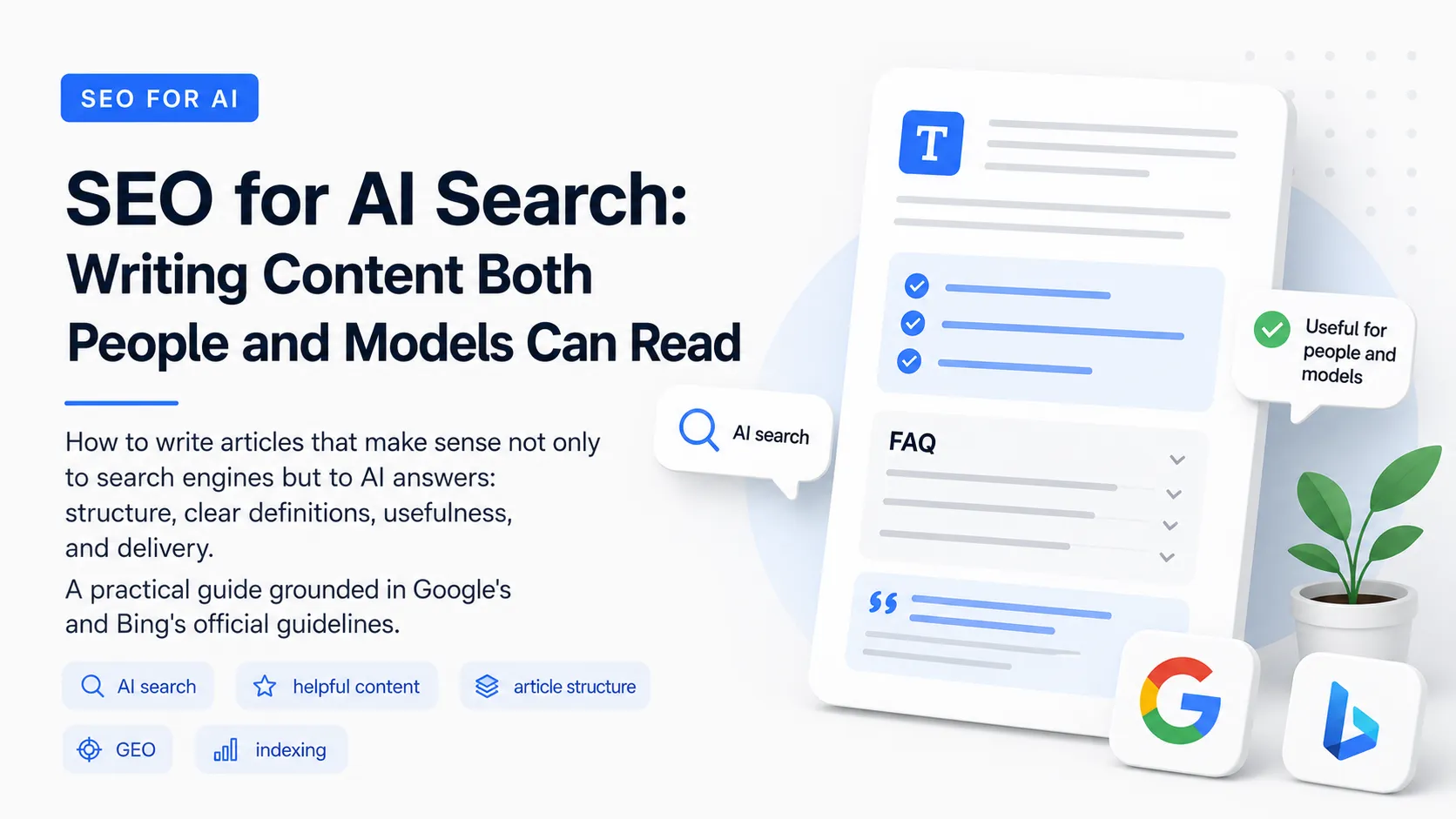
Search is changing faster than ever. Instead of "ten blue links," users increasingly get a ready answer — from Google's AI Overviews, from chatbots, from assistants. That sounds scary, but the good news is simple: the foundation of SEO hasn't changed. The emphasis has. Content that people read well and search engines understand correctly is now also "read" well by models.
In this article we'll unpack how to write articles that make sense to both human and machine: how to structure the material, why headings, FAQs, and clear definitions matter, and how to make text easy to index and genuinely useful. We'll lean on official sources — Google Search Central and the Bing Webmaster Guidelines. This is especially useful if you publish articles on your profile and want them found.
What Changed: From "Ten Links" to AI Answers
The old goal of SEO was simple — rank higher in the list of results. Now there's a new layer: AI systems read pages, extract facts from them, and compose an answer, sometimes citing the source. This phenomenon is often called GEO (Generative Engine Optimization) — optimizing for generative systems.
What that means in practice:
- a model must be able to easily extract a specific answer from your text;
- a source with clear structure and facts has a better chance of being cited;
- fluff and vague phrasing lose even harder than before.
Important: this is not a separate discipline replacing SEO, but its natural extension. The same principles, only stricter.
The Foundation Hasn't Changed: Useful Content First
Google has repeated one idea for decades, and it has become even more relevant: write helpful, people-first content — content for people, not for the algorithm. This is stated directly in Google Search Essentials on creating helpful content.
Simple check questions from Google worth asking yourself:
- Does the article give an exhaustive answer to the query, or just restate the obvious?
- Is there first-hand experience, examples, expertise — or is it a compilation of others' work?
- Will the reader leave satisfied, or run off to look elsewhere?
If content is truly useful to a person, it automatically becomes a better candidate for an AI answer too. So you should start not with "keywords" but with real value.
Structure Both People and Models Read
Structure is what most strongly affects a text's "readability" by a machine. A chaotic "wall of text" parses poorly; clearly structured material parses easily. Here's what works:
- A heading hierarchy (H2–H4). Break text into logical sections with descriptive headings. A heading should answer a specific sub-question, not be abstract ("Section 2").
- Answer-first. Give the gist in the first sentence of a section, and the detail afterward. Models often pull exactly that first clear paragraph.
- Clear definitions. When explaining a term, do it in one self-contained sentence: "X is…". Such sentences are easy to cite.
- Lists and tables. Structure enumerable facts, steps, and comparisons as lists — convenient for a human and clear for a machine.
- An FAQ block. Direct "question→answer" pairs map perfectly onto both a human query and the format of an AI answer.
Notice: all of this simultaneously makes the article more pleasant to read. So structure for machines and structure for people is the same structure.
How to Make an Article Easy to Index
Before content can be judged, it has to be found and indexed. The technical minimum, described by Google Search Central:
- Crawlability — the page must not be blocked from search bots (check robots and that content isn't rendered only on the client).
- Meaningful headings and
title— they form the snippet and signal the topic. - Internal linking — links between your own articles help both the reader and the crawler understand the site's structure and page weight.
- Speed and mobile-friendliness — a slow page loses both users and positions.
Track fresh announcements and rule changes on the Google Search Central blog — search evolves, and the official blog is the primary source.
Reinforcing the Topic with Usefulness (E-E-A-T)
Google evaluates not only the text but trust signals — experience, expertise, authoritativeness, trustworthiness (E-E-A-T). For an author that means:
- First-hand experience. "I did it this way and here's what happened" is worth more than restating theory.
- Specifics over generalities. Numbers, examples, screenshots, step-by-step actions.
- Depth. Cover the topic so the reader doesn't have to look for additions elsewhere.
- Honesty and freshness. Update stale content, note limitations and exceptions.
Depth and being a primary source are exactly what best distinguish you from the generated "noise" that has flooded the web.
What to Consider Specifically for AI Answers
A few extra emphases that raise the chance an AI system will use your article:
- Self-contained paragraphs. Each paragraph should be understandable out of context — a model may extract it separately.
- Grounded facts. Where possible, link to primary sources; it raises trust and citability.
- Unambiguity. Avoid vague phrasing — a clear fact is easier to "lift" into an answer.
- Current date and updates. Freshness signals that the material can be trusted.
Bing and Other Systems
Google isn't the only player, and some AI assistants rely on Bing's index. The good news: the principles are almost the same. The Bing Webmaster Guidelines stress the same triad — quality unique content, clean technical accessibility, and clear structure. So by making content good for Google, you almost automatically make it good for Bing and the assistants built on it.
Structured Data (schema.org)
A separate lever that's often ignored is structured data. It's markup (most often JSON-LD using the schema.org vocabulary) that explicitly "tells" a machine what's what on the page: where the article is, who the author is, where questions and answers are, where a rating or breadcrumbs are. For classic search this unlocks rich results (enhanced snippets); for AI systems it makes extracting facts easier.
The most useful types for articles: Article (material metadata), FAQPage (question-answer pairs), BreadcrumbList (navigation). An important condition from Google: the markup must match the page's visible content. Marking up something the user can't see violates the guidelines and can cost you eligibility for rich results. So structured data reinforces good content — it doesn't replace it.
Common Mistakes That Kill Visibility
- Fluff and keyword stuffing. Text written for the algorithm rather than the person now loses even harder — both in Google and in AI answers.
- Thin content. An article that restates the obvious with no depth or first-hand experience has nothing to stand out with among thousands of similar ones.
- Client-only content. If the main text renders only via JavaScript and isn't available without running scripts, the bot may not see it.
- Duplicates and cannibalization. Several similar pages for one query compete with each other; one strong page beats three mediocre ones.
- A title that doesn't match the content. A clickbait title that doesn't deliver raises the bounce rate — a signal that the content isn't useful.
A Checklist Before Publishing
A quick check worth running before every article:
- Does the first paragraph of each section answer a specific question (answer-first)?
- Is there a clear H2–H4 heading hierarchy with descriptive names?
- Are there FAQs, lists, or tables where appropriate?
- Is there first-hand experience, examples, numbers — or is it a restatement of others' work?
- Are internal links to related materials in place?
- Are the date and facts current, and are sources cited?
- Is the page not blocked from indexing, and does it load fast?
If every item is a "yes," the material is ready for both people and models.
Example: A Paragraph Before and After
Theory becomes clear with an example. Here's the same content "before" and "after" optimizing for AI search.
Before: "There are many different factors that can affect how your content is perceived by search engines, and it's important to consider all of them to achieve good results in the rankings."
The problem: many words, zero specifics. A model has nothing to extract, and the reader learned nothing new.
After: "Three things affect an article's visibility most: usefulness (does it answer the query better than competitors), structure (clear headings, lists, definitions), and technical accessibility (the page is indexed and loads fast)."
The difference: the second version gives a specific, self-contained answer that's easy to cite for both a human and a model. This style — "say it clearly instead of saying a lot" — is exactly what wins in AI search.
What to Track After Publishing
Publishing is half the job; after that you should look at the data and improve. The minimal set of signals:
- Impressions and positions. Google Search Console shows which queries the page appears for and at what positions. This hints at which topic to reinforce.
- Real queries. Often a page ranks for phrases you never thought of. If a query is relevant — add a dedicated section or FAQ question for it.
- Click-through rate (CTR). If there are many impressions but few clicks, work on the title and snippet description.
- On-page behavior. A fast exit signals that the content didn't deliver on the title's promise.
The core idea is that SEO isn't a one-off action but a cycle: publish → look at the data → refine. We wrote about the technical side of speed and accessibility in the article on modern web development.
Beware of Mass-Produced AI Content
The temptation to "generate a hundred articles a day" is strong, but Google has made it clear: mass-produced, faceless content made purely to manipulate rankings violates the guidelines — regardless of whether a human or a model wrote it. What matters isn't who wrote it but whether it's useful to the reader. So AI as a drafting tool is fine and even helpful, but publishing raw generated text in batches without editing, fact-checking, and added value is a direct path to losing visibility.
Practical guidelines so AI help doesn't turn into harm:
- Add your own. First-hand experience, examples, numbers a model couldn't know — exactly what sets you apart from thousands of identical texts and what E-E-A-T values.
- Edit and fact-check. AI is confidently wrong; an unverified fact in an article hurts trust in it and in the whole site.
- Don't chase volume. One deep article beats ten shallow ones, and it's the deep one that has a chance of being cited in AI answers.
- Keep one voice. Chaotically generated chunks are visible to the naked eye; a consistent style reads as expert.
- Update, don't multiply. Often it's better to deepen an existing strong article than to release a new shallow one on the same topic — otherwise the pages start competing with each other.
The rule is the same as throughout this article: AI speeds up the draft, but responsibility for usefulness, accuracy, and uniqueness stays with the human. That's exactly what, in 2026, separates content that ranks and gets cited from the "noise" that has flooded the web.
The Short Version
If you compress the whole article into a few points:
- The foundation hasn't changed: useful content for people wins both in classic search and in AI answers.
- Structure (headings, definitions, lists, FAQ) is what you do for the reader and the machine at the same time.
- Technical accessibility and internal links decide whether you're found and indexed at all.
- Structured data reinforces good content but doesn't replace it.
- SEO is a cycle with measurement, not a one-off action.
FAQ
Does SEO still work in the age of AI search?
Yes. AI systems rely on the same indexing and the same quality signals. What changes is the format of the results, not the foundation: useful, structured content wins both in classic search and in AI answers.
Do keywords still matter?
They do, but not as "keyword density." It's enough to use the topic and synonyms naturally and to answer real queries. Forcibly stuffing keywords tends to hurt.
What matters most — structure or usefulness?
Both, and they're linked. Usefulness decides whether the content deserves to be shown; structure decides whether a human and a machine can easily "read" it. A weak one drags down the other.
Can I write articles with AI?
You can, and it makes sense — as a drafting tool. But raw generated text without your editing, fact-checking, and added experience loses. Google judges usefulness, not authorship: what matters is that the article genuinely helps the reader rather than just existing for volume.
What This Means for Your Content
If you publish articles on your profile, these principles work directly for you: clear structure, usefulness, and honest expertise make your material visible to both people and models. It's also part of a modern web developer's SEO mindset.
Publish your material, skills, and projects so they read and index well, tag your technologies, and see how other specialists present their work.
Ready to act?
- Create your own portfolio: https://searchtalent.dev/en/projects/new
- Skill and technology directory: https://searchtalent.dev/en/talents/skill
- Browse other specialists' projects: https://searchtalent.dev/en/projects
- More articles: https://searchtalent.dev/en/articles