
Video editors have an advantage most professions lack: the work shows itself. You do not need to describe what you can do — you just let people watch. And that same advantage becomes the trap: a client opens the portfolio, sees fifteen three-minute pieces, realizes that is 45 minutes of viewing, and closes the tab.
An editing portfolio is not judged by how much work it contains but by how many seconds someone lasted. Realistically you have the first 10–15 seconds of the first piece. If your ability is not obvious by then, nobody sees what happens at minute three.
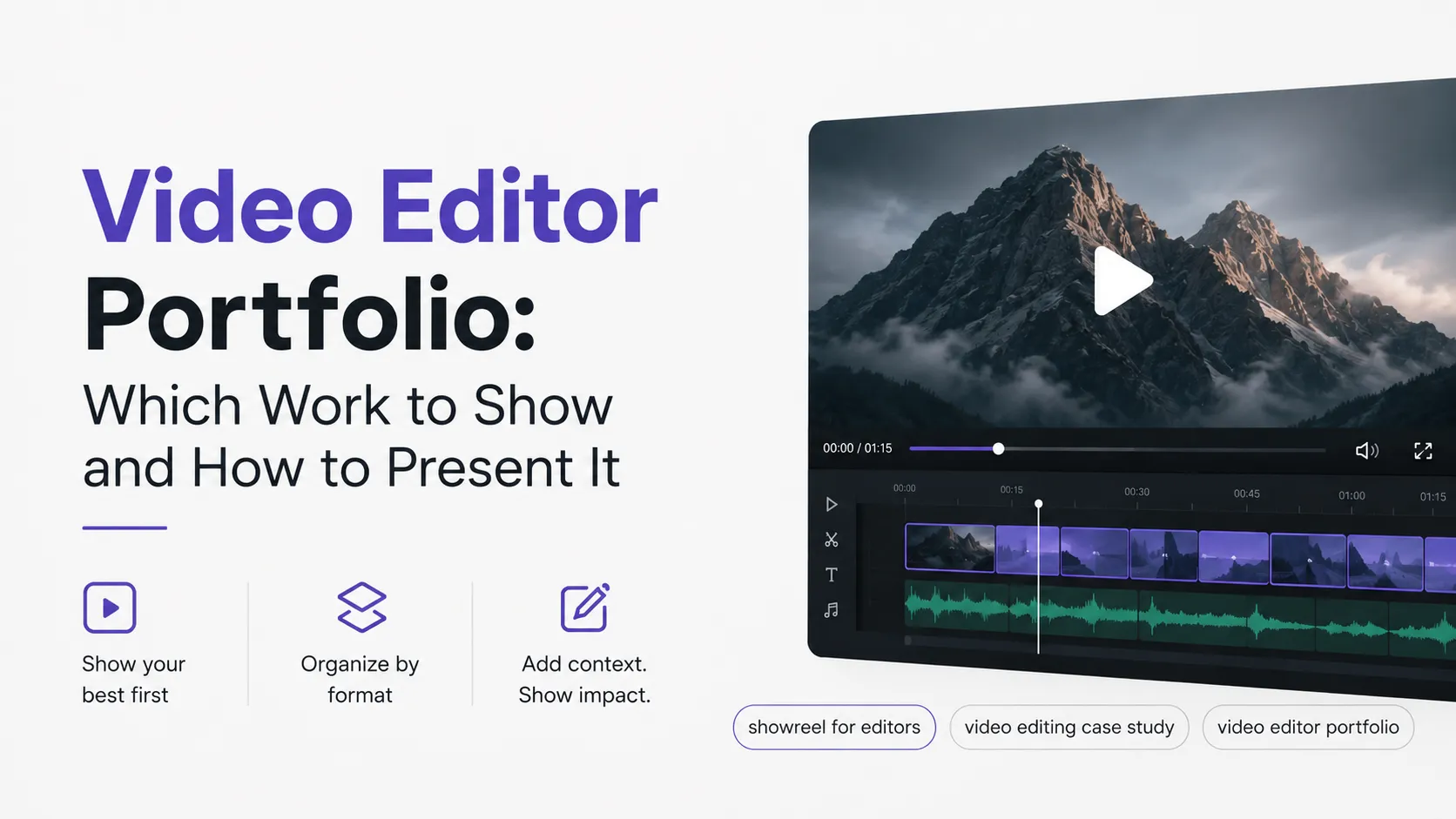
This article is about building a portfolio for that reality: what goes first, how to group the work, what to write under each piece, and how to show your level without making anyone watch everything.
The Main Rule: Best Work First
Not newest. Not chronological. Not "simple first, complex later." The first slot goes to the piece you consider strongest — and ideally one resembling the jobs you want more of.
The reason is simple: a portfolio sets expectations. If a wedding film sits first, you get read as a wedding editor, even if three strong commercial pieces follow. Nobody scrolls looking for your real positioning.
- The first piece is your best. Not "typical," not "most recent," but the one you would show if you got a single shot.
- The first 10 seconds of that piece matter too. If the work opens with a slow intro and a client logo, cut a portfolio version that starts on the strong moment.
- Three to five strong pieces beat fifteen assorted ones. A weak piece adds nothing and lowers the average impression of the strong ones.
An editing portfolio is not an archive of everything you have cut. It answers one question — what are you best at — in a form someone can grasp in a minute.
Showreel or Individual Pieces
The classic question. Short answer: you need both, and they do different jobs.
A showreel is a 30–90 second cut of your best moments over music. Its strength is giving a general read on level, pace and taste in a time anyone will spend. Its weakness is that it does not show what exactly you did in each fragment, or whether you can hold the structure of a long piece.
Individual pieces show a complete result: how the piece is built, how the hook works, whether the rhythm holds. That is what a client watches once they are interested.
The working combination: a showreel or one short strong piece as the entry point, then work grouped by format. And separately: showreels age fast. A two-year-old reel full of transitions that were trendy back then hurts more than having none.
Grouping by Type of Work
The most important structural idea. A client is not shopping for "an editor" — they are looking for someone who fits their task. Someone who needs Reels for a beauty salon does not want to scroll past wedding films and corporate reports.
Group your work by format:
- Short vertical video — Reels, Shorts, TikTok
- Commercials — product promos, paid-ad creatives
- Dialogue content — interviews, podcasts, expert video
- Music videos
- Events — weddings, conferences, coverage
- Corporate — training video, presentations, reports
You do not need every category — two or three strong groups look more convincing than six shallow ones. But every piece must be obviously assigned to a type: someone arrives, finds their format and watches only that.
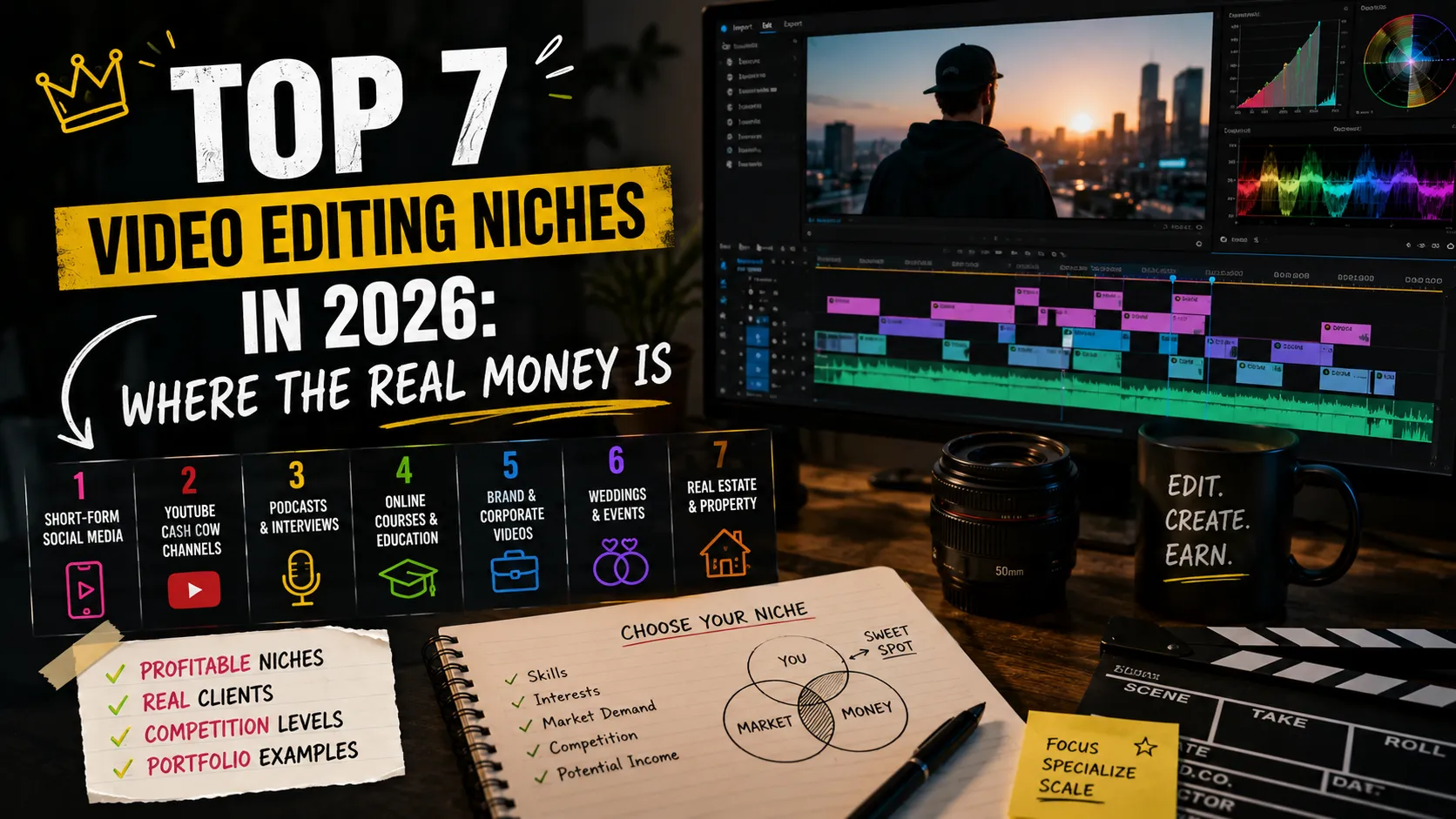
This also works for discovery: tags on your work are extra listings you appear in. Which video directions monetize best is covered separately in video editing niches.
Covers and the First Frame
The preview decides whether the piece gets clicked at all. It is the cheapest and most frequently ignored part of the job.
- One legible frame, not a collage of small details invisible in a list.
- Do not take the automatic timeline frame. Auto-grabs routinely catch a blurred cut or half-closed eyes.
- Covers in one series should look like a series. Consistent framing and caption logic instantly reads as "someone with taste works here."
- Vertical work gets a vertical cover. A cropped horizontal frame on a vertical piece reads as carelessness.
What to Write Under Each Piece
The video shows the result. It does not show which part of it was you — and that is the client's main question. Video almost always involves several people: a shooter, a colorist, a sound engineer, a writer. If you do not clarify, your contribution is either overestimated (and later disappoints) or underestimated.
A short description of three to five sentences:
- What the project was and for whom. "A series of short videos for an online school," "a launch promo for a product."
- Your role. Honestly: "editing and captions," "editing, sound, color," "full cycle — script to final master."
- The task. What had to be achieved: raise retention, produce 10 clips from one shooting day, assemble a piece from someone else's footage.
- What you did and why. One or two sentences on decisions: how you built the hook, why that pace, how you solved the bad audio.
- The outcome. Real client numbers are great. If there are none, describe it qualitatively: "the series went live and the client continued the engagement." Do not invent percentages — one question exposes them.
The "task → what I did → outcome" formula is the same as in any portfolio; the full breakdown is in How to make a portfolio.
Showing Your Level Without Filler
A few devices that work harder than long descriptions.
- Before / after. A raw frame and the same frame after color and sound is the most convincing five-second proof of technical skill.
- The hard part. One fragment where you rescued bad audio, matched footage from two cameras with different balance, or built a piece from phone footage.
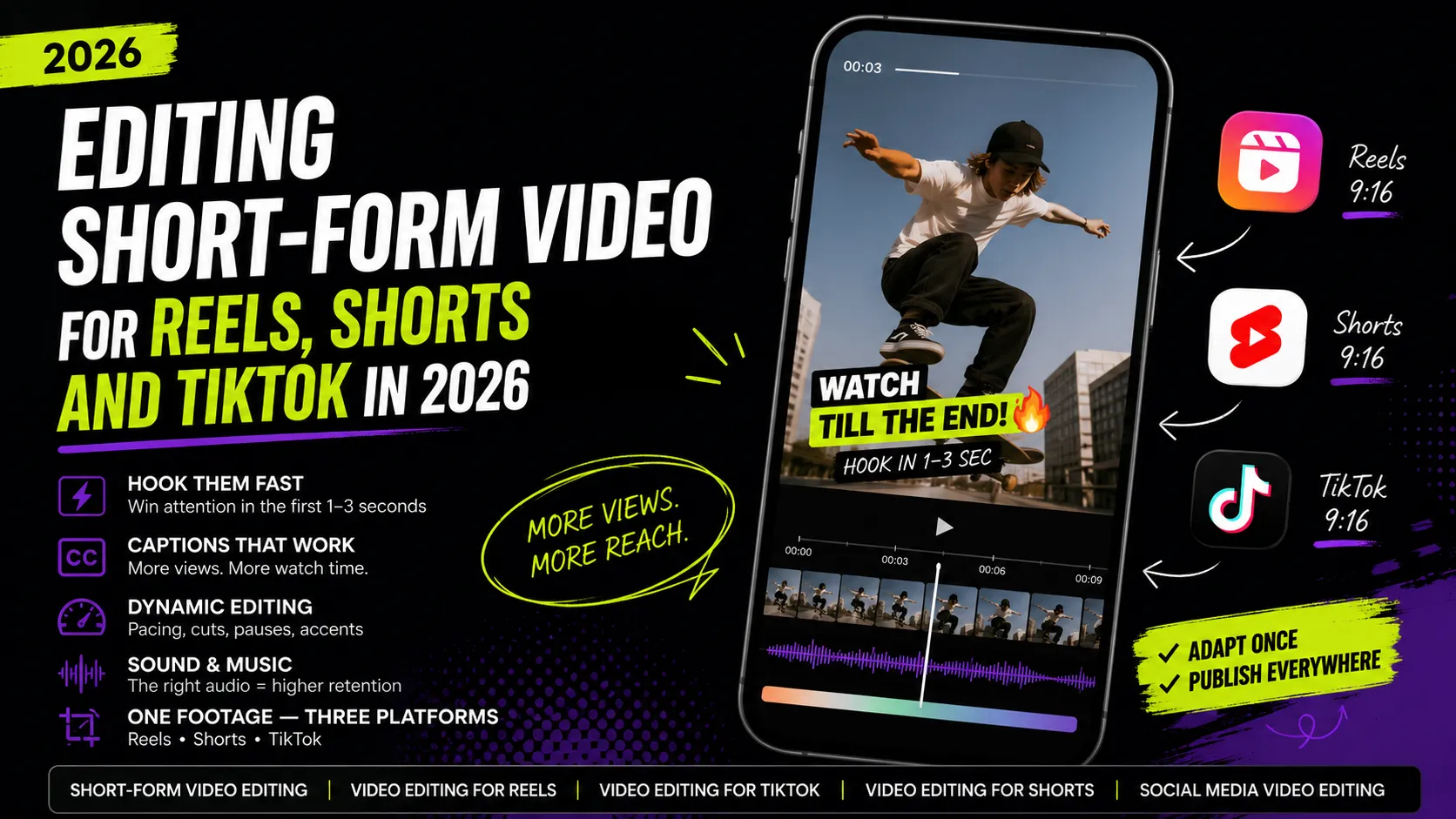
- One shoot, several formats. Show a long piece and a set of vertical clips from a single shooting day. That is the value clients pay for repeatedly — details in the article on short-form video editing.
- A series, not a single piece. Three clips in one style prove you hold a system rather than got lucky once.
- Your signature treatment. Titles, captions, transitions — if you have a recognizable manner, show it across several pieces in a row.
What if all my work is "as the client asked," with no authored style?
That is normal for commercial editing and not a problem — but then your strength is reliability and speed, not style. Show exactly that: the size of a series, several formats from one shoot, work with poor footage, adherence to a client's brand guide. "I work in the client's style, not my own" is also positioning, and for many clients it is more attractive than an authored manner.
The Technical Side: Do Not Lose Viewers on Details
- One link that opens on a phone. Not an archive, not "I'll send it later." Half of all portfolios are watched on mobile.
- Work must play without sign-ups or passwords. Every extra click costs you viewers.
- Publish vertical work vertically. A vertical clip letterboxed in a horizontal frame looks unprofessional.
- Captions on vertical work — most people watch without sound, and without captions your piece is judged as a silent one.
- Do not host a portfolio where clips expire. Stories, temporary links and archives that rot mean a portfolio that does not exist in six months.
- Check weight and load speed. A clip that takes ten seconds to start gets watched by nobody.
Rights, NDAs and Someone Else's Footage
Almost nobody writes about this, and conflicts happen regularly.
- Not everything you cut can be shown. Internal videos, unlaunched campaigns, NDA material — ask permission first.
- Ask right after delivery. In the moment the client is happy, permission is almost always granted. Six months later you are reintroducing yourself.
- Music in a portfolio must be licensed too. A reel over an unlicensed track risks takedown exactly when a client is watching.
- Do not claim other people's work. If you only edited and the shoot and color were someone else's, say so. It does not diminish you, and it saves you from awkward questions on a call.
A Beginner Editor's Portfolio
No commercial jobs is not a reason to have no portfolio. What works:
- Re-editing existing footage. Take open footage or a long interview and produce your own version: three vertical cuts with hooks and captions. That is a full demonstration of skill.
- A piece for a real local business — even unpaid. What matters is agreeing on a review and permission to show it.
- A personal project. A piece about a hobby, a trip, a process — anything where the intent and execution were yours.
- One subject in several formats. From one source, cut a 60-second version, a 15-second one and a vertical one — that shows format literacy better than three random pieces.
The one requirement is honest labeling: "study project," "personal project," "re-edit of open footage." A broader treatment is in How to build a portfolio with no experience.
Common Mistakes
- The longest piece first. Three minutes at the entrance filters out exactly the clients who are in a hurry.
- Everything in one pile. Weddings, ads and music videos in one list read as "I take anything."
- Pieces with no description. Nobody can tell what was you and what was the rest of the credits.
- Invented result numbers. "+300% views" with no source kills trust faster than having no numbers at all.
- A stale showreel. A reel built on the trends of two years ago works against you.
- Only a showreel, no full pieces. The client cannot see whether you can hold a whole video together.
- A portfolio scattered across five platforms. One link that opens everything is a baseline requirement.
- An abandoned portfolio. Last updated two years ago reads as "no longer working in the field."
Key Takeaways
- You realistically get 10–15 seconds, so lead with your strongest piece rather than the newest.
- A showreel gives a general impression; individual pieces prove you can hold structure. Both are needed.
- Group work by type: short vertical, commercials, dialogue content, events.
- Always state your role under each piece — video almost always involves several people.
- Before/after and hard-problem fragments demonstrate level better than any description.
- Vertical work goes vertical with captions; the portfolio must open on a phone.
- Ask for publishing permission right after delivery, while the client is happy.
- Three to five strong pieces beat fifteen assorted ones.
FAQ
How many pieces should a video editor's portfolio have?
Three to five strong pieces are enough if they are grouped by type and carry descriptions. A long list lowers the average impression: a weak piece adds nothing, and the strong ones start to look accidental beside it. The deciding factor is not the count but how closely the first pieces resemble the work you want to be hired for.
Does an editor still need a showreel in 2026?
A showreel is useful as a fast entry point — 30–90 seconds that convey level and pace. But it is not sufficient: it does not show whether you can hold the structure of a full piece, and it does not explain your role. The working setup is a showreel or one short strong piece up front, then individual work by type. And a reel must be remade as soon as it dates.
What do I show if I have had no paid work?
A re-edit of open footage, a piece for a real local business, a personal project, or one subject cut into several formats. Demonstrating skill does not depend on having been paid. The only requirement is labeling the work honestly as a study or personal project, with no hints at clients who do not exist.
Can I publish work I did for a client?
Only with their permission, and the best moment to ask is right after delivery. Internal videos, unlaunched campaigns and NDA material cannot be published at all. If permission is refused, you can sometimes agree to show an unbranded fragment or describe the case in words without publishing the video.
What to Do Next
Open your portfolio and check one thing: what a person sees in the first 15 seconds. If it is a slow intro, a client logo or your weakest piece — start there; it is the cheapest fix with the biggest effect.
Then add a description with your role to every piece and split the work by type. See how other specialists present video work in the project feed, and check whether your profile explains which format you are strong in — element by element in How to set up a profile.
Ready to act?
- Add your work to a portfolio: https://searchtalent.dev/en/projects/new
- Browse other specialists' projects: https://searchtalent.dev/en/projects
- Skills and technologies catalog: https://searchtalent.dev/en/talents/skill
- More articles: https://searchtalent.dev/en/articles