
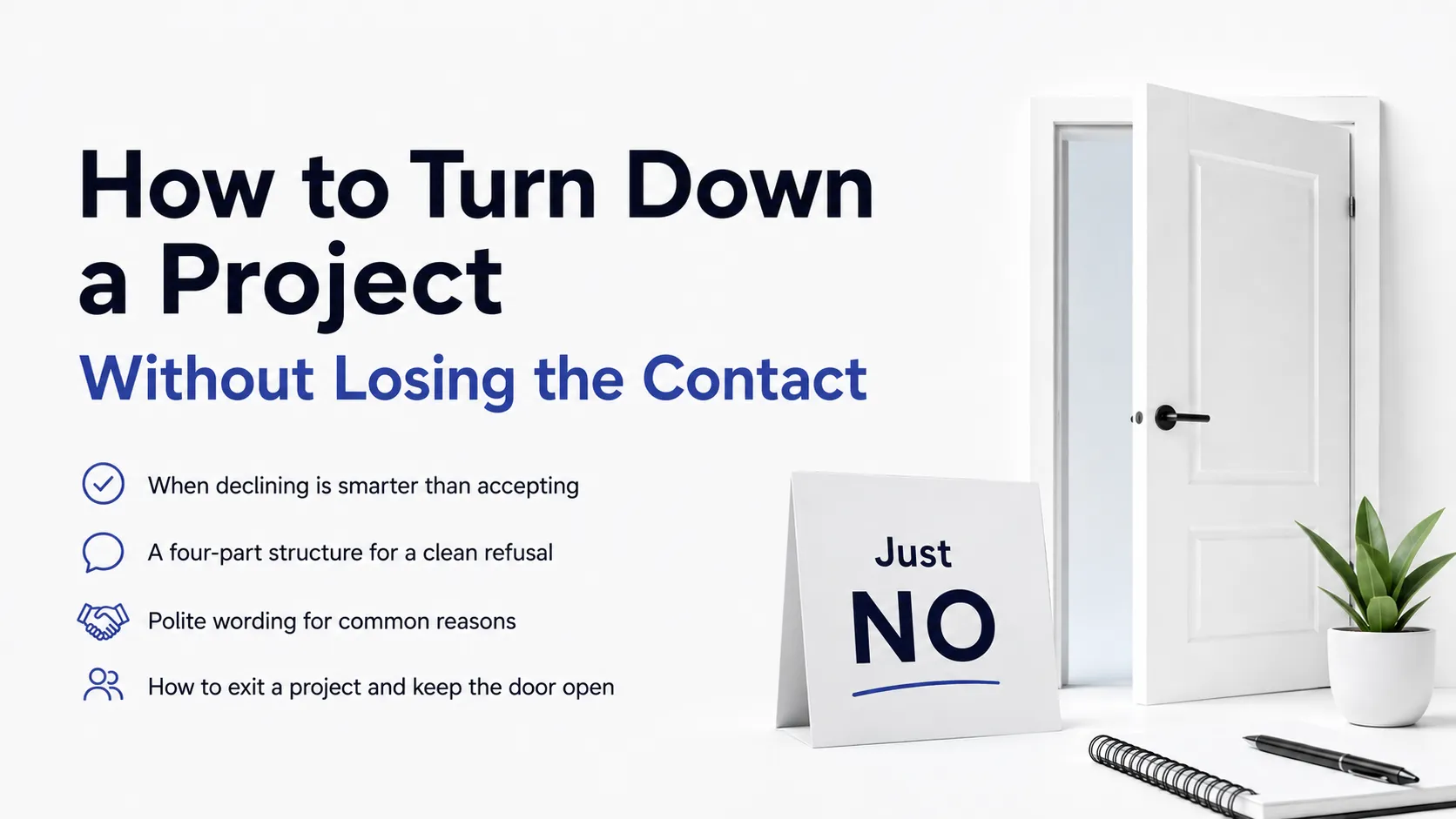
Knowing how to decline is not about being rude — it is about being able to choose your work. A specialist who takes everything works a lot and earns little: half the time goes to projects outside their focus, with impossible deadlines, or with clients they want to escape within a week.
The trouble is that declining feels intuitively like a loss. The actual loss is a bad refusal: going silent, dragging out the answer, inventing excuses. A well-phrased "no" costs five minutes and leaves the contact open — and a share of those contacts come back months later with a different, fitting task.
Below: when to decline, how to do it, and what to say in the most typical situations.
When Declining Is the Right Call
Signals, each sufficient on its own.
- The task is outside your expertise. Taking something "close enough" means learning on the client's money and risking a bad review.
- Budget does not match scope. Not "they pay little" but genuinely does not match: what they ask cannot be delivered for that money without a loss.
- An impossible deadline. If quality work needs twice the time offered, that is a decline, not a challenge.
- No capacity. Three parallel projects plus a fourth means being late on all four.
- Vague scope the client will not fix in writing. The most reliable predictor of endless revisions.
- Communication is already alarming during negotiation. Pressure, disregard for your time, "do it fast, details later," refusal to put anything in writing.
- The client negotiates from the first message and wants everything, sooner, cheaper.
- The project conflicts with your principles — also a legitimate reason that needs no explanation.
Every "yes" to the wrong task is a "no" to the right one arriving next week, when you will have no time.
The Core Principle: Fast, Short, Honest
Three properties of a good refusal.
Fast. The worst option is leaving someone in limbo for a week and then declining. They could have found somebody else in that time. A next-day no lands calmly; a no after a week of silence reads as disrespect.
Short. A long explanation reads as justification and invites negotiation: the client starts dismantling each of your arguments. One sentence of reason is enough.
Honest. Do not invent an illness or a fictional big project. First, it is easily caught in a small professional community. Second, an honest "this isn't my specialization" sounds more professional than any story.
The Structure: Four Elements
- Thanks for the enquiry. One sentence.
- A clear no. No "maybe," "I'll try," "let's look at it later" unless you mean it.
- One sentence of reason. General, without detail and without criticizing the client.
- Something useful at the end. A referral, a piece of advice, an open door for the future.
The fourth point is what converts a refusal into a contact. It costs a minute and is remembered for a long time.
Ready-Made Wording
Not your specialization:
"Thanks for reaching out. This isn't my specialization — I do X, and this needs Y, so the result would be weaker than you deserve. I can recommend someone who does exactly this kind of work."
No capacity:
"Thanks for the offer. I'm fully booked and couldn't take this on without risking the deadline. If it isn't urgent, I free up around [period] and would be glad to revisit it."
Budget mismatch:
"Thanks, it's an interesting brief. The scope you described doesn't fit that budget — I couldn't do it properly. If there's flexibility, I could propose a reduced version: [what]. If not, I completely understand."
Impossible deadline:
"Thanks for thinking of me. I won't take it on that timeline: doing it to a decent standard needs roughly [period]. If the date can move, let me know and I'll find a window."
Poor fit (careful phrasing):
"Thanks for walking me through the project. I don't think I'm the best person for it — you'd get a better result from someone who specializes in this area."
Client will not define scope:
"Thanks for the conversation. I only work to a defined scope — without it I can't give you a fair price or a realistic deadline. If it becomes possible to describe the task in more detail, let's return to it."
The general rule: the reason is always about you or the task, never about the client's shortcomings. "This way of working doesn't suit me" rather than "your requirements are chaotic."
Can I decline by quoting a very high price?
A common tactic that works worse than it seems. The obvious risk: they might say yes — and you end up in a project you never wanted, now by your own agreement and under obligation.
Price can be an honest filter when it genuinely reflects complexity, urgency or inconvenience: charging more for weekend work or bad input material is entirely normal. But if you would not do the work for any money, declining outright is the better move. It is faster and more honest for both sides.
Declining an Existing Client
Harder than a new one, because there is history. A few rules:
- Do not conflate the refusal with a judgment of them. "I can't take it right now" is about capacity, not about the client.
- Give notice if you are ending a recurring engagement. Vanishing destroys a reputation built over years.
- Offer a transition: finish the current stage, hand over materials, recommend a replacement.
- Do not promise "let's revisit this" if you do not intend to. It creates expectations you will then feel awkward about.
If you are ending things for good, clean wording looks like: "I'm changing the focus of my work and won't be taking this type of task going forward. I'll close my current commitments by [date] and hand over all materials and access."
Exiting a Project Already Underway
The least pleasant scenario, but sometimes necessary: the scope turned out fundamentally different, the client systematically breaks agreements, communication turned toxic.
- Try renegotiation first. Often the problem is solved by rewriting scope and dates rather than leaving.
- Give written notice with margin, not on delivery day.
- Agree settlement for work actually done. This is exactly why exit terms belong in the initial agreement — see Client agreements.
- Hand over everything produced. Materials, access, files — even if the parting is imperfect. Holding work hostage as leverage costs more reputation than any sum is worth.
- Do not air the dispute publicly. Professional communities are small, and the story travels faster than your version of it.
Referring Someone Else
The strongest way to convert a refusal into an asset — under conditions:
- Only refer people you genuinely vouch for. A bad referral hits you, not your colleague.
- Ask them first whether they have capacity. Throwing a contact over the fence disserves both sides.
- Pass context, not just contact details: the task, the budget, the client's quirks.
- Do not take a silent commission. If there is a referral fee arrangement, it should be transparent to everyone.
It works in reverse too: people you send clients to send clients back. That is the most common source of early work — see How to get your first clients.
Why a Refusal Often Comes Back as Work
A non-obvious but consistent effect: a clean refusal often leaves a better impression than a yes.
- You showed you understand the limits of your expertise — a mark of a professional, not a weakness.
- You did not waste the client's time and let them keep searching quickly.
- You helped anyway, through a referral or advice.
- You created the impression of someone busy and selective. That is a stronger signal than anything in a profile.
So it is entirely normal to revisit such contacts later: "You wrote in spring about project X — I have a window now if it's still relevant."
Common Mistakes
- Not replying at all. The worst option: read as contempt and closes the contact permanently.
- Dragging the answer out for a week. The client loses time and blames you for it.
- Inventing reasons. Easily caught, costs reputation.
- A long justification. Invites a negotiation that is hard to exit.
- Criticizing the client or their project. Even when you are right, it improves nothing.
- Saying "maybe later" with no intention. Creates expectations and awkwardness.
- Quoting an inflated price to force a no. You risk getting a yes.
- Accepting and then disappearing. The most expensive mistake of all: one such story cancels ten good projects.
Key Takeaways
- Declining is a tool for choosing work, not a loss.
- Reply fast: a next-day no is fine, a no after a week of silence reads as disrespect.
- The structure: thanks → clear no → one reason → something useful.
- The reason is always about you or the task, never about the client's flaws.
- Do not invent stories and do not use an inflated price as a refusal.
- A referral turns a refusal into an asset — but only with genuine confidence in the person.
- Exiting a live project: in writing, with notice, handing over everything.
- A clean refusal often returns as work later.
FAQ
How do I politely turn down a project?
Fast, short and honest: thank them for the enquiry, give a clear no, state one general reason, and offer something useful — a referral or an open door for the future. The reason should concern you or the task ("not my specialization," "fully booked"), not the client's shortcomings. Long justifications turn a refusal into a negotiation.
Can I leave a project that has already started?
Yes, but properly: try renegotiation first — often the issue resolves by rewriting scope and dates. If you do leave, do it in writing, with notice, settling payment for work actually done and handing over all materials and access. This is precisely why exit terms belong in the agreement from the start.
What if the client keeps pushing after I decline?
Repeat the no in one sentence with no new arguments: every new argument gives them something to negotiate against. "Thank you, but my decision won't change — I don't want to waste your time." If the pressure continues, that in itself confirms the refusal was right.
Should I refer a colleague instead of myself?
Yes, if you genuinely vouch for their level and asked them in advance whether they have capacity. Pass along context, not just a contact: the task, the budget, the specifics. A poor referral damages your reputation rather than theirs, so only recommend people whose work you have seen.
What to Do Next
Keep two or three ready refusal templates on hand — for "not my specialization," "no capacity" and "budget mismatch." Having the text written removes the main reason people go silent instead of replying: not wanting to compose it.
Then check whether your profile clearly states which tasks you take: half of all irrelevant enquiries come from vague positioning — see How to set up a profile. And to decline less often out of overload, manage your workload deliberately — covered in Freelance burnout and workload.
Ready to act?
- Update your profile and add a project: https://searchtalent.dev/en/projects/new
- Talent catalog: https://searchtalent.dev/en/talents
- Browse other specialists' projects: https://searchtalent.dev/en/projects
- More articles: https://searchtalent.dev/en/articles