
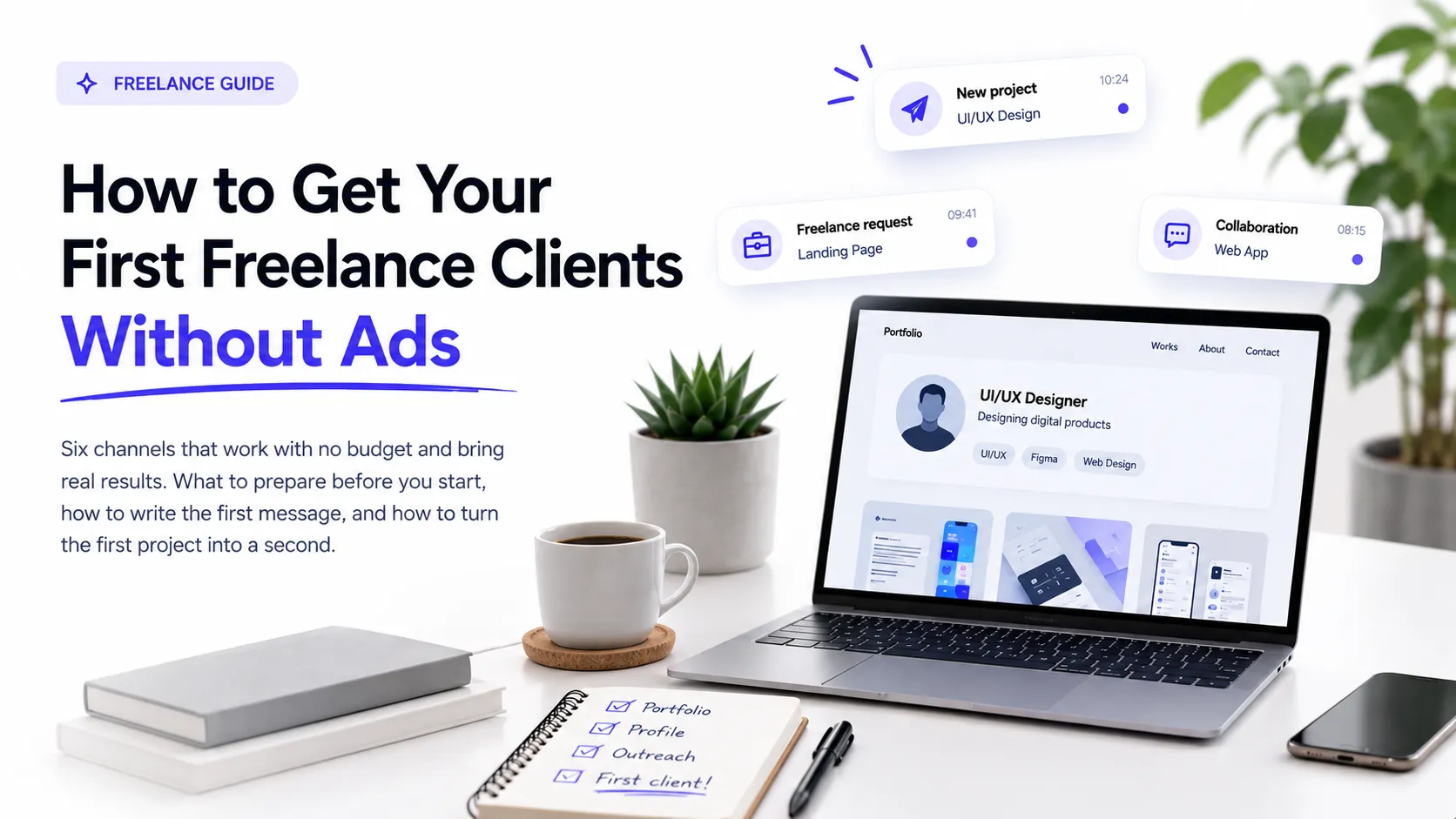
"Where do I find clients" almost always gets asked as a question about channels: which marketplace to join, where to run ads, how much it costs. But at the start the problem is usually not the channel. The problem is that there is nothing to look at — and any traffic, paid or free, leaks straight through an empty profile.
The good news: first jobs almost never come from advertising. They come from people who saw you — in a community, in a work feed, in someone's recommendation, or in a cold email that landed at the right moment. It is slower than an ad, but it costs nothing and, unlike ads, it does not vanish the moment you stop paying.
Below: what to prepare before you start, and the six channels that actually produce first clients.
Why Ads Barely Work at the Start
Three reasons beginners burn their first money for nothing:
- Nothing to show. Someone clicks, sees a profile with no work, and leaves. Ads add no trust; they only bring people to whatever you already have.
- No positioning. "I'll build your website" competes with a thousand identical offers and can only win on price. That is the road to the worst segment of the market.
- No understanding of the client. You do not yet know the words your audience uses for their problem, so you pay for impressions to people who do not need you.
Advertising scales what already converts. First you have to learn what converts, and that only becomes visible through real conversations.
At the start your shortage is not traffic — it is evidence. One properly presented portfolio brings more work than any ad budget.
What to Prepare Before the First Outreach
The minimum without which nothing else matters. One or two evenings of work.
- Two or three finished pieces. Not "something in a folder" but cases with an explanation: the task, what you did, how it turned out. If you have no commercial work yet, study projects and self-initiated concepts work fine — just label them honestly. Covered in depth in How to build a portfolio with no experience.
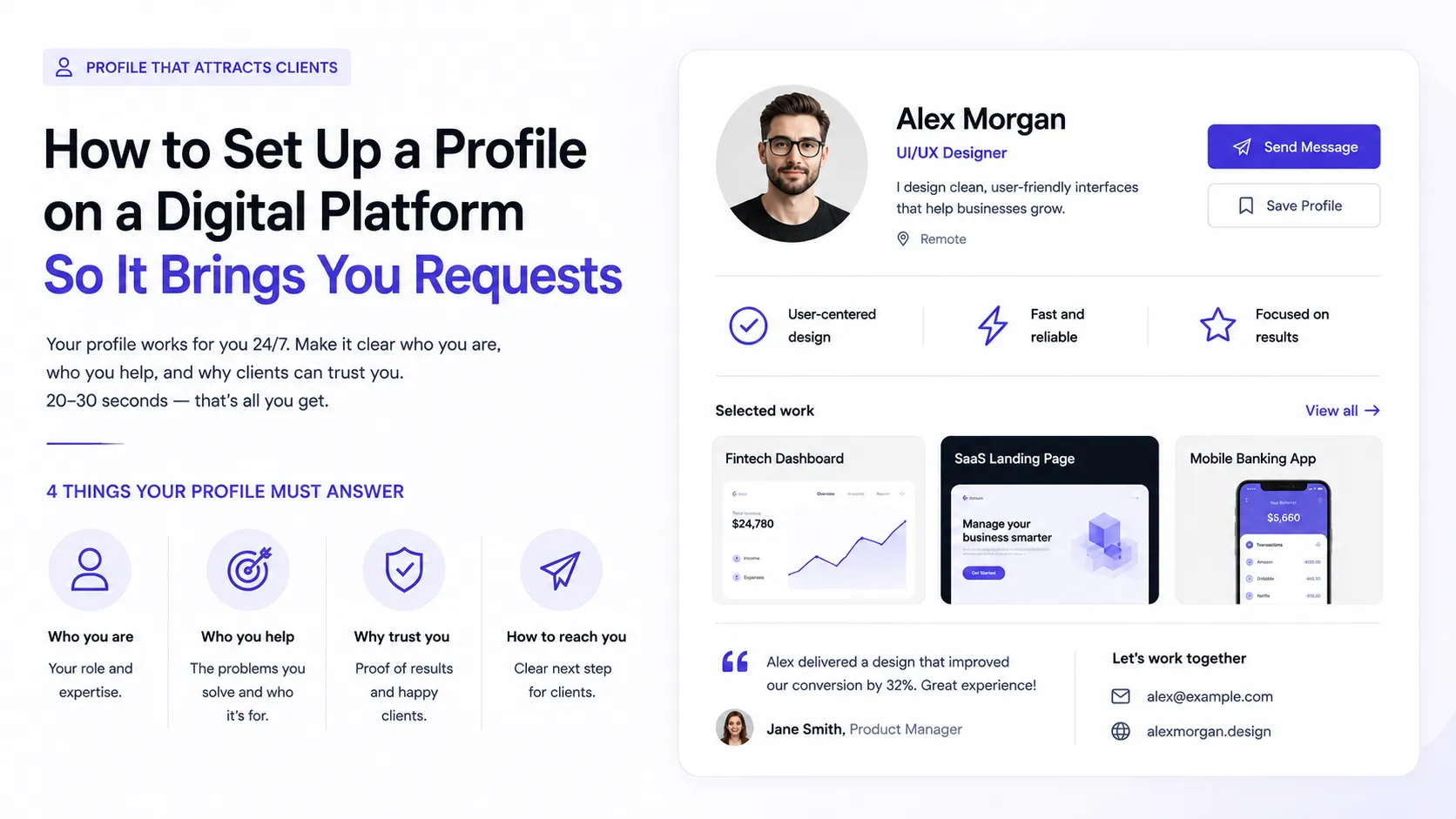
- A profile that answers "what will you do for me." A headline with a specialization, a bio with real problems, a visible contact. Element by element in How to set up a profile.
- One link you can drop into a chat. Not an archive, not ten files, not "I'll send it later." One link that opens on a phone.
- A 20-second description. The sentence you answer "so what do you do?" with. If it takes longer than 20 seconds, it still needs compressing.
That is it. Now the channels.
Channel 1: Professional Communities
The fastest way to get a first job with no budget is to be visible where your audience already talks: topic chats, forums, groups by discipline, specialist communities.
The main mistake is arriving with an ad: "looking for work, here are my services." Those get scrolled past. What works is a different sequence:
- Answer questions in your field. A thorough, useful answer is seen not only by the person who asked but by everyone reading the thread later — including people who arrive six months from now via search.
- Show work, not requests for work. "I worked through problem X, here is how I solved it" is a case study and a demonstration of thinking at the same time.
- React to other people's work with substance. A specific comment on someone's project is remembered; an empty "nice!" is not.
- Be regular. Five short appearances a week beat one long one a month.
The effect compounds: your first client from a community usually comes not from a single message but from having been seen several times and remembered as someone who knows their craft.
Channel 2: Content and Public Expertise
Content is the only channel that keeps working after you have made it. One breakdown of a problem can bring people in for months while search keeps finding it.
You do not need a blog. Minimal formats that produce results:
- A breakdown of your own task. "Here was the situation, here is what I tried, here is what worked." The easiest start, because you already have the material.
- An answer to a question you have been asked repeatedly. If you were asked, other people are searching for it.
- A short wrap-up after a finished project. A few sentences already count as content.
An article works better than a feed post: a post lives a day, an article stays findable. You can write your first one right here — create an article. How to write so both people and AI search engines find it is covered in SEO for AI search.
Channel 3: Peers, Not Competitors
The most underrated channel. First jobs very often come not from clients but from other specialists — for a simple reason: they already have a flow of work they physically cannot cover.
How it looks in practice:
- An overloaded specialist hands off a task they have no time for.
- An adjacent professional recommends you when a client asks "who can do the other part": a designer brings in a developer, a developer brings in a video editor, a copywriter brings in a designer.
- Subcontracting — you do part of someone else's project, gaining experience and a case study without finding a client.
- Agencies and studios regularly look for people for one-off tasks when volume exceeds capacity.
What to do about it: meet people in your own and adjacent fields, show them your work (not as a request but as "here's what I do"), and do not stay quiet about your availability. Most importantly, recommend others yourself: in this channel everything comes back, and faster than you would expect.
Channel 4: Warm Contacts
People who already know you reach out more readily than strangers — but only if they know what you do. The most common situation: former colleagues, classmates and friends simply have no idea you now build websites or edit video.
- Say it out loud. One direct message: "I'm now taking on X work, here are some examples. If you or someone you know needs this, happy to help."
- Do not ask for a favor — announce an option. That difference in tone decides whether you will feel comfortable writing to these people again.
- Do not dismiss small jobs. A first job from an acquaintance is rarely big, but it gives you a review, a case study and practice talking to clients.
- Treat them as clients. Same process, same agreements, same result. An acquaintance you worked with sloppily is minus two future referrals.
Channel 5: Cold Outreach (Done Properly)
Cold email has a bad reputation because most people write it badly: a mass template offering services genuinely does not work. But a targeted message to a specific person with a specific thought about their product outperforms advertising — and costs nothing.
The structure of a single message:
- Who. Not "everyone in the niche" but 10–20 companies or people whose product you have actually looked at and understand.
- First sentence — about them, not you. A concrete observation: what you looked at and what you noticed.
- Second — a concrete benefit. Not "I can do it better" but what exactly you propose to fix or add and why it matters to them.
- Third — proof. One link to comparable work.
- Fourth — a minimal next step. Not "let's collaborate" but "if it's interesting, I'll send a half-page idea."
The rules that decide the outcome: keep it short (5–7 lines), attach nothing, never send identical text to twenty recipients, and send one polite follow-up a week later if there is no reply. The reply rate will always be modest — that is normal; this channel runs on consistency, not on a single record-breaking week.
Should I work for free to get a first case study?
Free work "so they can showcase it" usually does not pay off: it devalues you in that client's eyes and drags in endless revisions, because nothing is at stake. Better options: build a project of your own around a real problem (that is a full case study), take a small but genuine budget, or do a strictly bounded free fragment — one screen, one clip, one block — in exchange for a review and permission to show the work. The boundary must be named up front, otherwise "a small favor" becomes a month of work.
Channel 6: Talent Catalogs and Platforms
A passive channel that runs in the background: a profile in a talent catalog enters internal search, skill and role listings, and external search results. People can find you with no action on your part — but only if the profile is filled in and has work in it.
What drives the number of inquiries:
- Completed skills and role — otherwise you appear in no filter.
- Tags on your work — every tag is one more list you exist in.
- Freshness — active profiles with new work surface more often than abandoned ones.
- Social proof — reviews, rating, articles. That is what separates you from the neighbor in the list with the same skill set.
Look at how specialists in your field present themselves in the talent catalog and how work is presented in the project feed — the fastest way to see what actually works in your niche.
The First Message From a Client: How Not to Lose It
The most painful losses happen not in prospecting but in the first five exchanges.
- Reply fast. In most cases the client messaged several people at once. A reply the next day is often already irrelevant.
- Ask questions before quoting. What is the task, what for, by when, what already exists. A price given without understanding scope is either lost money or a lost client.
- Propose the next step instead of waiting. "I can put together a half-page plan — shall I send it?" moves the conversation forward.
- Put agreements in writing. Scope, deadline, amount, number of revisions, what counts as done. That is not bureaucracy — it is what saves both sides from conflict.
- Do not say yes to everything. A job beyond your capacity earns a bad review and eats time that could have gone to a good project.
Turning the First Project Into a Second
The cheapest client is one who already worked with you. That makes the last 10% of a project matter more than it seems.
- Ask for a review right after delivery, while the impression is fresh. Make it easy: offer two or three questions to answer ("what was the task," "how did it turn out," "how was the process").
- Write up the case and add it to your portfolio — with the client's permission. A project nobody can see does not work for you.
- Follow up a month later. A short "how is it working, all good?" naturally brings a share of clients back.
- Tell them what else you do. Clients often do not know your full range and take the next job elsewhere.
- Ask for a referral directly. "If anyone you know has a similar task, I'd appreciate the referral" costs one sentence and works regularly.
Rhythm: What to Do Every Week
Finding clients without ads is a habit, not a campaign. A working weekly minimum:
- Two or three substantive answers or comments in communities.
- One new piece of work or an updated profile description.
- Five targeted cold messages.
- One contact with a peer or adjacent specialist.
- One short piece of writing every two weeks.
That is a few hours a week. The effect is not immediate — it usually shows after several weeks of accumulation — but unlike ads it does not reset to zero when you stop.
Common Mistakes
- Waiting until the portfolio is perfect. It will not be. Three finished pieces are enough to start.
- Writing "looking for work" instead of "here is what I do." The first invites pity, the second invites interest.
- The same message to twenty recipients. Recognized instantly and closes the channel.
- Undercutting on price. The lowest price attracts the hardest clients and locks you into a segment that is hard to climb out of.
- Accepting everything. A failed project costs more than a polite decline.
- Working free with no boundaries. A "small favor" without agreements reliably becomes weeks of work.
- Going silent after delivery. A client with no review and no follow-up is half the project's value thrown away.
- Spreading across ten channels. Two channels you show up in weekly beat ten you visited once.
Key Takeaways
- First clients come from people, not ads: communities, peers, acquaintances, targeted outreach.
- Three things are needed before you start: two or three finished pieces, a clear profile, and one shareable link.
- In communities, usefulness works; job-wanted posts do not.
- Peers and adjacent specialists are the fastest source of first jobs, because they already have overflow.
- Cold outreach works when it is targeted, short, and starts with them rather than you.
- A talent catalog works in the background — but only with a filled-in profile and real work.
- Every first project should end with a review, a case study and a follow-up.
FAQ
How long does it take to find a first client without ads?
Honestly, it depends on how much you have ready and how consistently you show up. The deciding factor is not luck but accumulation: the first job usually arrives not from the first message but after several weeks of steady activity, once people have seen you a few times. An empty profile multiplies that timeline.
Where exactly do I look for first clients with no connections?
Start with two channels: professional communities in your field (where you answer questions rather than advertise) and a talent catalog with a completed profile. In parallel, run targeted cold outreach — five a week, to people whose product you have genuinely examined. Connections appear through this, not before it.
Is free work worth it for a first case study?
It is better to build your own project around a real problem — that is a full case study with no dependence on someone else's goodwill. If you do work for free, bound the scope tightly (one screen, one clip) and agree on a review and the right to show the work. Unbounded free work devalues you and rarely converts into a paid job.
What if nobody replies to my cold emails?
That is normal for the channel: most will not reply. Check three things — whether the message is genuinely personal, whether the first sentence is about the client rather than you, and whether it contains one specific link to relevant work. One polite follow-up after a week raises your odds; two or more damage the impression.
Where to Start Today
Not with prospecting. First open your profile and check whether it has two or three pieces with descriptions and a clear headline. If not, that is your task for tonight: without it, every channel leaks.
Once you have something to show, pick two channels (communities + cold outreach, or communities + peers) and work them weekly for a month. Add your first piece to your portfolio, see how others present cases in the project feed, and start by writing one substantive answer to someone today.
Ready to act?
- Create a portfolio and add your first project: https://searchtalent.dev/en/projects/new
- Talent catalog: https://searchtalent.dev/en/talents
- Browse other specialists' projects: https://searchtalent.dev/en/projects
- More articles: https://searchtalent.dev/en/articles