
Almost every freelance conflict looks like a conflict about money and is actually a conflict about expectations. One side was sure the specialist writes the copy; the other assumed the client does. One thought two revisions were included; the other thought revisions were endless. Nobody is lying — nobody said it out loud.
A written agreement is not there so you can sue someone. It is there so the mismatch surfaces before the work starts rather than after. Nine times out of ten the act of agreeing is the prevention: when you write "two rounds of revisions," the client either agrees or says "I assumed otherwise" — and you settle it before it becomes a problem.
This article covers the minimum to record, in what form, and what to do when circumstances change mid-project.
Do You Need a Contract
A formal contract is warranted for large projects, for company clients, when rights are transferred, or when the cost of a mistake is high. For typical work, a written agreement in messages, confirmed by both sides, is enough.
The key word is confirmed. Your message saying "here's what we agreed…" with no reply is not an agreement. The working pattern: you write the summary, the client replies "yes, that's right." Two messages that later save weeks.
The main value of an agreement is not legal. It is that both sides articulated once how this works and discovered their mismatches for free.
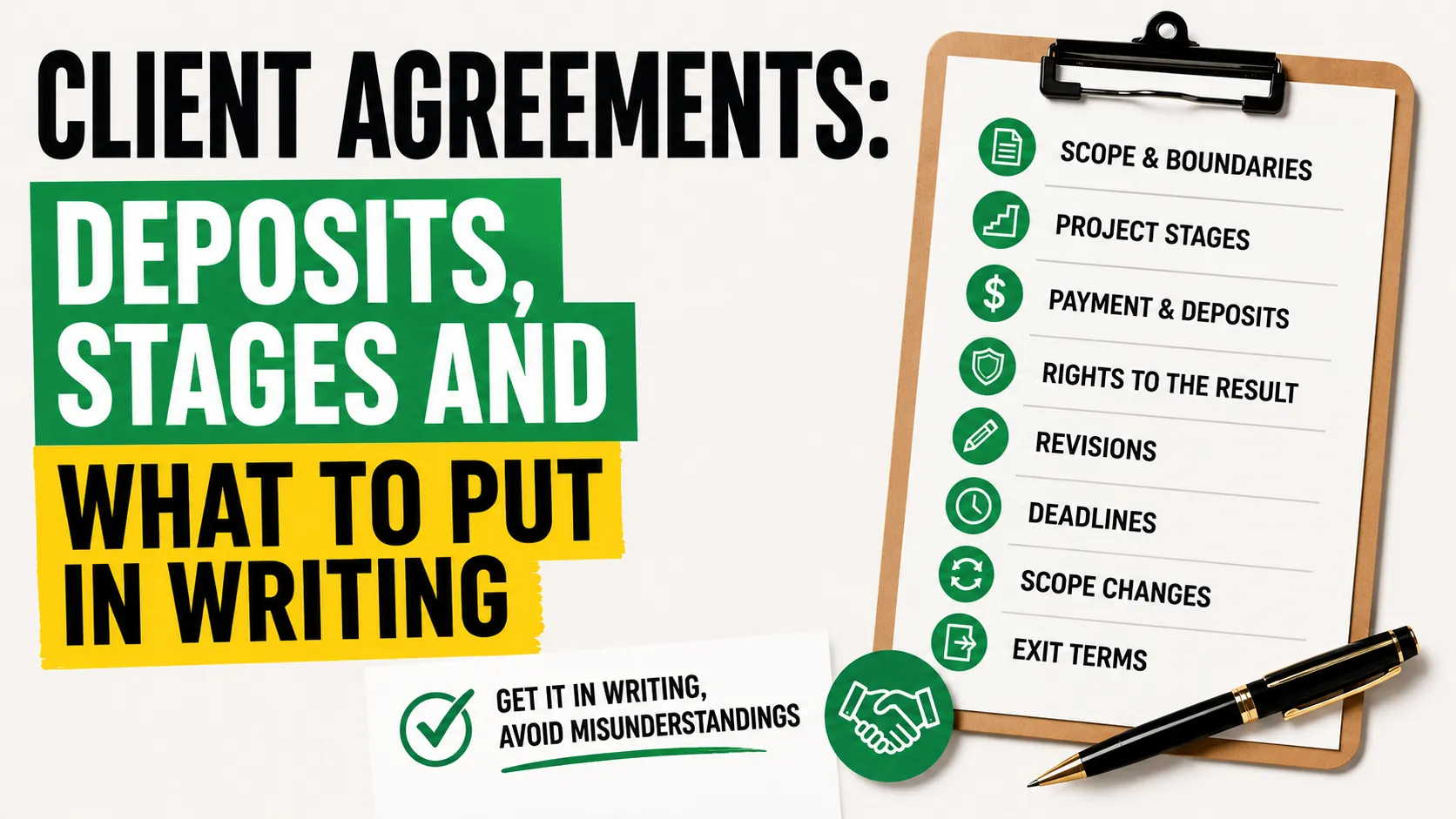
Ten Points to Settle
- Scope and what is NOT included. The most important item. Name the boundaries explicitly: "client supplies copy," "catalog population not included," "no tablet layouts." Most future conflicts hide here.
- Deliverable and completion criteria. What exactly you hand over and by what signs the work counts as done. Without this, "finished" becomes a matter of mood.
- Stages and deadlines. What is delivered at each stage, when the client gives feedback and how much time is allocated for it. The last part is critical: deadlines usually slip not because of the specialist but because of a week of silence.
- Price and payment terms. Amount, currency, method, deposit size, when the invoice is issued and when payment is due.
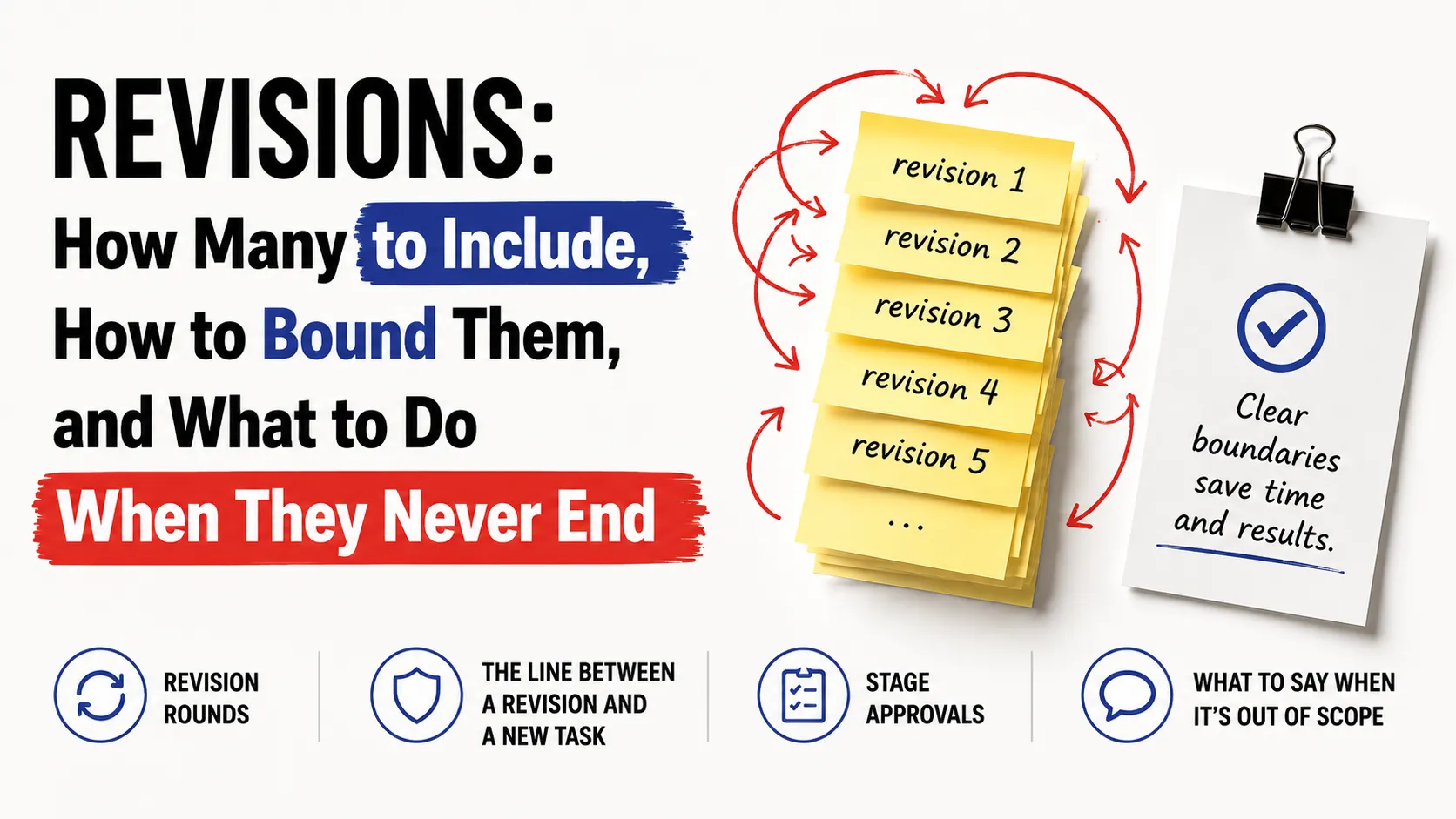
- Revisions. How many rounds are included, what counts as a revision versus a new task, how extras are billed. Details in Handling revisions.
- What is needed from the client. Materials, access, feedback, a point of contact. And what happens to the deadline if they arrive late.
- Rights to the result. What transfers: a license to use, or exclusive rights. Separately — whether you may show the work in your portfolio.
- Confidentiality. What is confidential, whether an NDA applies, whether the client can be named publicly.
- Scope changes. How new requirements are handled: a separate estimate of time and cost before work begins, not "just add this too."
- Exiting the project. What happens if either side wants to stop: payment for work actually done, handover of materials, notice period.
Deposits: How Much and Why
A deposit is not a sign of distrust but standard practice in services. It does two things: it confirms the client is serious, and it compensates you for reserved time you turned other work down for.
- For small jobs, half up front and the rest after acceptance is typical.
- For medium and large ones, stage payments are healthier: each stage is paid before or right after delivery, so both sides risk one stage at a time.
- For a new client, a deposit matters more than with someone you have worked with.
- For ongoing work, a retainer paid at the start of each period works well.
If a client refuses to pay anything up front, propose shrinking the first stage to a minimum (a concept only, for instance) — that makes the risk small for both sides and tests the relationship quickly. A flat refusal of any deposit on a large project is a reason to look at the client more carefully.
Rights to the Result — the Most Skipped Point
The most expensive of the "invisible" items, especially for designers, writers and editors.
- A license to use versus transfer of exclusive rights. Different things, different money. Exclusive transfer means you can no longer use that result — so it should cost more.
- When rights transfer. Sensible practice: rights pass after full payment, not when files are delivered.
- Portfolio rights. Discuss at the start, not after. If the client refuses publication, that should be reflected in the price: you are losing an asset.
- Third-party material inside the work. Fonts, stock images, music, libraries — record who buys the licenses and in whose name.
- Source files. State separately whether the price includes handing over working files (edit project, layered file, repository).
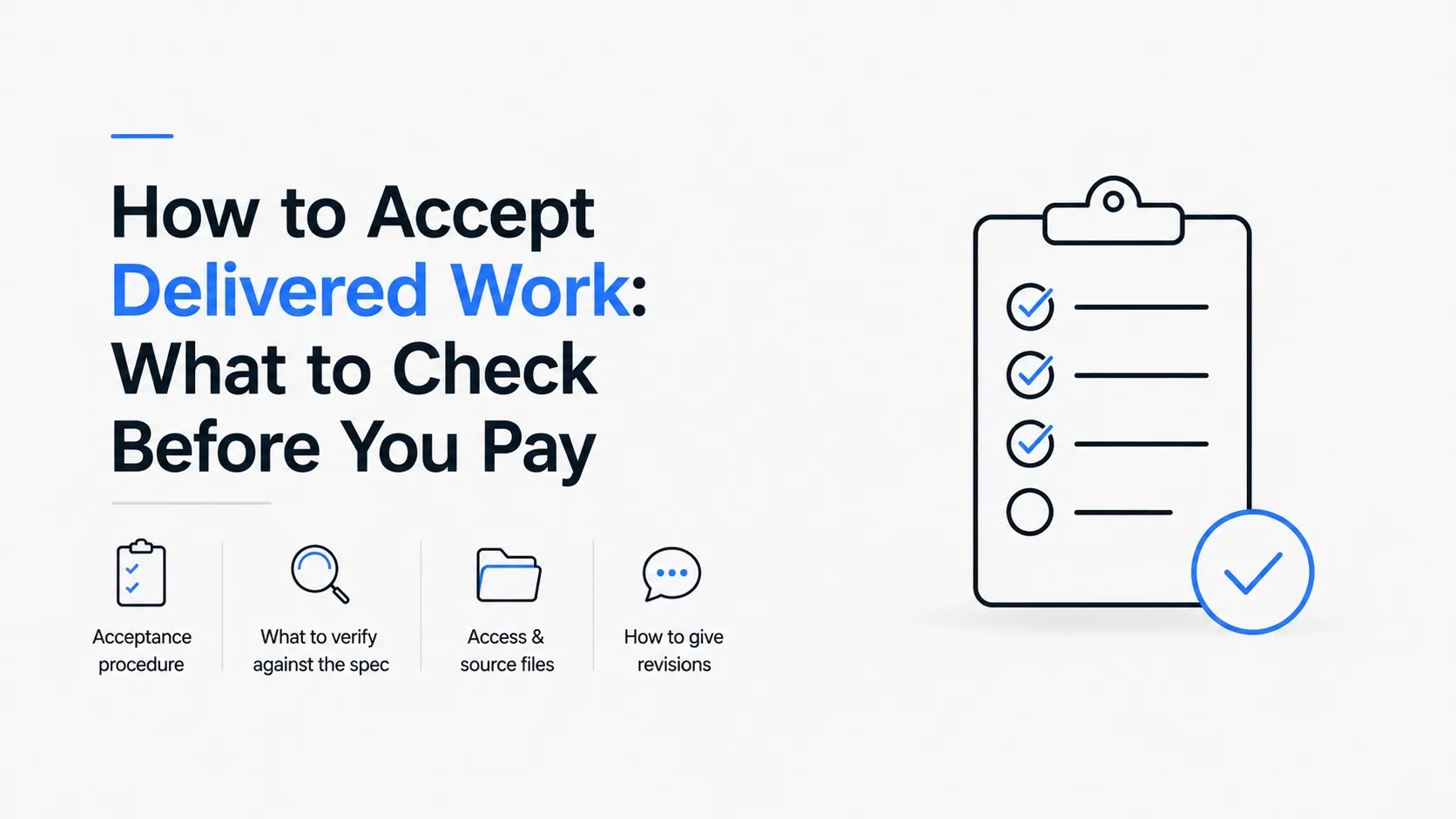
From the client's side this same block is an acceptance checklist — covered in How to accept delivered work.
Deadlines: Agree Them for Both Sides
The standard mistake is fixing a deadline only for the specialist. But a project has two participants, and a client's delay shifts everything just as much.
- The clock starts when materials arrive, not on the date of agreement.
- Fix the feedback window: "comments expected within 3 working days."
- State what happens if the client is late: the deadline shifts by the same number of days. Not a penalty, just arithmetic.
- Warn about your own slips early. Clients almost always accept a delay they hear about a week ahead, and almost never one they learn about on delivery day.
The client asks you to "just quickly add one more page." What now?
Neither refuse nor silently agree — process it as a scope change. Wording that works and offends nobody: "Yes, that's doable. It's +N hours, so +X to the price and +2 days to the deadline. Confirm and I'll start."
The key is naming the consequences before doing the work, not after. Silent agreement to "small things" is the main reason projects overrun and become unprofitable: each item looks tiny, and ten of them add up to half a project.
If the changes are many and systemic, it is a different project. Then the honest move is to stop, re-estimate the whole scope and continue on new terms.
Communication Agreements
An underrated part that strongly affects how comfortable the work is.
- One channel. Tasks spread across three messengers reliably get lost.
- A realistic response time. "I reply within the working day" is fine. Promising instant replies is not.
- Working hours. State them up front, or 11pm messages become normal.
- One point of contact. If a committee decides, ask them to nominate someone who consolidates all comments into one list.
- Regular updates. A short status every few days removes half the anxious "how's it going" messages.
Email Agreement Template
Copy it, fill it in and send it to the client for confirmation.
Hi! Summarizing what we agreed before I start:
- Scope: …
- Not included: …
- Deliverable: … , in … format
- Stages and dates: stage 1 — … — by … ; stage 2 — … — by … . The clock starts when materials are received.
- Needed from you: … by … . Feedback within … working days.
- Price: … . Deposit … , balance after acceptance.
- Revisions: … rounds included; extras billed at … .
- Rights: transfer after full payment. Permission to show the work in my portfolio: yes / no.
- Scope changes: estimated separately before work begins.
If that's all correct, please confirm and I'll get started.
Five minutes of work that removes most future disputes. Clients usually respond well: a message like that reads as professionalism, not distrust.
Common Mistakes
- Starting work "while we sort out the terms." The classic route to not being paid.
- Verbal agreements about money. A month later each side remembers a different version.
- Not writing what is excluded. The source of most delivery-day conflicts.
- Not discussing portfolio rights. Later you discover the work cannot be shown and you have no case study.
- Silently accepting a "small change." Ten small things equal half a project.
- Not fixing a feedback window. The most common real cause of missed deadlines.
- Working with no deposit for a new client on a large scope.
- Not defining an exit. When an engagement goes wrong, negotiating is late and emotional.
Key Takeaways
- Conflicts come from unspoken expectations, not from money.
- For typical work, a written agreement in messages confirmed by the client is enough.
- Ten mandatory points: scope and boundaries, deliverable, stages, payment, revisions, client inputs, rights, confidentiality, scope changes, exit.
- Deposits are normal; stage payments are healthier for large projects.
- Rights transfer after full payment; portfolio rights are discussed at the start.
- The clock starts when materials arrive, and feedback gets its own time allowance.
- Every scope change is estimated before the work begins.
FAQ
What must be put in writing before starting?
At minimum: scope and what is NOT included, the deliverable and completion criteria, stages and deadlines, price and payment terms, the number of revisions, what is needed from the client, rights to the result, and how scope changes are handled. For typical work a summary email confirmed by the client is enough — a formal contract is for large projects and transfers of exclusive rights.
How large should the deposit be?
For small jobs, half up front and the balance after acceptance is standard practice. For medium and large ones it is healthier to split into stages with each paid separately, so both sides risk one stage at a time. A deposit matters more with a new client than with a proven one. If a client objects strongly, shrink the first stage to a minimum instead.
Who owns the rights to the work?
That depends on the agreement, which is exactly why it must be recorded. Distinguish a license to use from a transfer of exclusive rights — the latter should cost more, because you lose the ability to use the result. Sensible practice is that rights pass after full payment. Portfolio rights are a separate conversation, best had at the start.
What if the client keeps adding requirements?
Process every change as its own estimate: how many hours, how much cost and how many days it adds — and start only after confirmation. Silently accepting "small things" makes a project unprofitable invisibly. If the changes are many and systemic, the honest move is to stop, re-estimate the whole scope and continue on new terms.
What to Do Next
Take the template above and send it on your next project, even if the client is familiar and the task is simple. The two most important lines are "NOT included" and "scope changes are estimated separately."
That leaves two topics: how to calculate the amount itself, in How to price your work, and how to avoid drowning in revisions, in Handling revisions.
Ready to act?
- Update your profile and add a project: https://searchtalent.dev/en/projects/new
- Talent catalog: https://searchtalent.dev/en/talents
- Browse other specialists' projects: https://searchtalent.dev/en/projects
- More articles: https://searchtalent.dev/en/articles