
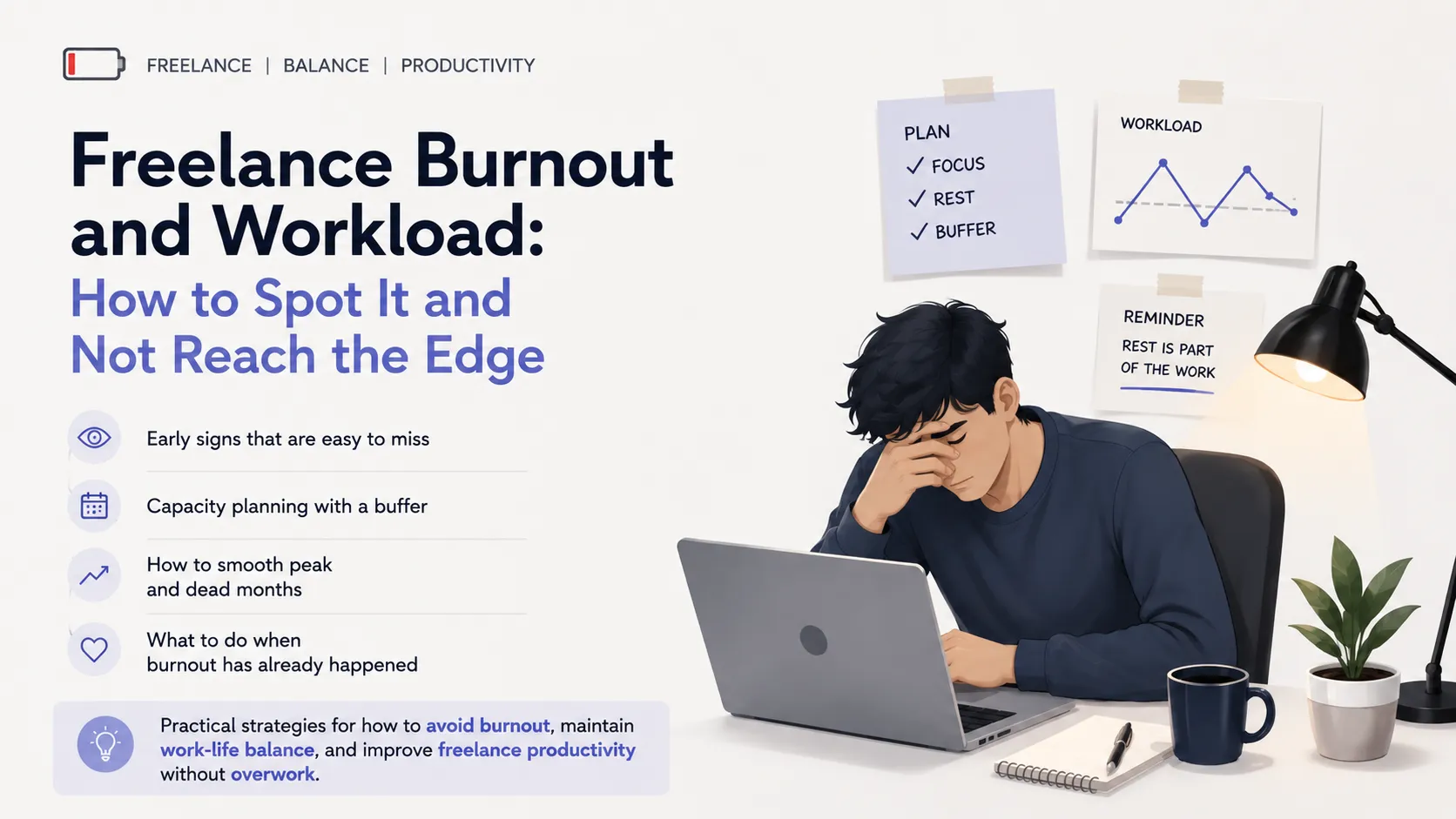
Freelance burnout rarely looks dramatic. It looks like this: you open the project file, stare at it for twenty minutes and close it. Work that used to take an hour now takes a day. A message from a client irritates you before you have read it. And you are not idle — you are working, quite a lot in fact, it just costs more effort every week.
The central mistake at this point is treating it as a personal weakness and trying to "pull yourself together." Freelance burnout almost always has structural causes: the way the work is organized makes it inevitable. The good news is that structure can be changed.
Why Freelancing Burns You Out Differently
Employment comes with external boundaries: the day ends, tasks arrive through a manager, holidays are paid. Freelancing requires building all of those yourself — and until you do, they do not exist.
- No boundary between work and life. The workplace is home, messages arrive at 11pm, "just a quick look on Sunday."
- Uneven income keeps you permanently anxious: in a month with three projects you are afraid to decline, because the next one might be empty.
- Everything is on you. Not only the work but sales, negotiation, paperwork, learning, and being your own IT support.
- No team. Nobody to split a task with, nobody to hand it to, nobody to say "that deadline is unreasonable."
- Fear of declining turns every peak into overload: three yeses in a row and you live in deadlines for a month.
- No paid pause. Sick means not earning, which builds the habit of working through everything.
- A blurred sense of completion. A project with endless revisions never ends, it drags — and psychologically you never "delivered."
Freelance burnout is almost never about the number of hours. It is about the absence of boundaries and predictability.
Early Signs That Are Easy to Miss
Worth catching before it is late. The typical sequence:
- Chronic tiredness that a weekend does not fix. The first and most important marker.
- Procrastination on easy tasks. You cannot start something that takes fifteen minutes.
- Irritation at clients — even at reasonable questions.
- Work has slowed at the same volume.
- No satisfaction from results. You delivered something good and felt nothing.
- You avoid email and messengers. You postpone checking because there is bound to be something unpleasant.
- Curiosity about the profession is gone. You read nothing new, you have no urge to try tools.
- Disturbed sleep and background anxiety about unfinished tasks.
- Cynicism about the work in general: "nobody cares," "it won't be appreciated anyway."
Recognizing three or four of these means it is no longer tiredness but a process that will not stop on its own.
Capacity Planning: How Many Projects Are Realistic
The main arithmetic error is counting workload in hours of work while forgetting everything else.
- Plan no more than 70% of your working time. The rest goes to communication, revisions, sales, admin and the unforeseen. That is not a "just in case" reserve — it is what will happen.
- Keep few projects active in parallel. Each extra project adds not only hours but context switching: approvals, calls, holding someone else's requirements in your head. Two projects in active phase plus one waiting on feedback is a typical ceiling for one person.
- Space out deadlines. Three deliveries in one week guarantees a crunch even when the total volume is fine.
- Add a buffer to each project, not "on average." A client being late with materials always happens — the only question is which project.
- Keep one day free of meetings. A day of uninterrupted work produces more than three days sliced by calls.
- Count revisions as work. A project does not end at delivery — two rounds are still ahead and they belong in the calendar. How to bound them is in Handling revisions.
Peaks and Dead Periods
Unevenness is built into freelancing, and it is what makes people take on too much. What helps:
- A financial cushion is the main defense against the fear of declining. Without one you are forced to say yes to everything, and that is exactly what creates the overload cycle.
- Retainers and packages give a predictable base. One or two ongoing clients remove half the anxiety — pricing models are covered in How to price your work.
- Do not stop looking for clients during busy months. A dead period two months from now is the consequence of doing nothing about future work during a peak.
- Use the quiet properly. It is time for portfolio, profile, articles and learning — the things that bring clients later. Not for panic.
- Raise your rate instead of taking more projects. It is the only form of growth that does not scale your hours.
Boundaries You Have to State Explicitly
Nobody will set them for you, and clients are not at fault: they work within the frame you gave them.
- Working hours — state them in the first conversation. Silence reads as "available always."
- One communication channel. Tasks across three messengers is not flexibility, it is chaos.
- A realistic response time. "I reply within the working day" is perfectly normal and loses no clients.
- Weekends. One reply on a Sunday sets the expectation for every following Sunday.
- A physical boundary. A separate desk, a separate computer profile, notifications off after a certain hour — anything that marks "work has ended."
- The right to be offline. You sell an outcome, not constant presence.
The most useful boundary is declining. Every extra project costs not only time but quality on everything else. How to do it cleanly is in How to turn down a project.
What if I can't decline because I need the money now?
That is a real situation, and "just say no" does not help. What does:
Short term: take the project but move the start honestly — "I can take it beginning in two weeks." Clients accept that far more often than expected, and you avoid adding work to an overloaded week.
Medium term: charge for urgency. If the job needs your evenings to hit a tight deadline, that should be paid separately — then at least the overload is compensated.
Structurally: the goal is to get out of the mode where every refusal is financially painful. That means a cushion and at least one recurring client. Until then, you are operating in a way that ends in burnout sooner or later, regardless of willpower.
What to Do Once Burnout Has Happened
In order, from fastest to structural.
Immediately:
- Stop taking new projects. Not forever — for a few weeks.
- Write an honest list of commitments and deadlines. Anxiety from uncertainty is often heavier than the work itself.
- Tell clients about realistic dates if they need to move. In advance — and it is almost always received calmly.
- Take a pause. Even a few days help, if you genuinely do not work during them.
Over the coming weeks:
- Remove the most toxic project or client. One of them often produces most of the strain.
- Restore a rhythm: sleep, a fixed start and end to the day, weekends without work.
- Lower the bar during recovery: "good enough" instead of "perfect."
Structurally:
- Review your rates. Burnout is often simply too many hours for too little money.
- Change your client mix: fewer one-off tasks, more predictable ones.
- Automate routine: templates for emails, briefs, agreements, delivery checklists. Some drafting can go to AI — see AI for freelancers.
- Find a professional environment. Isolation is its own burnout factor, and it is treated by talking to peers.
If the state persists for weeks and affects sleep and physical health, this is no longer a question of work organization. Seeing a professional is appropriate, and entirely unremarkable.
The Routine That Keeps You Level
A few habits that cost little and work continuously:
- A weekly review. Twenty minutes on Friday: what is done, what is urgent, what we take next week.
- Plan by the week, not the day. A day is too short to reveal overload — a week shows it.
- Templates. Brief, agreement, delivery checklist, standard replies. Each template saves not only time but decisions.
- Recorded agreements. Half of freelance anxiety comes from uncertainty about what was actually agreed. See Client agreements.
- One full day off. Not "no tasks, but I'll check email."
- Write down what you finished. Freelancing has no department and no manager to say "you did a lot" — you have to produce that effect yourself. Written-up portfolio cases do it twice over: they work for you and they show you your own progress.
Common Mistakes
- Counting workload only in hours of work. Communication, revisions and sales are work too.
- Filling the calendar to 100%. Any delay turns the week into a crunch.
- Taking a project "just in case." Fear of an empty month creates an overloaded one.
- Undercutting on price. Lower rates mean more projects for the same money and faster burnout.
- Working through weekends during a peak and assuming it is temporary. Peaks are temporary; habits are not.
- Having no cushion. Without one, declining becomes financially impossible.
- Ignoring early signs. Tiredness that does not lift will not "pass on its own."
- Confusing burnout with laziness. Different states, and "pulling yourself together" does not work on burnout.
Key Takeaways
- Freelance burnout is structural: no boundaries, uneven income, everything resting on one person.
- Early signs: tiredness that survives rest, procrastination on easy work, irritation, no satisfaction from results.
- Plan at most 70% of your time; the rest goes to communication, revisions and the unforeseen.
- Space out deadlines and keep parallel active projects to a minimum.
- A cushion and retainers remove the fear of declining — the main source of overload.
- Boundaries (hours, channel, weekends) must be stated: silence reads as round-the-clock availability.
- Undercutting leads directly to burnout: more work for the same money.
- If the state persists for weeks, it is no longer a work-organization question.
FAQ
How do I tell burnout from ordinary tiredness?
Tiredness lifts after a weekend; burnout does not. Characteristic signs: procrastination on simple tasks, irritation at routine client questions, no satisfaction from good results, avoiding email and messages, cynicism about the work. Recognizing three or four of these over a period of weeks means it is a process that will not stop by itself.
How many projects can I run in parallel?
Not many: each additional project adds not only hours but context switching — approvals, calls, holding someone else's requirements in mind. A working benchmark for one person is two projects in active phase plus one awaiting feedback. More important than the count is spacing deadlines: three deliveries in one week creates a crunch even at a normal total volume.
How do I plan workload without missing deadlines?
Plan at most 70% of your working time and leave the rest for communication, revisions, sales and the unforeseen — that is not a reserve but what will certainly happen. Add a buffer to each project individually, put revisions in the calendar as work, and keep at least one day a week free of meetings.
What should I do if burnout has already set in?
First stop taking new projects and write an honest list of commitments — uncertainty drains more than the work does. Then remove the most toxic project, restore sleep and fixed day boundaries. Structurally: review your rates and client mix, since the cause is often too many hours for too little money. If the state persists for weeks and affects sleep and health, see a professional.
What to Do Next
Calculate your real workload for the next two weeks — all projects, revisions, calls and admin. If it exceeds 70% of your working time, you are already in deficit, and the next delay will turn it into a crunch.
Then pick one boundary to set this week: working hours, a single channel, or one day off. One boundary works better than ten plans. And check your rates — burnout is often cured not by rest but by recalculating your rate using the method in How to price your work.
Ready to act?
- Update your profile and add a project: https://searchtalent.dev/en/projects/new
- Talent catalog: https://searchtalent.dev/en/talents
- Browse other specialists' projects: https://searchtalent.dev/en/projects
- More articles: https://searchtalent.dev/en/articles