
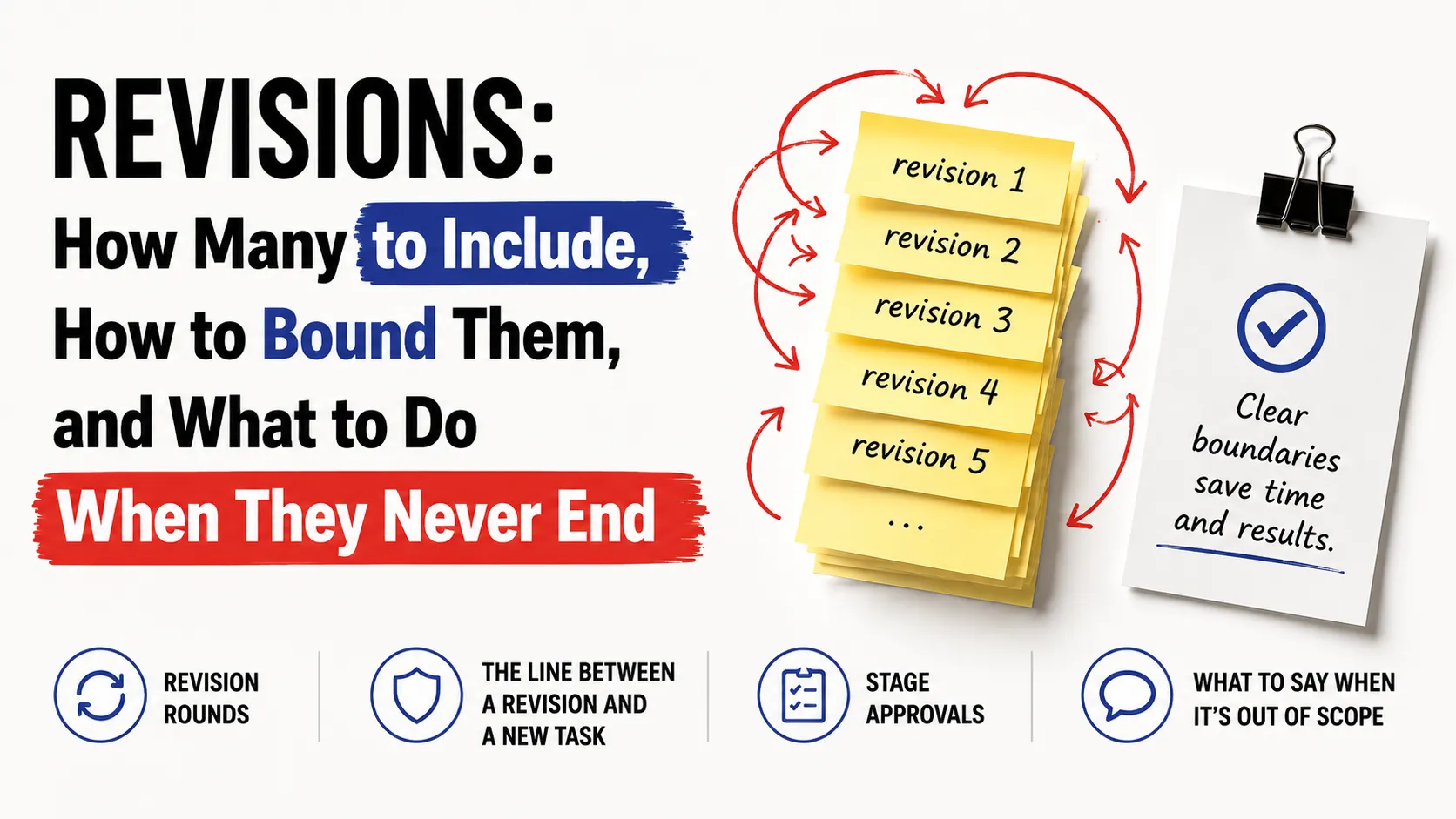
Revisions are not a sign of bad work. They are a normal part of the process: the client sees the result for the first time and only then works out what they actually wanted. The problem is not revisions but their boundlessness — the eighth wave of comments arriving two weeks after delivery, with the project still formally unfinished.
That situation is almost never created by client malice. It comes from the absence of two things: a boundary (how many revisions are included) and a completion criterion (by what signs the work counts as done). Without them the process has no natural end, and so it does not end.
Below: why endless revisions happen, how to build a process with few of them, and how to stop the flow properly once it has started.
Why Revisions Become Endless
The causes are almost always structural rather than personal.
- No written agreement on the count. If "two rounds" was never said, the default is "until the client is happy."
- No completion criteria. "Done" with no defining signs is a matter of mood, and moods change.
- Feedback at the wrong stage. Debating structure after the final polish is rework, not revision.
- A committee. Five people with different opinions generate mutually exclusive comments indefinitely.
- Late feedback. The client was silent for two weeks, then arrived with a long list — and you have lost context.
- The client does not know what they want. Then revisions are actually requirements-gathering, and that belongs in a separate paid stage.
- The specialist opens the door. "Just message me if anything needs adjusting" sounds polite and reads as "revisions are unlimited."
Endless revisions are not a client personality problem. They are the consequence of a process that never defined when the work ends.
How Many Rounds to Include
The working standard for most digital work is two rounds of revisions included in the price.
- Round 1 — substantive: structure, approach, key decisions.
- Round 2 — final refinement of details.
- Beyond that — billed separately, usually hourly.
The number matters less than the fact that it was named. Three rounds is fine too; what is not fine is saying nothing. And separately: budget hours for those rounds when estimating. Revisions and communication are real time that people routinely forget to count — see How to price your work.
Wording worth having in your agreement:
"The price includes two rounds of revisions. A round is one consolidated list of comments. Changes outside the agreed spec are estimated separately. Additional rounds are billed at an hourly rate."
The phrase "a round is one consolidated list" solves half the problem: without it, ten separate messages across a day technically count as ten revisions and practically as one mess.
Where a Revision Ends and a New Task Begins
The most important distinction, and it is simple.
A revision is when the result does not match what was agreed: the spec called for a three-field form and two were built; the copy was to be formal and came out conversational; the color is not from the brand guide.
A new task is when the result matches what was agreed but the client wants something different: "let's add another section," "we changed our mind, different style," "can we also get a stories version?"
The first is fixed within scope at no extra charge. The second gets its own time and cost estimate. That is not greed, it is arithmetic: a new requirement is new hours.
The gray zone is a vague spec. Be honest there: if the wording allowed two readings, split the cost or do it once for free while recording the clarification in writing. Then draw the lesson for the next spec — how to write one is in How to write a brief.
A Process With Few Revisions
The number of revisions is set by how the work is structured, not by the client's temperament. A well-built process cuts them dramatically.
- Approve stage by stage, not at the end. Concept → draft → final. Each stage is approved separately.
- Never move to the next stage without confirming the previous one. The central rule. An approved structure means nobody returns to it during the polish stage.
- Show work before it is "finished." A draft at 40% costs you an hour and saves days: fundamental disagreements surface while they are still cheap to fix.
- Record approvals in writing. One message — "structure approved, moving to design" — is the criterion you will point to later.
- Bound the feedback window. "Comments expected within 3 working days, after which the stage is considered approved" is standard and entirely polite practice.
- Ask for one point of contact. If a group decides, have one person consolidate comments — otherwise you get contradictory requirements.
How to Ask for Feedback
The quality of revisions depends heavily on how you requested them. A silent "here's the file, let me know what you think" guarantees vague comments.
- Ask specific questions. "Is the tone right?" and "are all the sections present?" beat "what do you think?"
- State what is under discussion and what is not. "At this stage we're looking at structure; colors and type come next" prevents premature revisions.
- Request a consolidated list. "Please gather all comments into one list so I can address them in a single pass."
- Set a date. With no feedback deadline the project stalls, and somehow the specialist ends up at fault.
- Ask for the problem, not the solution. "Something's off with the headline" is more useful than "make the headline blue": clients describe symptoms well, and the fix is your part of the job.
What to Say When Requests Go Out of Scope
Wording decides everything: the same content can read as a refusal or as normal procedure. A few working scripts.
A new requirement:
"Yes, that's doable. It's outside the agreed scope — about N hours, so +X to the price and +2 days to the deadline. Confirm and I'll start."
Rounds exhausted:
"We've been through both revision rounds included in the price. Further work is billed hourly at X — shall I send an estimate for your list?"
Reopening an approved stage:
"We approved the structure on the 12th, and the design was built on it. We can change it, but that means reworking the section — here's what that takes."
"Can we see another option?"
"I can produce an alternative version — that's separate work of N hours. Or we can refine the current one within this round: tell me what specifically isn't working in it."
A vague comment:
"So I make exactly the right change: what isn't working here — the tone, the structure or the wording? What should it feel closer to?"
The tone is what matters. You are not arguing or refusing: you are offering an option and naming its cost. The client keeps the choice, and that defuses the conflict.
What if the client insists it is "a tiny thing, five minutes"?
Often it genuinely is five minutes — and then there is no reason not to do it. Small concessions are normal and build the relationship; the problem starts when there are ten of them and each is "five minutes."
The working tactic is to count in aggregate rather than per item: "Individually it is quick. But this week those small items have added up to N hours — let me consolidate them into one list and estimate them together." That moves the conversation from emotion to arithmetic and is almost always received calmly.
And second: if you do small things for free, say so out loud. "Did that as a goodwill extra, outside scope" costs nothing and prevents the impression that scope is infinite.
When the Revisions Are Your Fault
Honesty runs both ways. Signs the client is not the problem:
- You asked no questions at the start and built on your own assumption.
- You skipped an approval stage and showed the final straight away.
- You did not read the brief carefully and built something that was not requested.
- You went silent during the work, and the client saw the result for the first time at the end.
- You said "just message me if anything needs adjusting" — and got exactly that.
In those cases, fix them without any conversation about extra payment. It is not only ethical but profitable: reputation costs more than a few hours.
Common Mistakes
- Not naming a number of rounds. By default the client hears "unlimited."
- Accepting revisions across four channels. Some get lost, and you will be blamed.
- Acting on every message immediately. Expensive and chaotic: wait for the consolidated list.
- Showing the final first. A guarantee of major rework if the direction was misjudged.
- Silently accepting new requirements. The project becomes unprofitable invisibly.
- Arguing instead of quoting. "That's not included" is a dead end; "that's +N hours" is a negotiation.
- Not recording stage approvals. Nothing to point to when settled matters reopen.
- No feedback deadline. The project stalls for months.
- Enduring endless revisions to avoid conflict. It does not save the relationship — it destroys it and your income.
Key Takeaways
- Revisions are normal; boundlessness is not, and it comes from a missing limit and completion criterion.
- The standard is two rounds in the price, with a round defined as one consolidated list.
- A revision is a mismatch with what was agreed; a new wish is a separate task with its own estimate.
- Approve stage by stage and never proceed without written confirmation.
- Show a draft early: disagreements are cheaper to find at 40% completion.
- Bound the feedback window and ask for one consolidated list from one person.
- Do not argue — quote time and cost, and leave the client the choice.
- If the cause is that you did not ask or did not show in time, the revisions are on you.
FAQ
How many revision rounds should be included in the price?
The working standard for most digital work is two: the first substantive (structure and approach), the second for details. More important than the number is that it is stated in the agreement, and that a round is defined — one consolidated list of comments rather than a stream of separate messages. Additional rounds are usually billed hourly.
How do I tell a revision from a new task?
A revision is when the result does not match what was agreed in writing: the spec said one thing, the delivery is another. A new task is when the result matches the agreement but the client now wants something different or additional. The first is fixed at no charge; the second gets its own time and cost estimate. If the spec allowed two readings, that is a gray zone — splitting the cost is the fair move.
What do I do when revisions never end?
Stop the flow and give it structure: ask for a consolidated list instead of individual messages, state which included rounds are already used, and estimate the remaining comments in hours and cost. "I can do that, it's +N hours and +X" works better than "that's not included," because it leaves the client a choice and does not read as a refusal.
How do I reduce revisions before they happen?
Approve the work in stages and never proceed without written confirmation of the previous one. Show a draft early rather than the final; state clearly what is under discussion now and what comes later; ask for one consolidated list from one point of contact and set a feedback deadline. That reduces revisions more effectively than any contractual limit.
What to Do Next
Add three lines to your standard agreement: the number of rounds, the definition of a round ("one consolidated list"), and a sentence saying changes outside the spec are estimated separately. The cheapest process change available.
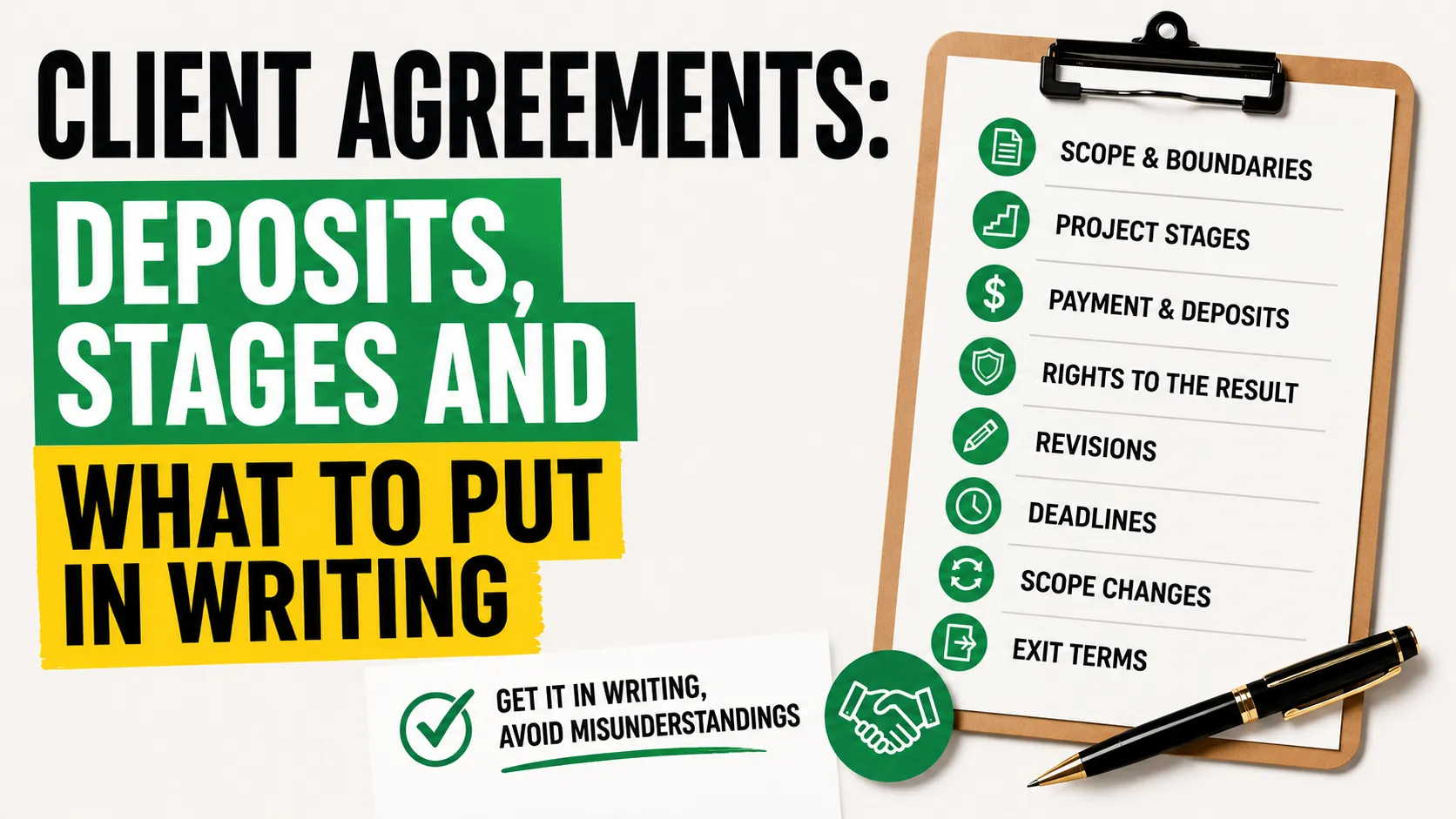
Then restructure how you present work: split the project into stages with written approval at each. The rest of the terms — payment, rights, deadlines — are collected in Client agreements, and from the client's side the same process looks like accepting delivered work.
Ready to act?
- Update your profile and add a project: https://searchtalent.dev/en/projects/new
- Talent catalog: https://searchtalent.dev/en/talents
- Browse other specialists' projects: https://searchtalent.dev/en/projects
- More articles: https://searchtalent.dev/en/articles