
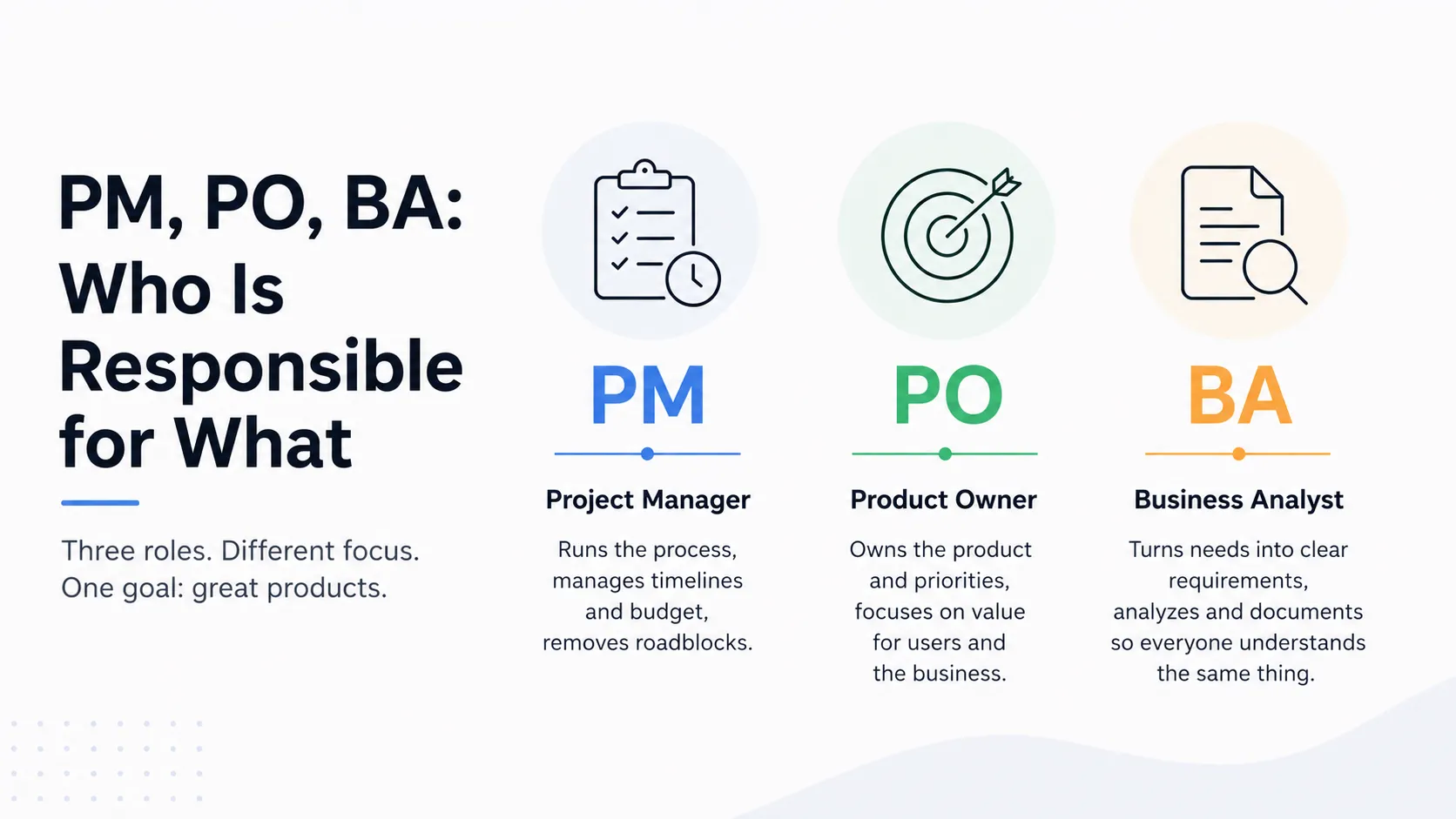
Teams building digital products contain three roles with no code and no mockups: Project Manager, Product Owner and Business Analyst. They get confused constantly — by clients who cannot tell what they are paying for, by newcomers choosing a direction, and even by companies where these titles mean different things.
The shortest distinction is this:
- The PM is responsible for the project getting done — on time, on budget, without chaos.
- The PO is responsible for the right thing getting done — what users and the business actually need.
- The BA is responsible for everyone understanding the same thing by "what needs to be done."
Below: what each does day to day, where the roles overlap, which one your project needs, and what to show in a portfolio if you want to work in one of them.
Project Manager: Process, Deadlines, Risks
The PM's core question: "Are we on track, and what's blocking us?"
This is the delivery role. A PM does not decide what should be built — they make sure the agreed thing is built on time and without derailment.
Day-to-day work:
- Planning. Break work into stages, estimate with the team, build a schedule.
- Coordination. Who is doing what right now, who is waiting on whom, where things are stuck.
- Risk. Spotting a problem before it becomes a slip: someone is ill, a contractor is late, scope has grown.
- Stakeholder communication. Regular status, bad news on time rather than good news late.
- Budget and resources. What has been spent, whether we fit, whether more people are needed.
- Removing obstacles. A large part of the job is taking blockers off the team's plate.
Accountable for: schedule, budget, predictability, quality of process.
Key skills: organization, communication, the ability to have difficult conversations, risk management, and enough technical grounding to judge feasibility rather than write code.
Product Owner: Value and Priorities
The PO's core question: "What do we build next, and why?"
This is the direction role. A PO works with substance rather than schedule: which features are needed, in what order, what creates value, and what should not be built at all.
The work:
- Product vision — where we are going and for whom.
- The backlog — an ordered list of what to build, with reasons attached.
- Prioritization. The hardest and most important part: saying "no" or "later" to most ideas.
- Working with users and data. What people actually do in the product, where they drop off, what they ask for.
- Framing tasks for the team at the level of "which problem we're solving" rather than "how to implement it."
- Accepting results from a value standpoint: does this solve the user's problem?
Accountable for: what gets built being worth building. The PO is who you ask when a product shipped on time, on budget, and nobody needed it.
Key skills: understanding of business and users, analytics, the ability to refuse, hypothesis-driven thinking, stakeholder communication.
Business Analyst: Requirements and Detail
The BA's core question: "What exactly does that mean?"
This is the precision role. The BA stands between a wish ("we want a customer account area") and a task the team can execute without guessing.
The work:
- Requirements gathering — stakeholder interviews, clarifying questions, surfacing contradictions.
- Requirements documentation — user scenarios, rules, states, exceptions. This is where "what happens if…" gets answered.
- Process description — how things work now and how they should work after the change.
- Data and systems analysis — which systems are involved, where data comes from, what integrates with what.
- Documentation that development, testing and acceptance later rely on.
- Supporting the team — answering requirement questions throughout development.
Accountable for: no ambiguity. The most expensive mistakes in projects are not bugs but building the wrong thing; the BA exists to prevent that.
Key skills: structured thinking, attention to detail, question-asking, written clarity, understanding of systems and data.
One Comparison Table
PMPOBACore questionAre we on track?What and why?What exactly does this mean?FocusprocessvaluerequirementsAccountable forschedule and budgetbusiness outcomeprecision of definitionArtifactsplan, schedule, status, risksbacklog, priorities, metricsrequirements, scenarios, process diagramsTheir key "no""we can't fit that in""we're not building that""that isn't defined, let's clarify"
What about a Scrum Master — how is that different from a PM?
A Scrum Master is a role from one specific way of organizing work, and it is narrower than a PM. Its purpose is to help the team work within the chosen process: running the regular meetings, removing impediments, keeping the agreed rules alive.
The main difference: a PM is usually accountable to the client for the project outcome — schedule, budget, scope. A Scrum Master is accountable for the effectiveness of the team's process and is not the project's "boss." In many companies one person does both, which is where the confusion starts.
Where the Roles Overlap
In practice the boundaries are rarely clean, and that is normal.
- PM and PO. In client project work, a PM often covers part of the PO's function: agreeing scope, prioritizing with the client. In product companies the split is stricter.
- PO and BA. The PO says what we build and why; the BA describes how exactly it should behave. In small teams one person does both.
- PM and BA. Both write a lot and clarify a lot, but the PM writes about process and the BA about the product.
- In small teams all of it can be one person — often the product owner in the literal sense, or the client. Then the question is not the job title but whether all three functions are covered: schedule, substance and precision.
This is why identical titles mean different things at different companies. When choosing a job or a contractor, look at the list of responsibilities, not the label.
Which Role Your Project Needs: The Client's View
- A small one-off task (a landing page, a set of clips, a few screens). No dedicated roles needed — a clear brief from you is enough. How to write one is in How to write a brief.
- A project with several contributors and deadlines. You need a PM, or that function inside your contractor. Without it, coordination lands on you.
- A product under continuous development. You need a PO — someone has to decide what comes next and why.
- Complex logic, integrations, many scenarios. You need a BA, or at least someone who formally writes requirements down. Without that you pay for rework.
- You cover some of these functions yourself — that is fine, but budget your time for it: answering the team's questions is work too.
A simple test: if nobody on the project can answer "what should happen if a user does X?", you are missing the BA function. If nobody knows the release date and the blockers, the PM function. If everyone is doing everything at once and nothing finishes, the PO function.
How to Get Into These Roles and What to Show
These professions differ from design or development in one way: you have no visual portfolio. There is no mockup or clip to show. So you have to show something else.
Where people come from. PMs from administrative, coordination and client-facing roles, from testing, from adjacent fields with project work. BAs from analytics, support, data work, sometimes testing. POs usually from BA, marketing, analytics, or deep domain expertise.
What to show instead of a portfolio:
- A case in "situation → what I did → outcome" form. Not "managed projects" but "the project was slipping due to vague requirements — I introduced a scenario description format and rework dropped noticeably."
- Artifacts you can anonymize. A process diagram, a sample requirements write-up, a backlog structure, a status report template — with no client names or sensitive data.
- A study case. Take a public product and write up: which problem you see, how you would prioritize, how you would specify one feature. A full demonstration of thinking.
- Public writing. A process breakdown, an article about your experience, an explanation of your approach — for these roles written clarity is the core skill, so text works as a direct portfolio.
- References. They matter more here than in any other role: what is being assessed is how you work with people.
How to build cases as "task → solution → outcome" generally is in How to make a portfolio; if you have no commercial experience yet, the approach is in Portfolio with no experience.
Myths and Common Mistakes
- "A PM is the person who chases everyone." The main job is removing obstacles, not reminding people about deadlines.
- "A PO is the team's boss." A PO sets direction rather than managing people.
- "A BA just writes documents." A BA surfaces contradictions in requirements — exactly what would otherwise become rework.
- "Small projects don't need these roles." They need the functions, not the job titles: someone still owns schedule, substance and precision.
- "These are non-technical roles." All three need technical context — not to write code but to judge feasibility and ask the right questions.
- "The job title explains everything." The same title hides different duties at different companies; always read the responsibilities.
- "You can't get into tech without coding." The most common misconception among career changers: analysis and management are entirely viable entry points.
Key Takeaways
- The PM owns schedule and process, the PO owns value and priorities, the BA owns precision of requirements.
- Their core questions: "are we on track," "what and why," "what exactly does this mean."
- In small teams the roles merge — what matters is the functions, not the titles.
- The same title means different things at different companies: read the responsibilities.
- Clients need a PM with multiple contributors, a PO for an evolving product, a BA for complex logic.
- If nobody can say what happens in an edge case, the BA function is missing.
- These roles have no visual portfolio: they show cases, anonymized artifacts and writing.
FAQ
What is the difference between a Project Manager and a Product Owner?
A PM is responsible for the project being delivered on time, on budget and without chaos — their domain is schedule, risk and coordination. A PO is responsible for the right thing being built: they decide which features are needed and in what order, based on user and business needs. Put simply, the PM runs the process and the PO defines the substance.
What is a business analyst and why is one needed?
A BA turns a client's wishes into requirements the team can execute without guessing: gathering information, surfacing contradictions, describing scenarios, rules and exceptions. They are needed wherever the logic is complex or several systems are involved. The most expensive project mistakes are not bugs but building the wrong thing, and that is precisely what a BA prevents.
Can one person cover all three roles?
Yes, and in small teams it is routine: one person runs the schedule, the priorities and the requirements at once. The problem appears at scale — prioritization and detailed specification demand different kinds of attention, and at volume one person becomes the bottleneck. What matters is that all three functions are covered, even with fewer job titles.
Can I get into tech through these roles without programming?
Yes, it is one of the realistic career-change routes. PMs typically come from coordination, administrative and client-facing roles, BAs from analytics, support or data work, POs from BA, marketing or domain expertise. Technical context is needed, but at the level of understanding rather than writing code.
What to Do Next
If you are choosing a direction, look past the titles at the daily work: some people prefer holding process and people together, some prefer digging into logic and writing requirements, some prefer deciding what comes next. Three different kinds of work, and the affinity is usually obvious quickly.
If you are a client, test your project with three questions: does anyone know the schedule and the blockers, does anyone decide priorities, is edge-case behavior written down? A gap in any of the three is the role you are missing. To see how specialists in these fields present their experience, browse the talent catalog and the project feed.
Ready to act?
- Talent catalog: https://searchtalent.dev/en/talents
- Browse specialists' projects: https://searchtalent.dev/en/projects
- Skills and technologies catalog: https://searchtalent.dev/en/talents/skill
- More articles: https://searchtalent.dev/en/articles