
When a beginner first hears that "design patterns are interview basics," it sounds like something complex and academic. In reality, design patterns are simply time-tested recipes for common situations in code. In this article we will unpack what design patterns are in plain words, why they matter, which kinds exist, and when a pattern only causes harm.
What Design Patterns Are, in Plain Words
Design patterns are typical, time-tested ways to solve common problems in software architecture. They are not ready-made code you copy, but rather an idea — a solution blueprint that you adapt to your task.
An analogy: a soup recipe is a pattern. It describes an approach, but everyone cooks with their own ingredients. Likewise, a pattern describes the structure of a solution, and the specific implementation is yours.
Why Patterns Matter
- A shared language. Saying "this is an Observer here" is faster and more precise than explaining the implementation in a paragraph.
- Proven solutions. No need to reinvent the wheel — the problem was solved before you.
- Maintainability. Code built on known patterns is easier for a team to read and evolve.
- Interviews. Patterns are a classic technical-interview topic, especially at middle+ levels.
Three Groups of Patterns (the GoF Classification)
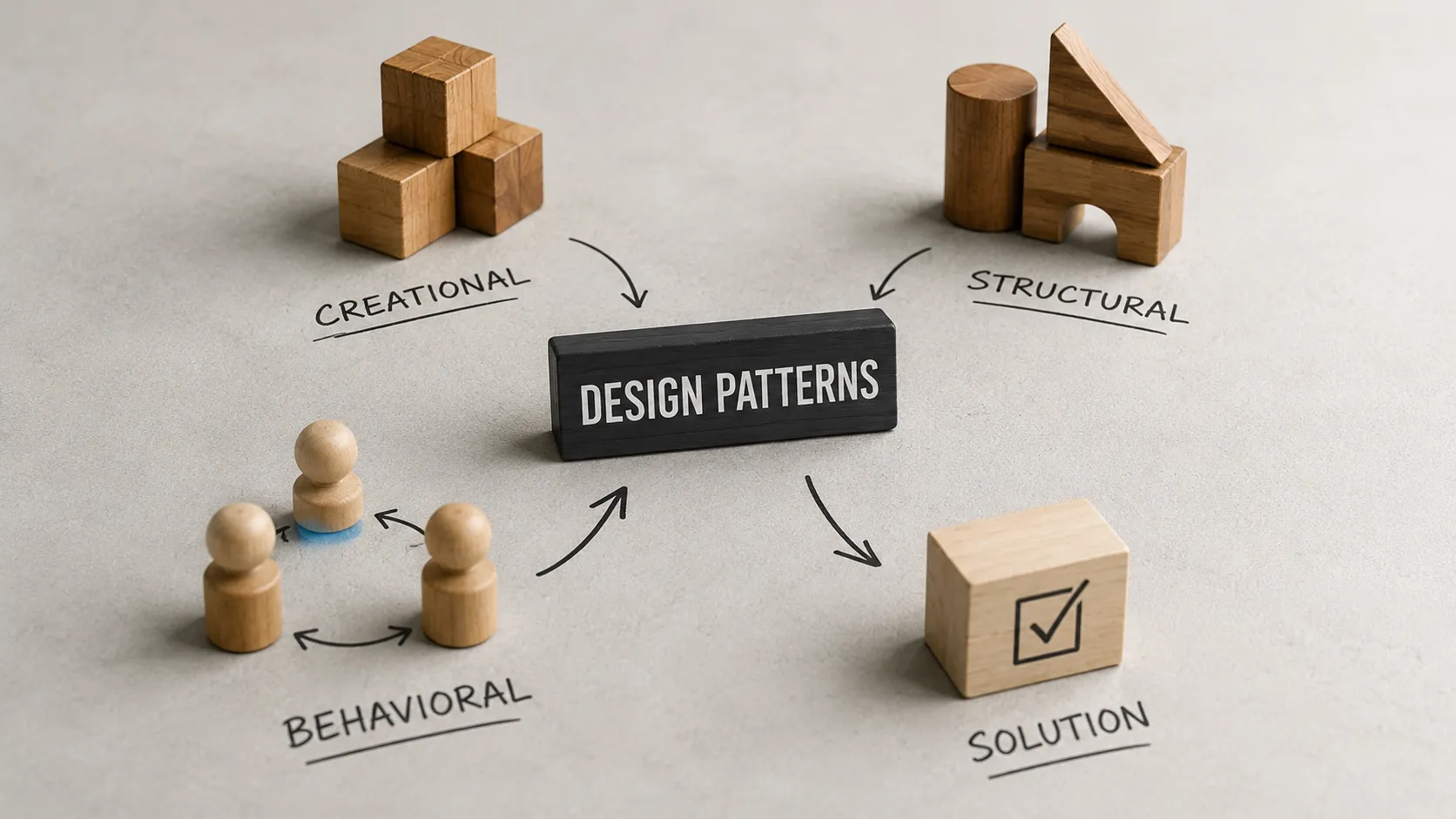
The canonical "Gang of Four" (GoF) book splits patterns into three groups:
- Creational — about how to create objects. Examples: Singleton, Factory Method, Builder.
- Structural — about how to assemble objects into larger structures. Examples: Adapter, Decorator, Facade.
- Behavioral — about how objects interact and share responsibilities. Examples: Observer, Strategy, Command.
Examples of Popular Patterns
- Singleton — guarantees a class has only one instance (for example, a single config connection).
- Factory — creates objects without tying your code to concrete classes.
- Observer — objects subscribe to events and react to changes (the basis of reactivity in interfaces).
- Strategy — lets you swap an algorithm "on the fly" without rewriting the surrounding code.
Do not try to learn all 23 at once — start with these four; they appear most often.
When a Pattern Only Does Harm
The most common beginner mistake is "a pattern for the pattern's sake." If the task is simple and you stretch three layers of abstraction over it, the code becomes more complex than the problem it solves.
The rule is simple: a pattern should simplify the understanding and maintenance of code. If things got more tangled after you introduced it, the pattern does not belong here.
How to Learn Design Patterns
- Understand the problem each pattern solves, not just its name.
- Find an example in real code (frameworks are literally built on patterns).
- Try implementing a pattern yourself in a small side project.
- Explain the pattern out loud as if to a colleague — if you can, you understand it.
FAQ
How many design patterns are there? The classic GoF book describes 23 patterns. In practice, only a subset is used regularly — start with the most common ones.
Does a junior need patterns? Deeply, no — but understanding the basics (Singleton, Factory, Observer, Strategy) is useful from the start: they come up often and appear in code.
Do patterns depend on the programming language? The idea of patterns is universal, but the implementation differs. In some languages certain patterns are built into the syntax, so they look different.
Ready to act?
- Project technologies: https://searchtalent.dev/en/projects/tag
- Skill and technology directory: https://searchtalent.dev/en/talents/skill
- Create your own portfolio: https://searchtalent.dev/en/projects/new