
Almost every app you use — from your bank to your favourite social network — remembers something about you. Behind that "memory" sit a database and a DBMS. In this article we will unpack what a database and a DBMS are in plain words, how they differ, which kinds of databases exist, why the SQL language matters, and where a beginner should start.
What a Database Is, in Plain Words
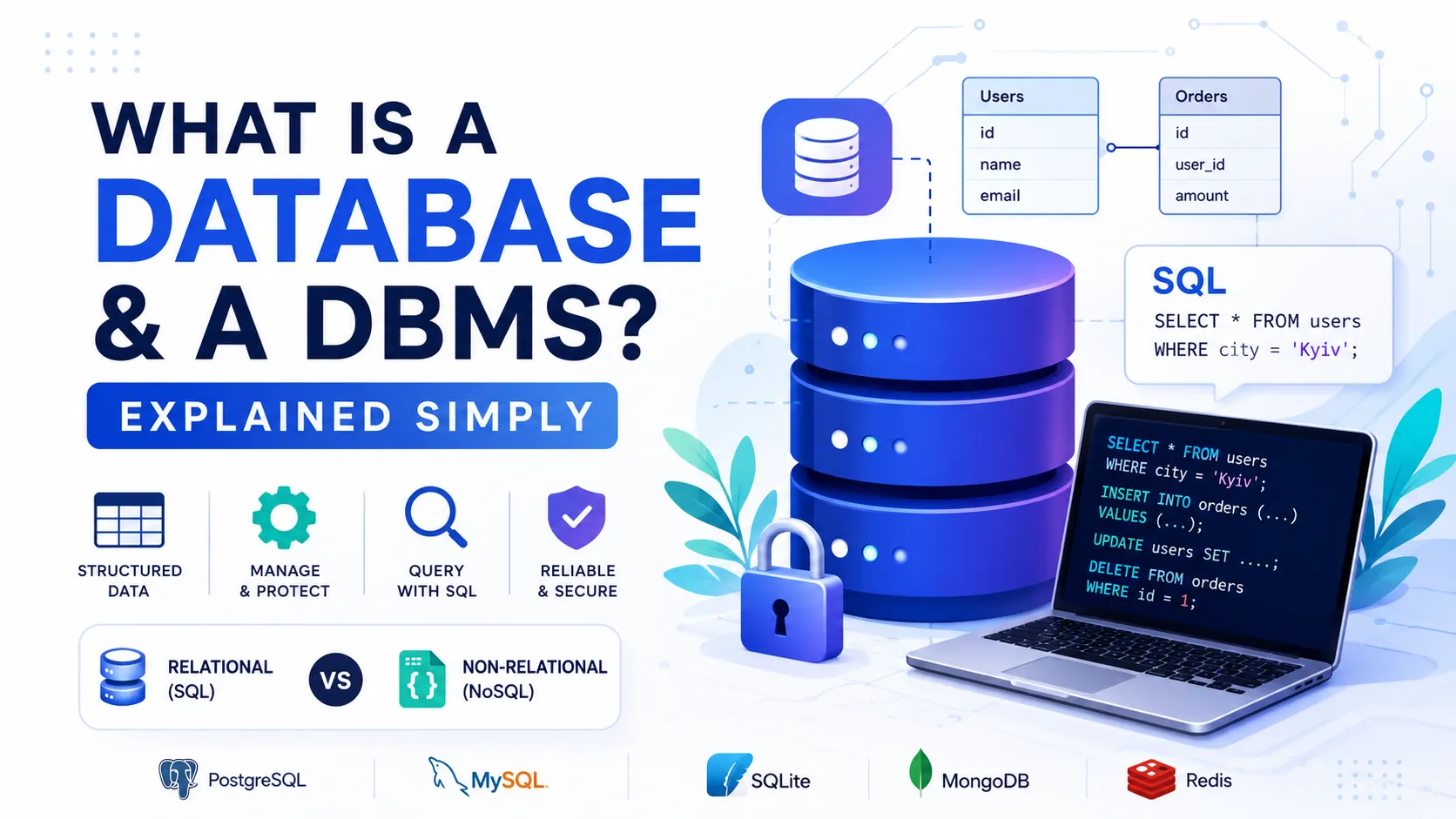
A database is an organized store of information that lets you retrieve the data you need quickly and reliably.
Picture a large card catalogue in a library: the cards are arranged in a specific order, so the librarian finds a book in seconds instead of scanning every shelf. A database is the same catalogue — only digital and thousands of times faster.
Data is kept in a structured way: all users in one table, all their orders in another, and a relationship that records who ordered what. It is this structure that separates a database from a plain file or an Excel sheet.
What a DBMS Is and How It Differs from a Database
These are two different things that people often mix up:
- A database is the data itself and its structure (tables, relationships).
- A DBMS (Database Management System) is the program that manages that data: it adds, searches, updates, deletes, and enforces integrity and access.
A simple analogy: the database is the contents of a warehouse, and the DBMS is the storekeeper who knows where everything is, hands out goods on request, and won't let you take more than you should. When someone says "we set up PostgreSQL," they mean the DBMS; the data inside it is a specific database.
Relational vs Non-Relational: SQL vs NoSQL
The most important split among databases is into two big camps.
- Relational (SQL) — data lives in tables of columns and rows, and tables link to one another. This is the classic choice for most business applications.
- Non-relational (NoSQL) — data is stored more flexibly: as documents, key-value pairs, or graphs. Handy where the structure changes often or where you need huge scale and speed.
SQL vs NoSQL — when to choose which
Choose a relational database when the data has a clear structure and many relationships (users, orders, payments) and accuracy matters above all: banks, shops, accounting.
Choose NoSQL when the data structure is unstable or hard to predict (logs, events, profiles with varying fields) and scale and read speed come first.
In practice, large products often use both at once — each database type for the job it fits best. So it is not "either-or," but a question of matching the tool to the task.
The SQL Language: How You "Talk" to a Database
To read or change data in a relational database, you address it in SQL (Structured Query Language). It is remarkably readable — a query looks almost like an English sentence:
SELECT— read data ("show me all users from Kyiv").INSERT— add a new record.UPDATE— change existing data.DELETE— remove a record.
That is why relational databases are often simply called "SQL databases": SQL is the shared language used to talk to them.
Popular Database Systems
PostgreSQL— a powerful relational DBMS, a favourite of modern web projects.MySQL— one of the most widespread, historically the engine behind half the internet.SQLite— a lightweight "single-file" database, ideal for mobile apps and learning.MongoDB— the best-known document NoSQL database.Redis— a blazing-fast key-value store, often used for caching.
Don't try to learn them all at once — start with one relational system (PostgreSQL or MySQL), and 80% of your knowledge will transfer to the rest.
Why a Beginner Should Know This
Working with data is a base skill in almost any IT role:
- Frontend receives data from the backend, which reads it from a database.
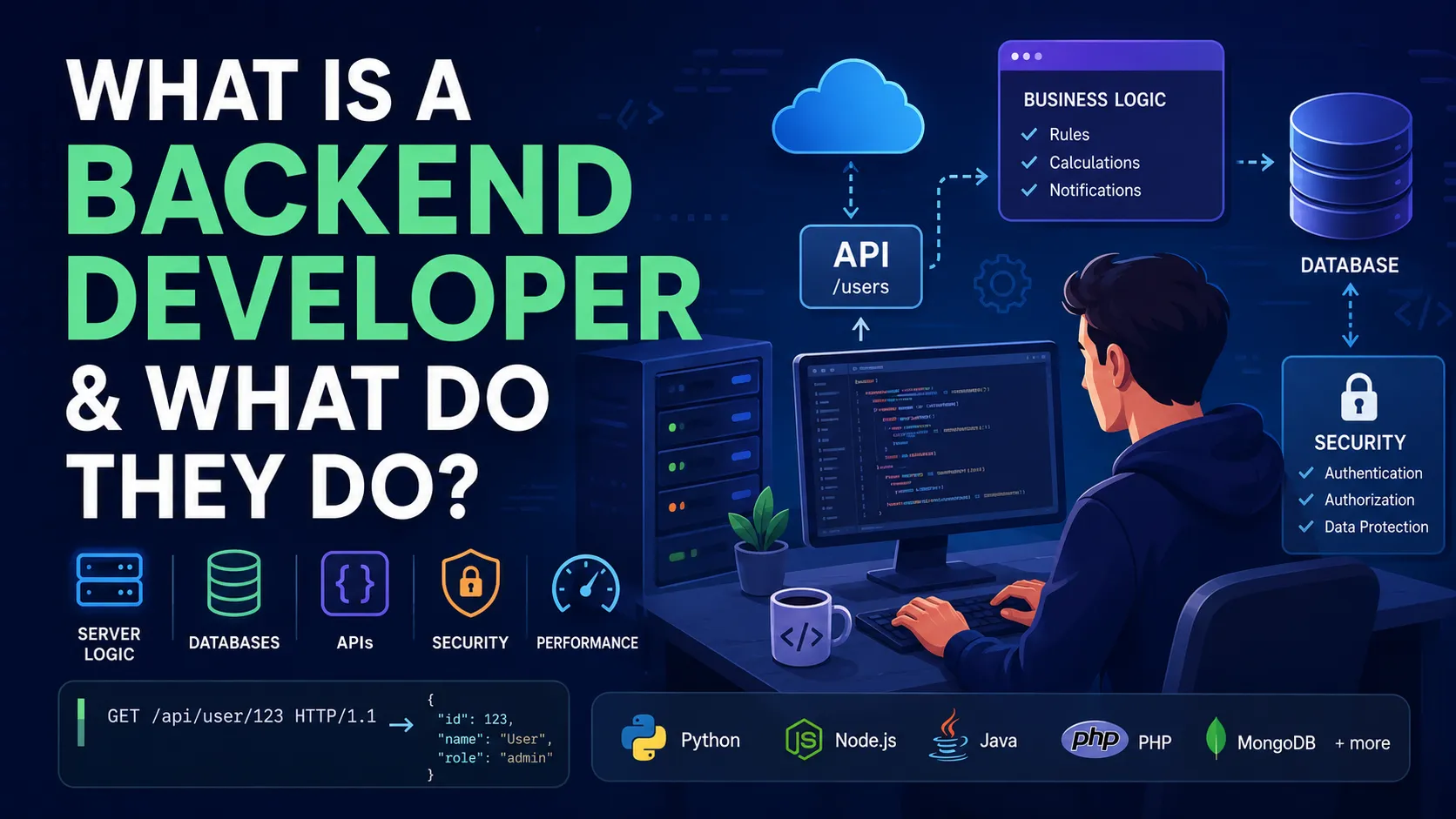
- Backend writes queries to a DBMS every day.
- QA checks that data is stored and changed correctly.
- Analysts build reports straight from
SELECTqueries.
So understanding databases is not a "narrow specialty" but a shared foundation for the whole team.
How to Start Learning Databases
- Understand the model: tables, rows, columns, and relationships between tables.
- Learn basic
SQL— start withSELECT, then filters, sorting, andJOIN. - Install
SQLiteorPostgreSQLand practise on a small database of your own. - Add database work to a side project — that is where the knowledge sticks best.
FAQ
How does a database differ from a DBMS? A database is the data and its structure; a DBMS is the program that manages it. In short: the database is "what you store," the DBMS is "what you store and manage it with."
Which should I learn first: SQL or NoSQL? Start with SQL and relational databases. They are more common, have clearer logic, and give you a foundation that transfers easily to NoSQL later.
Can a project do without a database? For a learning example, yes — you can keep data in a file. But as soon as you have users, relationships, and search, a database becomes practically unavoidable.
Ready to act?
- Project technologies: https://searchtalent.dev/en/projects/tag
- Skill and technology directory: https://searchtalent.dev/en/talents/skill
- Browse projects: https://searchtalent.dev/en/projects
- Create your own portfolio: https://searchtalent.dev/en/projects/new